

Blog

How Do
Businesses Handle Customer Feedback And Complaints On Instagram
Introduction: The Evolution of Instagram into a Primary Customer
Service Channel Contents hide 1 Introduction: The Evolution
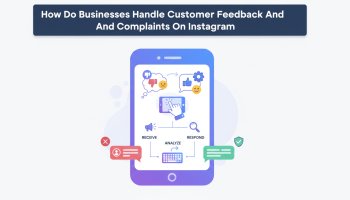
Introduction: The Evolution of Instagram into a Primary Customer Service Channel
In the contemporary digital ecosystem, Instagram has transcended its origins as a mere photo-sharing application to become a robust interface for brand-consumer interaction. For modern enterprises, understanding how do businesses handle customer feedback and complaints on Instagram is no longer optional; it is a critical component of Brand Reputation Management and Customer Experience (CX) optimization. As consumers increasingly prefer social media over traditional telephony or email for immediate dispute resolution, the architectural approach to handling these interactions dictates the semantic authority and trustworthiness of a business.
Effective management of customer feedback involves a multi-layered strategy encompassing real-time monitoring, sentiment analysis, and the deployment of algorithmic response protocols. Businesses must navigate the delicate balance between public transparency and private resolution, ensuring that negative sentiment is neutralized while positive engagement is amplified to signal social proof. This guide deconstructs the operational frameworks, technological integrations, and psychological tactics required to master Instagram customer care.
The Strategic Architecture of Social Customer Care
Social Customer Care is the practice of providing support through social media channels. On Instagram, this manifests through distinct touchpoints: Direct Messages (DMs), post comments, Story replies, and public mentions. Each touchpoint requires a specific protocol to ensure information density and resolution efficiency.
The Shift from Passive Monitoring to Active Resolution
Historically, businesses used social media for broadcasting. Today, the paradigm has shifted to active conversational commerce. When a customer logs a complaint on Instagram, they expect near-instantaneous acknowledgement. The semantic distance between a user’s problem and the brand’s solution must be minimized. This immediacy is often achieved by integrating comprehensive digital marketing strategies that align customer support teams with social media managers, ensuring a unified brand voice across all channels.
Mechanisms for Capturing and Categorizing Feedback
Before a complaint can be resolved, it must be accurately captured and categorized based on urgency, sentiment, and complexity. This process, known as Triage, is essential for high-volume accounts.
1. Direct Messages (DMs): The Private Resolution Channel
DMs are the preferred channel for sensitive issues involving order numbers, personal data, or complex grievances. Businesses often use the “link in bio” or “Message” buttons to funnel public complaints into this private sphere. However, managing a flood of DMs requires sophisticated infrastructure.
Advanced organizations utilize Conversational AI to handle this influx. By deploying an AI chatbot for Instagram, businesses can automate initial responses, collect ticket information, and resolve Tier-1 queries without human intervention. This automation ensures that the customer feels heard immediately, preventing the escalation of frustration associated with long wait times.
2. Public Comments and Sentiment Management
Comments on posts are public records of a brand’s service quality. A negative comment left unaddressed acts as “negative social proof,” potentially deterring future customers. The protocol here is Public Acknowledgment, Private Resolution. A business should reply publicly to show responsiveness—e.g., “We are sorry to hear this, please check your DMs so we can fix it”—and then move the conversation to a private channel.
3. Story Mentions and Tags
When a customer tags a business in a Story, the feedback is ephemeral but highly visible to that user’s network. This is a form of User-Generated Content (UGC). Positive mentions should be reposted to build community, while negative tags require immediate DM outreach to mitigate reputation damage.
Operational Frameworks for Complaint Resolution
To establish topical authority in customer service, businesses must adhere to a rigorous operational framework. This involves defined Service Level Agreements (SLAs) regarding response times and resolution rates.
The HEARD Method in Digital Context
Adapted for digital platforms, the HEARD method (Hear, Empathize, Apologize, Resolve, Diagnose) remains relevant:
- Hear: Use social listening tools to detect mentions even when the brand isn’t tagged.
- Empathize: validatethe customer’s frustration without being defensive.
- Apologize: Offer a sincere apology for the inconvenience, regardless of fault.
- Resolve: Provide a concrete solution or refund.
- Diagnose: Analyze the root cause to prevent recurrence.
Escalation Matrices and Human Handoff
Not all complaints can be solved by scripts or bots. An escalation matrix dictates when a query must be transferred from an automated system to a human agent. Developing automated customer support systems that seamlessly transition to human agents is crucial. If a bot loops a frustrated customer, sentiment plummets. Therefore, the “human handoff” must be frictionless, retaining the context of the conversation so the customer does not have to repeat themselves.
Leveraging AI and Automation for Scale
For enterprise-level entities, manual handling of every Instagram interaction is operationally unfeasible. This is where Artificial Intelligence and Natural Language Processing (NLP) become pivotal.
Implementing Intelligent Chatbots
Custom AI chatbot development allows businesses to parse natural language, detect sarcasm or anger, and prioritize tickets accordingly. Unlike simple rule-based bots, AI agents can learn from past interactions to provide more accurate responses over time.
However, the tonality of the bot is paramount. It must not sound robotic or dismissive. Businesses must focus on human-like conversational agents that utilize empathy markers and natural phrasing to de-escalate tension effectively.
Automated Sentiment Analysis
Tools integrated with Instagram’s API can analyze the aggregate sentiment of comments on a product launch post. If the sentiment skews negative, the marketing team receives an alert, allowing for real-time crisis management. This proactive approach separates reactive support from strategic reputation defense.
Crisis Management: Handling Viral Negativity
Occasionally, a complaint goes viral, creating a PR crisis. In these scenarios, the standard playbook changes. The response must be swift, unified, and often public.
1. Pause Scheduled Content: automated posts can seem tone-deaf during a crisis.
2. Issue a Statement: Use Instagram Stories or a static text post to acknowledge the issue broadly.
3. Centralize Communication: Direct all traffic to a single point of contact or a dedicated support page to control the narrative.
Effective crisis handling is a core component of online presence and reputation management. How a business recovers from a stumble often defines its long-term brand equity more than the mistake itself.
Turning Feedback into Strategic Assets
Customer complaints are semantically rich data points. They highlight friction points in the user journey, product defects, or logistical failures. Businesses with high topical authority in their niche use this data to inform product development.
Closing the Feedback Loop
When a systemic issue identified via Instagram feedback is fixed, the brand should communicate this back to the community. “You asked, we listened” posts generate high engagement and restore trust. This transforms negative feedback into a narrative of continuous improvement.
Conclusion
Mastering how businesses handle customer feedback and complaints on Instagram requires a synthesis of human empathy and technological sophistication. It is not merely about deleting spam or replying to DMs; it is about constructing a responsive ecosystem where every interaction strengthens the brand-consumer relationship. By leveraging AI automation, adhering to strict triage protocols, and maintaining a unified digital marketing strategy, businesses can turn their Instagram presence from a liability into their most powerful customer loyalty engine.
Frequently Asked Questions
1. Should businesses delete negative comments on Instagram?
Generally, no. Deleting genuine complaints can trigger a “Streisand Effect,” causing the user to post more aggressively or take the issue to other platforms. It is better to address the comment publicly and resolve it privately. However, hate speech, spam, or abusive language should be deleted immediately in accordance with community guidelines.
2. How fast should a business respond to a complaint on Instagram?
Customer expectations on social media are high. A response time of under 60 minutes during business hours is the industry standard for best-in-class service. Utilizing chatbots can reduce the initial acknowledgement time to mere seconds.
3. Can AI chatbots handle complex customer complaints?
AI chatbots are excellent for Tier-1 support (FAQs, order status, policy questions) and data collection. However, for complex emotional issues or unique grievances, the AI should be programmed to recognize its limitations and seamlessly hand off the conversation to a human agent.
4. How do I move a public complaint to Direct Messages?
Reply to the public comment with empathy and a clear call to action (CTA). For example: “We’re so sorry to hear about this experience. We want to make it right immediately. Please send us a DM with your order number so our support team can assist you right away.” This acknowledges the issue publicly while protecting customer privacy.
5. What tools can help monitor Instagram feedback?
Enterprise social listening tools like Sprout Social, Hootsuite, or custom API integrations allow businesses to track brand mentions, comments, and specific keywords across the platform in real-time, ensuring no feedback slips through the cracks.

Editor at XS One Consultants, sharing insights and strategies to help businesses grow and succeed.