

Blog

How To
Get More B2b Leads
Introduction: Mastering the Art of B2B Lead Generation in
a Digital-First Economy Contents hide 1 Introduction: Mastering
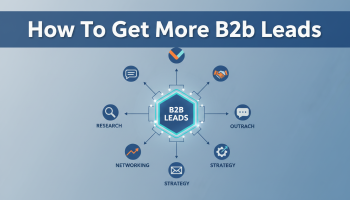
Introduction: Mastering the Art of B2B Lead Generation in a Digital-First Economy
In the complex ecosystem of Business-to-Business (B2B) commerce, the ability to consistently generate high-quality leads is the single most critical determinant of sustainable growth. Unlike B2C markets, where emotional triggers and impulse buys often drive revenue, the B2B landscape is defined by long sales cycles, multiple decision-makers, and a rigorous demand for authority and trust. Learning how to get more B2B leads is not merely about increasing traffic; it is about engineering a semantic environment where your brand is perceived as the absolute solution provider for specific industry pain points.
Modern lead generation has evolved beyond cold calling and generic email blasts. It now requires a sophisticated blend of Semantic SEO, topical authority architecture, and omnichannel digital presence. To dominate your niche, you must transition from being a vendor to being a thought leader. Companies that succeed in this arena understand that every piece of content, every digital touchpoint, and every interaction must build a cohesive narrative of expertise.
As a leader in digital transformation, XSOne Consultants stands at the forefront of this evolution. We empower businesses to navigate this complexity by leveraging advanced digital frameworks—from custom software development to high-level SEO strategies—ensuring that your pipeline is not just full, but filled with qualified prospects ready to convert. This comprehensive guide will dissect the methodologies required to establish topical authority and secure a steady stream of valuable B2B leads.
The Anatomy of the Modern B2B Buyer’s Journey
To effectively capture B2B leads, one must first understand the psychographics and behavioral patterns of the modern decision-maker. The linear funnel is obsolete. Today’s B2B buyer engages in a non-linear loop of exploration, evaluation, and validation. They consume an average of ten pieces of content before ever speaking to a sales representative.
1. The Awareness Phase: Establishing Semantic Relevance
At the top of the funnel, potential clients are identifying their problems. They are searching for answers, not products. Here, your goal is to achieve Information Overlap—ensuring your brand covers every possible query related to the problem entity. If a prospect is researching “enterprise efficiency bottlenecks,” your content must appear with authoritative answers.
2. The Consideration Phase: Demonstrating Technical Competence
Once a problem is defined, the buyer seeks solutions. This is where technical whitepapers, case studies, and detailed service pages play a pivotal role. For instance, a SaaS company looking for growth must see that you understand the nuances of their sector. This is why tailoring strategies, such as SEO services for software SaaS companies, is crucial for signaling specific competence rather than generalist ambiguity.
3. The Decision Phase: Trust and Validation
In the final stages, trust signals—reviews, portfolios, and direct consultations—are paramount. The semantic distance between the user’s intent to buy and your conversion mechanism must be zero. A frictionless transition from reader to lead is essential.
Strategy 1: Leveraging Semantic SEO and Topical Authority
The foundation of sustained B2B lead generation is organic visibility. However, standard keyword targeting is insufficient. You must build Topical Authority. This involves creating a dense network of interlinked content that covers a central topic from every conceivable angle.
Building a Topical Map
A topical map organizes your content hierarchically. If your core entity is “B2B Marketing,” your sub-topics should range from “Lead Scoring Models” to “CRM Integrations.” Google’s algorithms reward sites that demonstrate depth. By exhaustively covering a topic, you signal to search engines that you are a subject matter expert (SME).
Entity Density and Optimization
Search engines now read content like humans do—looking for related concepts (entities) rather than just keywords. To rank for competitive B2B terms, your content must include semantically related entities. For example, an article about “Lead Generation” should naturally discuss “Conversion Rate Optimization (CRO),” “Marketing Qualified Leads (MQLs),” and “Sales Qualified Leads (SQLs).”
For businesses struggling to adapt to these algorithmic shifts, understanding how to optimize your website and content to rank in AI search results is no longer optional—it is a survival requirement.
Strategy 2: High-Value Content Marketing
B2B buyers are risk-averse. They need proof that your solution works. Content marketing serves as a risk mitigation tool by educating the prospect.
Creating “Cornerstone” Assets
Cornerstone content includes comprehensive guides, original research reports, and technical whitepapers. These assets attract backlinks and high-intent traffic. When you offer immense value upfront without a gatekeeper, you build the reciprocity bias—prospects feel compelled to engage with you because you have already helped them.
Industry-Specific Vertical Content
Generic content gets generic results. High-converting B2B strategies often involve narrowing down to specific verticals. A general article on “Getting Leads” is less effective than a targeted guide like how to get more leads for my business, which allows for segmentation. Similarly, addressing the unique challenges of new ventures through resources on how to get more leads for my startup business can attract high-growth potential clients early in their lifecycle.
Strategy 3: Digital Infrastructure as a Lead Magnet
In the B2B space, your digital infrastructure—your website and applications—is often the first handshake. A slow, poorly designed, or confusing platform will kill lead generation instantly.
Custom Applications and Tools
Developing free tools (calculators, auditors, estimators) is a powerful way to capture leads. By offering a utility that solves a micro-problem, you earn the right to ask for contact information. Furthermore, ensuring your main platform is built on robust technology is critical. This connects directly to broader digital marketing efforts, where the destination (your site) must be as optimized as the traffic source.
Strategy 4: Strategic Outbound and Social Selling
While inbound brings leads to you, outbound allows you to select your dream clients. In B2B, LinkedIn is the premier channel for this.
Social Selling on LinkedIn
Social selling is not about spamming inboxes; it is about engaging in conversations. It involves optimizing your personal and company profiles to act as landing pages. Share insights, comment on prospect posts, and add value before pitching. This builds “relational equity” before a transaction is ever discussed.
Precision Cold Outreach
Cold email is dead only if it is generic. Personalized, researched outreach that speaks directly to a prospect’s recent company news or pain points still yields high conversion rates. The key is relevance and timing.
Strategy 5: Optimizing for Conversion
Getting traffic is vanity; getting leads is sanity. You must optimize your conversion rate (CRO).
Clear Calls to Action (CTAs)
Every piece of content must have a logical next step. For an informational post, the CTA might be to download a guide. For a service page, it should be to book a consultation. Avoid ambiguity.
Speed to Lead
When a B2B lead submits a form, the clock starts ticking. The likelihood of qualification drops dramatically after the first hour. Implementing automated follow-up sequences or chatbots can bridge the gap between submission and human contact.
Strategy 6: Analytics and Continuous Improvement
You cannot improve what you do not measure. B2B lead generation requires rigorous tracking of KPIs such as Cost Per Lead (CPL), Customer Acquisition Cost (CAC), and Lead-to-Close rate.
Utilize tools like Google Analytics 4 and CRM dashboards to visualize the funnel. Identify where drop-offs occur. Is it at the landing page? Is it during the demo booking? Continuous A/B testing of headlines, form fields, and value propositions is necessary to refine the engine.
For companies needing expert guidance in auditing and refining these channels, professional SEO services can provide the analytical deep dive required to uncover hidden opportunities and technical roadblocks preventing conversion.
Conclusion: Building a Lead Generation Ecosystem
Generating more B2B leads is not the result of a single hack or tool; it is the outcome of a well-architected ecosystem. It requires the integration of authoritative content, semantic SEO, technical excellence, and strategic outreach. By positioning your brand as a topical authority and solving real problems for your prospects before they even sign a contract, you build a pipeline that is resilient and scalable.
At XSOne Consultants, we specialize in building these digital ecosystems. Whether through custom development, strategic SEO, or comprehensive digital consultancy, we help B2B organizations transcend noise and achieve market dominance.
Frequently Asked Questions (FAQs)
1. What is the most effective channel for B2B lead generation?
There is no single “best” channel, but organic search (SEO) and LinkedIn generally offer the highest ROI for B2B. SEO provides long-term, compounding traffic, while LinkedIn offers precise targeting of decision-makers. A hybrid approach yields the best results.
2. How long does it take to see results from B2B SEO?
SEO is a long-term strategy. Typically, it takes 6 to 12 months to build significant topical authority and rank for competitive keywords. However, the leads generated via SEO often have higher intent and close rates compared to paid channels.
3. What is the difference between an MQL and an SQL?
An MQL (Marketing Qualified Lead) is a prospect who has engaged with your marketing efforts (e.g., downloaded a whitepaper) but isn’t ready to buy. An SQL (Sales Qualified Lead) has been vetted and indicates a direct interest in purchasing, ready for a sales conversation.
4. How can I get B2B leads without a large budget?
Focus on high-quality content creation and organic social selling. Writing authoritative articles, engaging in LinkedIn communities, and leveraging cold email outreach are low-cost strategies that rely on time and expertise rather than ad spend.
5. Why is my website traffic not converting into leads?
Low conversion usually stems from three issues: poor user experience (UX), lack of clear Call-to-Actions (CTAs), or a mismatch between search intent and content. Ensure your landing pages address the specific pain points of the visitor and offer a clear value exchange.
6. How does XSOne Consultants help with lead generation?
We provide end-to-end digital solutions, from building high-performance websites and apps that convert, to executing sophisticated SEO and digital marketing campaigns that drive qualified traffic. Our approach ensures your technical infrastructure supports your growth goals.

Editor at XS One Consultants, sharing insights and strategies to help businesses grow and succeed.