

Blog

Kubernetes 1.35:
In-Place Pod Resizing and AI Workload Optimization
Introduction Contents hide 1 Introduction 2 The Evolution of
Resource Management: From Static to Dynamic 3 Deep
Introduction
As organizations increasingly shift towards cloud-native architectures, the orchestration of containerized applications has become the backbone of modern digital infrastructure. With the release of Kubernetes 1.35, the platform has taken a monumental leap forward, particularly addressing two of the most critical pain points in DevOps and Machine Learning Operations (MLOps): the disruption caused by resource scaling and the efficient management of high-performance hardware for Artificial Intelligence.
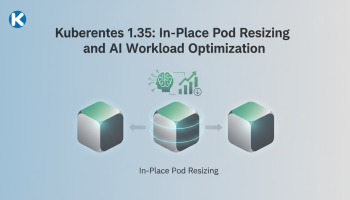
For years, platform engineers have struggled with the trade-off between resource optimization and service availability. Traditionally, changing the resource limits of a running Pod required a restart, leading to potential downtime, cold caches, and latency spikes. Kubernetes 1.35 solidifies the maturity of In-Place Pod Resizing, a feature that promises to redefine how we handle stateful applications and volatile workloads.
Furthermore, as the demand for Generative AI and Large Language Models (LLMs) skyrockets, Kubernetes 1.35 introduces enhanced scheduling capabilities specifically designed for AI Workload Optimization. These updates ensure that expensive GPU resources are utilized with maximum efficiency, reducing the astronomical costs associated with AI training and inference.
In this cornerstone guide, we will dissect the technical architecture of these new features, explore their impact on enterprise software, and demonstrate how leveraging expert technology consultancy can help your organization adopt these bleeding-edge capabilities.
The Evolution of Resource Management: From Static to Dynamic
To appreciate the significance of Kubernetes 1.35, we must understand the limitations of previous versions. Historically, the resources field in a Pod specification was immutable. If a Java application unexpectedly required more memory to handle a surge in traffic, the Vertical Pod Autoscaler (VPA) would detect the need, evict the Pod, and schedule a new one with higher limits.
This “destroy and recreate” approach presents severe challenges:
- Service Interruption: Even with Pod Disruption Budgets, restarts introduce risks.
- Cold Starts: Applications like JVM-based services or databases with large buffer pools require significant time to “warm up” after a restart, leading to degraded performance.
- Operational Complexity: Managing stateful sets (like PostgreSQL or Kafka) becomes precarious when Pods are constantly recycled.
Kubernetes 1.35 addresses this by making the resources.requests and resources.limits fields mutable for running Pods. This allows the Kubelet to adjust the cgroup parameters on the underlying node without killing the container process.
Deep Dive: In-Place Pod Resizing Architecture
The mechanism behind In-Place Pod Resizing in Kubernetes 1.35 is sophisticated. It involves a coordinated handshake between the API Server, the Scheduler, and the Kubelet residing on the node.
The Resize Workflow
- User Initiation: A user or an autoscaler patches the Pod spec with new resource values.
- Admission Control: The API server validates the request. If the
ResizePolicyallows it, the change is accepted. - Scheduler Evaluation: The scheduler determines if the node currently hosting the Pod has enough unallocated capacity to accommodate the increase.
- Node-Level Actuation: The Kubelet receives the update and interacts with the Container Runtime Interface (CRI) to adjust the cgroups (CPU shares, memory limits) dynamically.
Handling Resize Policies
One of the most powerful aspects of this feature in Kubernetes 1.35 is granular control via resizePolicy. This allows developers to define how specific containers react to resource changes. For experienced teams delivering custom software development, this granular control is vital for high-availability SLAs.
resources:
  limits:
    cpu: "2"
    memory: "4Gi"
resizePolicy:
  - resourceName: cpu
    restartPolicy: NotRequired
  - resourceName: memory
    restartPolicy: RestartNotRequired
This configuration ensures that if CPU or memory requirements change, the application simply receives more resources seamlessly, maintaining uptime and preserving the application state.
AI Workload Optimization in Kubernetes 1.35
While In-Place Resizing benefits general microservices, the driving force behind many Kubernetes 1.35 adoptions is Artificial Intelligence. Training AI models and running inference at scale requires massive computational power, typically provided by GPUs (NVIDIA, AMD) and TPUs.
Dynamic Resource Allocation (DRA) for AI
Prior to Dynamic Resource Allocation, claiming hardware accelerators was a static, all-or-nothing affair. Kubernetes 1.35 enhances DRA, enabling more flexible sharing and slicing of GPU resources. This is critical for businesses building AI-powered applications where maximizing GPU utilization directly correlates to profitability.
With the new scheduling semantics, a cluster can dynamically assign a fraction of a GPU to a lightweight inference bot while reserving full GPUs for heavy training jobs, all within the same namespace.
Optimizing Training Pipelines
Long-running training jobs often suffer from fluctuating resource needs. In the initial phases of data loading, CPU and I/O are the bottlenecks. During backpropagation, the GPU is pegged at 100%. Kubernetes 1.35 allows training operators to resize the sidecar containers (handling data ingestion) without restarting the main training container.
This capability is particularly beneficial when implementing AI chatbot integration strategies, where the backend inference services scale up and down rapidly based on user interaction volume, necessitating fluid resource management rather than static allocation.
Strategic Implications for DevOps and Business Leaders
Adopting Kubernetes 1.35 is not just a technical upgrade; it is a strategic business decision. The efficiency gains translate directly to the bottom line.
1. Cost Reduction in Cloud Spend
By eliminating the need to over-provision resources “just in case,” and by allowing Pods to resize down during quiet periods without the penalty of restarts, organizations can run their clusters at much higher utilization rates. This reduces the number of worker nodes required, significantly lowering AWS, Azure, or Google Cloud bills.
2. Improved Reliability for Mobile Backends
For companies specializing in mobile app development, backend reliability is non-negotiable. Mobile users are fickle; latency or downtime results in uninstalls. In-Place Resizing ensures that when a mobile app goes viral and backend traffic spikes, the supporting pods grow instantly to meet demand without the connection drops associated with pod rotation.
3. Enhanced Developer Velocity
Developers spend less time tuning resource requests and limits manually. With automated vertical scaling that doesn’t disrupt workflows, engineering teams can focus on feature development rather than infrastructure plumbing. This agility is a core component of the philosophy at XSOne Consultants, where enabling client velocity is paramount.
Implementing In-Place Resizing: Best Practices
To leverage these features effectively, organizations must update their operational playbooks. Here are the recommended steps for rolling out Kubernetes 1.35 features.
Audit Your Container Runtimes
Not all container runtimes support In-Place Resizing immediately. Ensure that your underlying Container Runtime Interface (CRI), such as containerd or CRI-O, is updated to a version compatible with Kubernetes 1.35 protocols.
Update QoS Classes
Review your Quality of Service (QoS) classes. In-Place Resizing works best with the Burstable QoS class, where requests and limits differ. For Guaranteed pods (where requests equal limits), resizing is possible but requires careful node capacity planning.
Monitoring and Observability
Traditional monitoring tools might interpret a resource spike as an anomaly. Update your Prometheus alerts and Grafana dashboards to visualize container_cpu_usage_seconds_total against the dynamic limit, rather than a static line.
Frequently Asked Questions
What is the primary benefit of In-Place Pod Resizing in Kubernetes 1.35?
The primary benefit is the ability to change the CPU and memory resources allocated to a Pod without restarting the container. This eliminates downtime, preserves the cache state, and ensures continuous service availability during scaling events.
Does In-Place Resizing work with all types of applications?
It works with most applications, but it is most beneficial for stateful applications (like databases) and JVM-based applications that have high startup costs. It requires the underlying container runtime (CRI) to support the update mechanism.
How does Kubernetes 1.35 help with AI costs?
Kubernetes 1.35 improves AI cost efficiency through better Dynamic Resource Allocation (DRA). It allows for more granular scheduling of GPUs and enables the resizing of support containers in ML pipelines, ensuring expensive hardware is not idle or blocked by minor processes.
Can I use Vertical Pod Autoscaler (VPA) with In-Place Resizing?
Yes. In fact, the VPA is the primary driver for this feature. In Kubernetes 1.35, the VPA can be configured to actuate resource changes via the in-place update mechanism rather than the traditional eviction method.
Is a cluster upgrade required to use these features?
Yes, the control plane and the worker nodes (specifically the Kubelet) must be upgraded to version 1.35 (or a version where the feature gate is enabled) to utilize In-Place Pod Resizing and the latest DRA features.
Conclusion
Kubernetes 1.35 represents a pivotal moment in the maturity of container orchestration. By solving the long-standing challenge of disruptive scaling through In-Place Pod Resizing and addressing the modern needs of AI Workload Optimization, it empowers enterprises to build more resilient, efficient, and cost-effective platforms.
However, navigating the complexities of Kubernetes upgrades, CRI configurations, and AI hardware scheduling requires deep expertise. Implementing these changes incorrectly can lead to cluster instability.
Whether you are looking to optimize your existing Kubernetes footprint, deploy large-scale AI models, or modernize your legacy infrastructure, expert guidance is essential. We invite you to contact XSOne Consultants today. Our team of elite engineers is ready to help you unlock the full potential of Kubernetes 1.35 and drive your digital transformation forward.

Editor at XS One Consultants, sharing insights and strategies to help businesses grow and succeed.