

Blog

DeepSeek-V2 vs
Claude 3.5 Sonnet: Coding Performance and Cost Efficiency Benchmark
Introduction: The New Heavyweights in AI Code Generation Contents
hide 1 Introduction: The New Heavyweights in AI
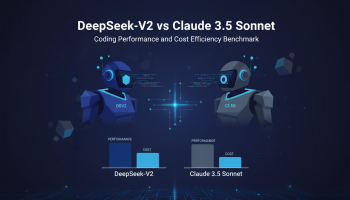
Introduction: The New Heavyweights in AI Code Generation
The landscape of Large Language Models (LLMs) for software development has shifted dramatically. While the industry previously fixated on the GPT-4 supremacy, a new generation of efficient, high-performance models has emerged. Two names, in particular, are dominating the conversation for developers and technical CTOs: DeepSeek-V2 and Claude 3.5 Sonnet.
Choosing the right AI infrastructure is no longer just about picking the model with the highest theoretical IQ. It is a balancing act between coding performance, API latency, context window management, and cost efficiency. For enterprises and independent developers alike, the primary keyword driving this decision is DeepSeek vs Claude 3.5 Sonnet coding performance. Can the open-weights innovator from DeepSeek AI truly compete with Anthropic's refined, safety-aligned powerhouse?
In this cornerstone analysis, we dismantle the marketing hype. We provide a granular benchmark comparison covering architecture, synthetic benchmarks (HumanEval, MBPP), real-world debugging capabilities, and the all-important cost-per-token economics. By the end of this guide, you will know exactly which model fits your technical stack.
The Contenders: DeepSeek-V2 vs. Claude 3.5 Sonnet
Before diving into the code, it is essential to understand the architectural philosophies separating these two giants.
DeepSeek-V2: The Mixture-of-Experts (MoE) Disruptor
DeepSeek-V2 (and its specialized variant, DeepSeek Coder V2) represents a paradigm shift in open-science AI. Built on a massive Mixture-of-Experts (MoE) architecture, it boasts a total parameter count of 236B but activates only 21B parameters per token. This architectural decision allows it to punch significantly above its weight class regarding inference speed and training efficiency while maintaining a massive 128k context window.
- Key Strength: Unrivaled cost-efficiency and strong reasoning capabilities in code generation.
- Architecture: MLA (Multi-head Latent Attention) and DeepSeekMoE.
Claude 3.5 Sonnet: The Mid-Size Masterpiece
Anthropic’s Claude 3.5 Sonnet was released to immediate acclaim, rapidly displacing GPT-4o on leaderboards like LMSYS Chatbot Arena. While Anthropic does not disclose exact parameter counts, Sonnet is positioned as the "middle" model—faster and cheaper than Opus, but smarter than Haiku. In coding tasks, however, it has demonstrated a near-perfect ability to follow complex, multi-step instructions and maintain coherence over long context windows (200k).
- Key Strength: Superior nuance, instruction following, and "Artifacts" UI integration (in the web interface).
- Architecture: Proprietary Anthropic architecture optimized for reasoning and safety.
Coding Performance Benchmark: HumanEval, MBPP, and LiveCodeBench
When analyzing DeepSeek vs Claude 3.5 Sonnet coding performance, synthetic benchmarks provide a baseline, though they tell only half the story.
1. HumanEval & MBPP Scores
Historically, the HumanEval benchmark (Python coding problems) has been the standard. Both models score exceptionally high here, effectively saturating the benchmark.
- DeepSeek Coder V2: Has reported scores surpassing 90% on HumanEval, positioning itself as the premier open-weights coding model. Its training on trillions of code tokens allows it to generalize across lesser-known languages.
- Claude 3.5 Sonnet: Anthropic reports scores of 92.0% on HumanEval (0-shot). Where Sonnet shines is in LiveCodeBench, a benchmark designed to prevent data contamination by using problems published after the model’s training cutoff.
Insight: In raw function generation for Python, both are effectively equal. The difference appears in edge cases and polyglot programming.
2. Multi-Language Proficiency
DeepSeek-V2 explicitly supports hundreds of programming languages. Its expansive training data includes vast repositories of older or niche languages (like Rust, Go, or even Cobol). Claude 3.5 Sonnet is incredibly proficient in modern stacks (TypeScript, Python, Rust) but occasionally hallucinates syntax in very obscure languages compared to the breadth of DeepSeek.
3. Debugging and Code Refactoring
Coding is 20% writing and 80% reading/fixing.
- Claude 3.5 Sonnet excels at architectural reasoning. If you paste a 2,000-line React component and ask for a refactor to improve rendering performance, Sonnet tends to provide a safer, more logically structured explanation alongside the code.
- DeepSeek-V2 is a powerhouse for syntax correction and translation. It is aggressive in generating code fixes but may sometimes lack the verbose explanatory layer that Claude provides, which can be a pro or a con depending on whether you want a lecture or a fix.
Cost Efficiency Analysis: The MoE Advantage
This is where the battle lines are drawn for CTOs. The DeepSeek vs Claude 3.5 Sonnet coding performance debate cannot exist without discussing the bill.
DeepSeek-V2 Pricing Structure
DeepSeek acts as a price-anchor for the industry. Because of its active parameter efficiency (only activating ~21B parameters), inference is cheap.
- Input Cost: ~$0.14 / 1M tokens
- Output Cost: ~$0.28 / 1M tokens
- Context Caching: significantly reduces costs for repetitive prompts (like large codebases).
Note: Prices fluctuate based on API providers, but DeepSeek is consistently one of the cheapest high-IQ models available.
Claude 3.5 Sonnet Pricing Structure
Anthropic markets Sonnet as a mid-tier model, but it is priced higher than DeepSeek.
- Input Cost: ~$3.00 / 1M tokens
- Output Cost: ~$15.00 / 1M tokens
The Math: DeepSeek-V2 is roughly 20x to 50x cheaper than Claude 3.5 Sonnet depending on the input/output ratio. For high-volume tasks—such as automated unit test generation, large-scale code migration, or retrieval-augmented generation (RAG) over documentation—DeepSeek offers an undeniable ROI.
Architecture and Latency: Speed vs. Smarts
Latency matters when you are building autocomplete tools or real-time agents.
DeepSeek’s Latency Advantage
Thanks to the Mixture-of-Experts (MoE) architecture, DeepSeek-V2 achieves lower Time-To-First-Token (TTFT) in many hosted environments. Since the model only engages a fraction of its neural network for any given prompt, it computes faster than dense models of similar total size.
Claude’s Context Window Handling
Claude 3.5 Sonnet features a 200k token context window and is famous for its "needle in a haystack" retrieval accuracy. In coding, this means you can dump an entire library’s documentation into the prompt, and Claude will adhere to it strictly. While DeepSeek supports 128k, reports suggest Claude maintains coherence slightly better at the extreme ends of the context window.
Use Case Scenarios: When to Choose Which?
To help you decide, we have categorized common development tasks.
Choose DeepSeek-V2 When:
- Budget is the constraint: You are a startup or individual developer running millions of tokens.
- Local/Private Hosting is required: As an open-weights model, DeepSeek (Coder V2) can be distilled and hosted on private infrastructure for data privacy.
- High-Volume Generation: You are building an agent that writes thousands of unit tests per hour.
- Polyglot Tasks: You need support for a massive variety of programming languages.
Choose Claude 3.5 Sonnet When:
- Reasoning is paramount: You need architectural advice, system design, or complex refactoring strategies where logic errors are costly.
- Instruction Following: The prompt involves complex, multi-step constraints (e.g., "Write this in Python, adhere to PEP8, use Type hinting, and ensure it is compatible with pandas 1.4").
- Frontend Development: Claude’s ability to visualize code (via Artifacts) and its training on modern web frameworks makes it superior for React/Vue/Tailwind generation.
- Zero-Shot Accuracy: You need the code to run perfectly on the first try without iteration.
Frequently Asked Questions (FAQ)
1. Is DeepSeek-V2 better than Claude 3.5 Sonnet for coding?
In terms of pure price-to-performance, DeepSeek-V2 is better. However, for raw reasoning capability and complex instruction following, Claude 3.5 Sonnet holds a slight edge in accuracy, albeit at a significantly higher cost.
2. Can I run DeepSeek-V2 locally for coding?
Yes, because DeepSeek releases open weights, quantized versions of DeepSeek Coder V2 can be run locally using tools like Ollama or vLLM, provided you have sufficient VRAM (usually requiring dual 3090s or enterprise GPUs for the larger parameter versions).
3. What is the context window size for DeepSeek vs Claude?
Claude 3.5 Sonnet offers a 200k token context window. DeepSeek-V2 offers a 128k token context window. Both are sufficient for most repository-level coding tasks.
4. Does DeepSeek support Python and Javascript?
Absolutely. DeepSeek Coder V2 is trained on a massive dataset of code covering 338 programming languages, with exceptional performance in Python, JavaScript, Java, C++, and Go.
5. Why is DeepSeek so much cheaper than Anthropic’s Claude?
DeepSeek utilizes a Mixture-of-Experts (MoE) architecture. This means for every token generated, only a small subset of the model’s parameters are active (roughly 21B out of 236B), drastically reducing the computational power (and electricity) required for inference.
6. Which model is better for code completion extensions?
DeepSeek-V2 (specifically the smaller Lite versions) is often preferred for code completion extensions (like VS Code plugins) due to its low latency and low cost, whereas Claude is better suited for chat-based coding assistants.
Conclusion: The Strategic Verdict
The comparison of DeepSeek vs Claude 3.5 Sonnet coding performance reveals two distinct winners depending on the arena.
DeepSeek-V2 is the undisputed champion of efficiency. It democratizes high-level AI coding, making it possible to integrate GPT-4 level intelligence into high-volume workflows without bankrupting the project. It is the pragmatic choice for systems engineers and budget-conscious developers.
Claude 3.5 Sonnet is the premium engineer’s choice. It acts less like a code generator and more like a Senior Software Architect. If your workflow requires deep understanding, nuance, and reliable handling of massive context, the premium price of Claude is an investment in quality assurance.
For the ultimate coding setup, many advanced teams are now using a hybrid approach: using Claude 3.5 Sonnet for high-level planning and architecture, and handing off the implementation and unit testing to DeepSeek-V2. This leverages the best of both worlds—DeepSeek’s raw horsepower and Claude’s sophisticated reasoning.

Editor at XS One Consultants, sharing insights and strategies to help businesses grow and succeed.