
Blog

Grok API
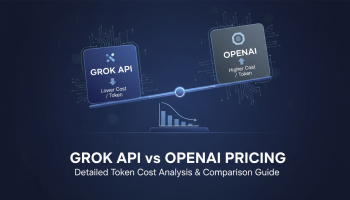
vs OpenAI Pricing: Detailed Token Cost Analysis & Comparison Guide
Introduction: The Battle for API Dominance and Cost Efficiency
Contents hide 1 Introduction: The Battle for API
Introduction: The Battle for API Dominance and Cost Efficiency
The landscape of Artificial Intelligence is no longer just about who has the smartest model; it is rapidly becoming a war of economics. For developers, CTOs, and enterprise decision-makers, the choice between Grok API pricing and OpenAI’s established pricing structure is a critical strategic decision. With the emergence of xAI, Elon Musk’s AI venture, the monopoly on high-performance Large Language Models (LLMs) has been challenged, introducing a new variable into the cost-benefit analysis of building AI-powered applications.
Choosing the right API provider is not merely about finding the lowest cost per million tokens. It requires a nuanced understanding of throughput, context window efficiency, reasoning capabilities per dollar, and the long-term viability of the ecosystem. While OpenAI has set the industry standard with GPT-4o and its predecessors, xAI’s Grok is aggressively positioning itself as a raw, unfiltered, and highly competitive alternative. This guide serves as a definitive cornerstone resource, dissecting the financial and technical implications of integrating the Grok API versus the OpenAI suite.
In this detailed analysis, we will explore the granular token costs, hidden integration expenses, and the performance-to-price ratios that define the current market. Whether you are scaling a customer support chatbot or building complex reasoning agents, understanding these pricing dynamics is essential for maintaining healthy margins. For those tracking the evolution of xAI, you can read more about the latest Grok AI update to understand the technical foundation behind these prices.
The Economics of LLMs: How API Pricing Works
Before diving into the specific numbers for Grok and OpenAI, it is crucial to establish a baseline for how enterprise-grade LLMs are priced. The industry standard has coalesced around a pay-per-token model, distinct from the flat-rate SaaS subscriptions used for consumer front-end tools like ChatGPT Plus.
- Input Tokens: The cost of the data you send to the model (user prompts, system instructions, RAG context).
- Output Tokens: The cost of the data the model generates (answers, code, creative writing).
- Context Window: The maximum amount of information the model can hold in short-term memory, often affecting pricing tiers (e.g., 128k context vs. 32k).
For businesses heavily invested in AI chatbot integration, input costs often outweigh output costs because large volumes of documentation are fed into the prompt to ground the AI’s responses. Conversely, for creative writing or code generation apps, output costs become the primary driver of monthly bills.
Grok API Pricing: Analyzing xAI’s Aggressive Entry
xAI has entered the market with a clear goal: to disrupt the status quo. The Grok API pricing strategy reflects a desire to undercut competitors while offering a model that boasts real-time access to the X (formerly Twitter) platform’s data stream. While prices fluctuate as models move from beta to general availability, xAI generally categorizes its offerings into two main tiers: the flagship model (Grok-2) and the efficiency model (Grok-2 mini).
1. Grok-2 Pricing Structure
Grok-2 targets the high-intelligence bracket, competing directly with GPT-4o and Claude 3.5 Sonnet. Its pricing is designed to be attractive to developers who need reasoning capabilities without the “premium” tax often associated with market leaders.
- Competitive Input Rates: xAI typically prices input tokens slightly below the market leader’s flagship rate to encourage migration.
- Output Token Value: The output cost is generally higher than input, following standard industry logic (generation is computationally more expensive than reading).
2. Grok-2 Mini: The Speed and Cost Champion
For high-volume tasks where latency and cost are more critical than deep philosophical reasoning—such as summarization, simple classification, or conversational flow—Grok-2 mini is the go-to solution.
- Volume Discounts: The pricing disparity between the Mini and the flagship model is significant, often offering 10x to 20x savings.
- Throughput: Ideal for real-time applications where users expect instant responses.
It is important to note that xAI is constantly refining its infrastructure. Just as we have analyzed competitor landscapes in our DeepSeek pricing technical analysis, we observe that challenger brands like xAI often use price as a lever to gain initial market share before stabilizing rates.
OpenAI Pricing Breakdown: The Incumbent Standard
OpenAI remains the benchmark against which all other providers are measured. Their pricing structure is mature, but it can be complex due to the variety of models available. Understanding this is vital for a direct comparison with Grok API pricing.
1. GPT-4o (Omni) Pricing
GPT-4o is OpenAI’s flagship, offering multimodal capabilities (text, audio, image) and faster speeds than the legacy GPT-4 Turbo. Pricing for GPT-4o has been aggressive to maintain dominance.
- Efficiency Gains: GPT-4o is significantly cheaper than the original GPT-4, effectively halving costs for many developers while doubling speed.
- Batch API: OpenAI offers a Batch API that provides a 50% discount for requests that can tolerate a 24-hour turnaround, a feature currently distinct to their ecosystem.
2. GPT-4o Mini
This model effectively replaced GPT-3.5 Turbo, offering superior intelligence at a fraction of the cost. It is the direct competitor to Grok-2 mini.
- Commodity Pricing: At mere cents per million tokens, this tier makes AI viable for low-margin use cases like high-volume email processing or basic data extraction.
For a deeper look at OpenAI’s feature sets relative to their costs, you can review our insights on ChatGPT Atlas and OpenAI features.
Head-to-Head: Grok API vs OpenAI Token Cost Analysis
To provide a clear picture, let’s analyze hypothetical spending scenarios based on standard pricing tiers observed in the current market (Note: specific cent-per-token values change rapidly; always verify official docs). We will assume a standard enterprise workload processing 1 billion tokens per month.
Scenario A: The Customer Support Bot (High Input, Low Output)
In this scenario, the system ingests large knowledge bases (Input) and provides concise answers (Output).
- OpenAI Advantage: If utilizing the GPT-4o mini, the costs are incredibly low. OpenAI’s infrastructure is highly optimized for this, and the caching features (Context Caching) can further reduce input costs by up to 50% for repetitive prompts.
- Grok Opportunity: If the support bot requires real-time knowledge of current events (e.g., a news aggregator or trend analyzer), Grok’s access to the X platform creates value that transcends raw token cost. You are paying for freshness of data, not just token processing.
Scenario B: The Coding Assistant (High Output, High Intelligence)
Coding requires deep reasoning. Comparisons here focus on Grok-2 vs. GPT-4o.
- Cost Per Solution: While OpenAI might charge, for example, $5.00 per million input tokens, and xAI might charge a similar or slightly lower rate, the quality of the code determines the true cost. If Grok-2 requires fewer prompts to get the code right, the effective cost is lower, even if the token price is identical.
- Implementation: For developers building in Apple ecosystems, understanding integration is key. See our guide on how to integrate AI keys in Xcode to see how these APIs function in production environments.
Performance-Per-Dollar: Beyond the Price Tag
A pure price comparison is often misleading in the world of generative AI. “Cheap” tokens are expensive if the model hallucinates or fails to follow instructions, requiring multiple retries.
Reasoning Capabilities
OpenAI currently holds a slight edge in complex, multi-step reasoning tasks (Agentic workflows) due to the maturity of their RLHF (Reinforcement Learning from Human Feedback) pipeline. However, Grok is rapidly closing this gap. For “edgy” or less filtered content generation, Grok offers utility that OpenAI’s strict safety guardrails might block, offering a unique value proposition for specific creative industries.
Context Window Utilization
Both providers offer massive context windows (128k+). However, the recall accuracy at high context varies. Paying for 100k tokens of context is wasted money if the model forgets the instruction at the beginning of the prompt. Early benchmarks suggest competitive performance from Grok, making it a viable alternative for RAG (Retrieval-Augmented Generation) applications.
Migration and Integration Considerations
Switching from OpenAI to Grok (or vice versa) involves more than just changing the base URL in your API call.
- Prompt Engineering Compatibility: Prompts optimized for GPT-4 often need tweaking for Grok. This re-optimization represents a labor cost.
- SDK Ecosystem: OpenAI has a massive library of community-supported tools. xAI is newer, meaning you may need to build more custom tooling.
- Reliability and SLAs: For enterprise clients, uptime guarantees are paramount. OpenAI has an established status page and history; xAI is newer to the enterprise SLA game.
If you are looking for professional assistance in navigating these architectural choices, specialized agencies can help. You can find experts via our list of top 10 AI chatbot development services.
Strategic Conclusion: Which API Should You Choose?
The choice between Grok API pricing and OpenAI depends on your specific use case:
- Choose OpenAI if: You need the absolute highest reliability, advanced features like Batch API or Vision, and a model that excels at complex, multi-step reasoning with strict safety adherence.
- Choose Grok (xAI) if: You need real-time access to social sentiment (X data), prefer a model with fewer content restrictions, or are looking to diversify your vendor list to avoid vendor lock-in.
Ultimately, the “cheapest” API is the one that solves your user’s problem in the first attempt. As the price war continues, we expect token costs to trend toward zero, shifting the value to proprietary data and application logic.
Frequently Asked Questions (FAQ)
1. Is the Grok API cheaper than OpenAI’s GPT-4o?
Generally, Grok API pricing is structured to be highly competitive, often matching or slightly undercutting OpenAI’s flagship models to attract developers. However, OpenAI’s “mini” models are currently among the most cost-effective options for lightweight tasks. It is best to compare the specific model tier (e.g., Grok-2 vs. GPT-4o) rather than the providers as a whole.
2. Does Grok API offer a free tier for developers?
xAI has periodically offered free credits to early beta testers, but unlike OpenAI’s widely accessible free trial credits for new accounts, Grok’s access has historically been tied to Premium subscriptions on X or specific developer invites. Check the latest xAI developer portal for current offers.
3. Can I use OpenAI code to run Grok API?
While the logic is similar, the SDKs are different. However, xAI has made efforts to make their API compatible with standard chat completion formats, meaning minimal code refactoring is often required to switch models.
4. How does the context window cost compare?
Both providers charge based on tokens processed. If both offer a 128k context window, the cost is purely a multiplication of the input token price. Currently, high-context operations are expensive on both platforms, though caching mechanisms (like OpenAI’s Prompt Caching) are beginning to reduce this for repetitive tasks.
5. Why is Output usually more expensive than Input?
Generating text (Output) requires significantly more computational power (compute) than reading and understanding text (Input). The model must predict probabilities for every single token generated, whereas input processing can be parallelized.
6. Is Grok better for uncensored content?
Grok is marketed as having a “fun mode” and being less restrictive than OpenAI’s models regarding certain topics. For developers building apps that require edgy humor or less restrictive content moderation, Grok offers a distinct advantage over OpenAI.
Final Thoughts
The API economy is fluid. Prices change, models update, and new competitors emerge weekly. To stay ahead, businesses must remain agile, utilizing abstraction layers that allow them to swap models based on current performance and pricing data. If you are ready to build a robust AI strategy or need a custom solution that leverages the best of both worlds, contact our team at XSOne Consultants today.

Editor at XS One Consultants, sharing insights and strategies to help businesses grow and succeed.