

Blog

Strategic Benefits
of Serverless Computing: Evaluating Cloud Function Adoption for Enterprise Scalability
Introduction: Redefining Enterprise Agility Through Serverless Architectures Contents hide
1 Introduction: Redefining Enterprise Agility Through Serverless Architectures
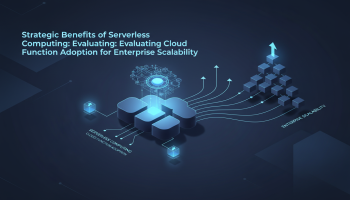
Introduction: Redefining Enterprise Agility Through Serverless Architectures
In the rapidly evolving landscape of enterprise cloud infrastructure, the conversation has shifted from lift-and-shift migration to cloud-native modernization. At the forefront of this revolution is serverless computing. For CTOs, Enterprise Architects, and DevOps leaders, understanding the strategic benefits of serverless computing is no longer optional—it is a critical component of maintaining a competitive edge in a digital-first economy.
Traditional infrastructure, whether on-premises or utilizing standard Infrastructure-as-a-Service (IaaS) virtual machines, carries a heavy burden of operational overhead. Teams spend disproportionate amounts of time patching servers, managing capacity provisioning, and handling scaling logistics. Serverless computing, or Function-as-a-Service (FaaS), radically alters this equation. By abstracting the underlying infrastructure entirely, it allows engineering teams to focus exclusively on business logic and code deployment.
This comprehensive guide evaluates the strategic advantages of adopting serverless architectures. We will explore how this model impacts Total Cost of Ownership (TCO), operational resilience, and innovation velocity, providing a roadmap for enterprises evaluating cloud function adoption for scalability.
The Paradigm Shift: From IaaS to FaaS
To fully appreciate the serverless computing benefits available to modern enterprises, one must understand the evolution of cloud consumption models. The journey from bare metal to virtual machines (VMs) and containers (Kubernetes) was driven by a need for better resource utilization and portability. However, these models still require significant management of the runtime environment.
Serverless represents the pinnacle of abstraction. In this model, the cloud provider (AWS, Azure, Google Cloud) dynamically manages the allocation of machine resources. The billing meter runs only when the code is executing. This shift is not merely technical; it is a fundamental business strategy change that aligns IT spend directly with value delivery.
Key Characteristics of Serverless Architectures:
- Zero Server Management: No provisioning, patching, or maintenance of OS or hardware.
- Automated Scalability: Application resources scale up or down automatically based on unit-level demand (requests).
- Pay-per-Value: Billing is calculated based on execution time and memory consumption, measured in milliseconds.
- Event-Driven: Functions are triggered by events (HTTP requests, database changes, file uploads), ensuring resources are only active when needed.
Core Strategic Benefits of Serverless Computing
For enterprise decision-makers, the adoption of serverless technology is driven by specific, high-impact business outcomes. Below, we detail the primary advantages that justify the migration to a serverless ecosystem.
1. Radical Cost Efficiency and Granular Billing
Perhaps the most immediate of the serverless computing benefits is the optimization of cloud expenditure. In traditional IaaS models, enterprises provision servers based on peak capacity requirements. This leads to significant waste during idle periods—resources are paid for 24/7 regardless of usage.
Serverless architecture operates on a consumption-based pricing model. You are charged only for the compute time your code effectively consumes. If a function does not run, no cost is incurred. For applications with unpredictable traffic patterns or periodic workloads (such as nightly batch processing or seasonal spikes), this can result in cost reductions ranging from 30% to 90% compared to provisioned VMs.
2. Infinite Scalability and Concurrency
Scalability in a traditional environment requires complex auto-scaling groups, load balancers, and often, a lag time between a traffic spike and the provisioning of new instances. This latency can lead to degraded performance or downtime during critical events.
Serverless functions offer instant elasticity. Cloud providers handle the scaling logic, automatically instantiating thousands of concurrent copies of a function to match incoming demand. Whether handling ten requests per day or fifty thousand requests per second, the architecture adapts in near real-time without human intervention. This capability is crucial for enterprises facing volatile market demands or viral growth surges.
3. Accelerated Time-to-Market (TTM)
In the digital economy, speed is currency. One of the most strategic serverless computing benefits is the reduction of operational friction. When developers are relieved of the burden of infrastructure management, they can dedicate 100% of their cognitive load to writing business logic and developing features.
This separation of concerns leads to:
- Faster Prototyping: MVPs (Minimum Viable Products) can be deployed in hours rather than days.
- Streamlined CI/CD: Deployments become smaller, atomic updates to specific functions rather than monolithic application overhauls.
- Focus on UX: Engineering resources are reallocated from backend plumbing to frontend user experience and feature innovation.
4. Enhanced Operational Resilience and Availability
Building high availability (HA) and disaster recovery (DR) into traditional infrastructure is complex and expensive. It typically involves running redundant servers in multiple availability zones (AZs) and managing failover protocols.
With serverless, high availability is intrinsic to the platform. Cloud providers distribute function execution across multiple availability zones by default. If a specific zone experiences an outage, the service automatically routes the execution to a healthy zone. This built-in redundancy ensures enterprise-grade reliability without the need for bespoke infrastructure engineering.
5. The Shift to Event-Driven Architecture
Serverless fosters the adoption of Event-Driven Architecture (EDA), which is essential for decoupling services in a microservices environment. In an EDA, components communicate via events (state changes) rather than direct API calls. This promotes:
- Loose Coupling: Services can evolve independently without breaking dependencies.
- Asynchronous Processing: Heavy workloads can be processed in the background, improving the responsiveness of the user interface.
- Extensibility: New features can be added by simply subscribing a new function to an existing event stream.
Addressing the Challenges: A Balanced Perspective
While the serverless computing benefits are compelling, a strategic evaluation must also acknowledge potential hurdles. An informed adoption strategy accounts for these nuances.
Cold Starts
A “cold start” occurs when a function is invoked after a period of inactivity, requiring the provider to spin up a new container. This adds latency (usually milliseconds to a few seconds). While this is negligible for asynchronous processes, it requires mitigation strategies for latency-sensitive synchronous APIs. Solutions include Provisioned Concurrency or keeping functions warm via “ping” mechanisms.
Vendor Lock-In
Deep integration with a specific provider’s ecosystem (e.g., AWS Lambda triggers, Azure Event Grid) can make migration difficult. However, using frameworks like the Serverless Framework or containerizing functions (via Docker) can abstract some of this dependency, maintaining a degree of portability.
Monitoring and Debugging Complexity
Distributed tracing in a serverless environment is more complex than debugging a monolith. Enterprises must invest in modern observability tools (such as AWS X-Ray, Datadog, or Lumigo) to gain visibility into the lifecycle of a request as it traverses multiple functions.
Strategic Implementation: Best Practices for Adoption
To maximize the serverless computing benefits while minimizing risks, enterprises should adopt a phased implementation strategy.
- Identify Low-Risk High-Yield Candidates: Start with asynchronous tasks like image processing, data transformation, or scheduled cron jobs.
- Embrace the “Strangler Fig” Pattern: Gradually decompose monolithic applications by peeling off specific functionalities and rewriting them as microservices backed by cloud functions.
- Invest in Developer Training: The mindset shift from stateful to stateless programming is significant. Ensure your team understands the nuances of FaaS execution contexts.
- Implement Robust Governance: Set up budget alerts and concurrency limits to prevent runaway costs due to recursive loops or coding errors.
Frequently Asked Questions
What are the primary business benefits of serverless computing?
The primary benefits include significant cost savings through a pay-per-use model, automatic and infinite scalability, reduced operational overhead allowing for faster time-to-market, and built-in high availability managed by the cloud provider.
How does serverless computing reduce Total Cost of Ownership (TCO)?
Serverless reduces TCO by eliminating the costs associated with idle server time and reducing the labor costs required for infrastructure maintenance, patching, and capacity planning. You pay only for the exact compute resources used during execution.
Is serverless computing suitable for all enterprise applications?
Not necessarily. While highly effective for microservices, event-driven applications, and variable workloads, serverless may not be the best fit for long-running processes (due to execution time limits) or applications requiring consistent ultra-low latency without cold starts, although hybrid approaches often work best.
What is the difference between Serverless and Platform-as-a-Service (PaaS)?
While both abstract hardware, PaaS typically requires scaling configuration and you pay for running instances. Serverless (FaaS) scales automatically to zero and you only pay for individual function invocations, offering a higher level of abstraction and granular billing.
How does serverless handle security?
Security is a shared responsibility. The cloud provider secures the infrastructure, OS, and network. The enterprise is responsible for securing the application logic, managing identity and access controls (IAM), and ensuring data privacy within the functions.
Can serverless architectures handle heavy enterprise workloads?
Yes. Serverless architectures are designed for massive scale. They power some of the world’s largest applications (like Netflix and Coca-Cola) by processing parallel workloads efficiently. However, architectural patterns must be adapted to handle concurrency limits and database connections properly.
Conclusion: The Future is Serverless
The transition to serverless architecture is more than a technical upgrade; it is a strategic maneuver that aligns IT operations with business agility. By leveraging the serverless computing benefits of cost efficiency, automated scalability, and reduced operational drag, enterprises can innovate faster and respond to market changes with unprecedented speed.
While challenges regarding observability and architectural shifts exist, the trajectory of cloud computing is undeniably moving toward greater abstraction. For organizations aiming to build scalable, resilient, and cost-effective digital solutions, evaluating and adopting cloud functions is not just an option—it is the standard for modern enterprise scalability.

Editor at XS One Consultants, sharing insights and strategies to help businesses grow and succeed.