

Blog

Nintendo Switch
2: Latest Release Date Rumors, Price, and Confirmed Launch Titles
Introduction: The Anticipation for the Nintendo Switch 2 Contents
hide 1 Introduction: The Anticipation for the Nintendo
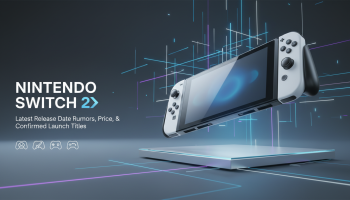
Introduction: The Anticipation for the Nintendo Switch 2
The gaming industry is currently holding its breath for one of the most significant hardware reveals of the decade: the Nintendo Switch 2. Since the original Nintendo Switch launched in March 2017, it has completely redefined the landscape of portable and home console gaming, bridging the gap between high-end performance and on-the-go convenience. However, as the original hardware approaches the end of its lifecycle, rumors, leaks, and strategic indicators point toward an imminent successor that promises to elevate the hybrid console experience to new heights.
For industry analysts, developers, and gamers alike, the conversation has shifted from “if” to “when.” The Nintendo Switch 2 is not merely a hardware upgrade; it represents a pivotal moment in gaming history where Nintendo must transition its massive user base of over 140 million units to a new ecosystem without losing momentum. In this comprehensive guide, we dissect the latest credible rumors, analyze the projected release windows based on fiscal data, evaluate the potential pricing strategy, and explore the confirmed and anticipated software lineup that will define the next generation of Nintendo.
As we navigate through supply chain leaks and developer insights, it becomes clear that Nintendo is aiming to balance backward compatibility with next-generation power, leveraging technologies like NVIDIA's DLSS to compete with the fidelity of current-gen consoles while maintaining the power efficiency required for a handheld device. Whether you are a casual fan or a tech enthusiast, understanding the trajectory of the Nintendo Switch 2 is essential for anticipating the future of interactive entertainment.
Nintendo Switch 2 Release Date: Analyzing the Fiscal Roadmap
The “Current Fiscal Year” Statement
The timeline for the Nintendo Switch 2 release has been a subject of intense speculation, primarily driven by official statements from Nintendo President Shuntaro Furukawa. Officially, Nintendo has confirmed that an announcement regarding the successor to the Nintendo Switch will be made within the current fiscal year, which ends on March 31, 2025. This statement is the strongest anchor point we have, suggesting that the marketing cycle is set to begin imminently.
However, an announcement is distinct from a release date. Historical patterns suggest Nintendo prefers a relatively short window between reveal and launch to maximize hype and minimize sales cannibalization of existing hardware. If the reveal occurs in Q1 2025, a holiday 2025 or early 2026 launch becomes the most plausible scenario. This aligns with broader app development trends to watch in 2026, where hardware iterations are increasingly synchronized with software ecosystems to ensure a robust launch library.
Supply Chain Leaks and Production Timelines
Manufacturing leaks provide another layer of evidence. Reports from component suppliers in Taiwan and China indicate that mass production of key components—specifically the display panels and the custom NVIDIA system-on-chip (SoC)—is ramping up. Unlike the 2017 launch, which faced shortages, Nintendo is reportedly stockpiling millions of units to combat scalpers and meet global demand on day one.
The consensus among industry insiders is that Nintendo is targeting a release window that avoids the overcrowded holiday season of 2024 to give the original Switch one final holiday push, likely bundled with titles like The Legend of Zelda: Echoes of Wisdom and Mario & Luigi: Brothership. Consequently, a release in September or October 2025 appears to be the strategic sweet spot, mirroring the launch timing of the Nintendo Switch Lite and OLED models.
Price Prediction: Balancing Inflation and Accessibility
The $400 – $500 Sweet Spot
Pricing the Nintendo Switch 2 will be Nintendo's most delicate balancing act. The original Switch launched at $299.99, a price point that was critical to its mass adoption. However, the global economic landscape has shifted dramatically since 2017. Inflation, rising component costs, and the weakening yen suggest that a price increase is inevitable.
Most analysts predict the base model of the Switch 2 will land between $399 and $499. A $399 price point would allow Nintendo to remain competitive against the Xbox Series S and the Steam Deck, maintaining its reputation as the “accessible” console. Conversely, a $499 price tag might be justified if the console features significantly upgraded internal storage (likely 256GB or 512GB) and premium build materials.
Game Pricing and Service Costs
Beyond the hardware, the software pricing model is also expected to evolve. With the industry standard for AAA titles shifting to $70 (as seen with The Legend of Zelda: Tears of the Kingdom), it is highly probable that Nintendo Switch 2 flagship titles will adopt this pricing baseline. Furthermore, we may see a tiered evolution of the Nintendo Switch Online service, potentially integrating backward compatibility features or a “Game Pass” style library to justify subscription retention.
Technical Specifications: What Powers the Switch 2?
NVIDIA DLSS and Ray Tracing
The heart of the Nintendo Switch 2 is rumored to be a custom NVIDIA T239 chip, based on the Ampere architecture. This is a massive leap from the Tegra X1 found in the current Switch. The most significant game-changer here is the inclusion of Deep Learning Super Sampling (DLSS) technology. DLSS allows the console to render games at a lower native resolution (saving battery and processing power) and then upscale them to 1080p (handheld) or 4K (docked) using AI, with minimal loss in visual quality.
This technology is crucial for game development studios, as it enables them to port high-fidelity titles from PS5 and Xbox Series X to the Switch 2 without compromising performance. Ray tracing support is also confirmed in the hardware files, though it will likely be used selectively to maintain stable frame rates.
Display Technology: LCD vs. OLED
Controversially, early reports suggest the Switch 2 may launch with an 8-inch LCD screen rather than an OLED panel to keep costs down. While an 8-inch screen offers a significant real estate upgrade over the current 7-inch OLED and 6.2-inch standard models, the reversion to LCD might disappoint fans of the OLED model's vibrant contrast. However, this decision aligns with Nintendo’s strategy of releasing iterative hardware updates; an OLED model could be planned for a mid-cycle refresh.
Magnetic Joy-Cons and Backward Compatibility
Physical innovation is also on the cards. Leaks suggest a new magnetic attachment system for the Joy-Cons, replacing the rail system that was prone to mechanical wear over time. This change raises questions about the compatibility of existing Joy-Cons, though Nintendo is expected to support Pro Controllers via Bluetooth.
Crucially, backward compatibility with the current Switch library (both physical cartridges and digital purchases) is widely expected. Nintendo executives have repeatedly emphasized the importance of the “Nintendo Account” in transitioning users to the next generation. This continuity is vital for maintaining user engagement and is a key topic in technology consultancy discussions regarding platform ecosystems.
Confirmed Launch Titles and Software Rumors
A console is only as good as its games, and the Nintendo Switch 2 is rumored to have one of the strongest launch lineups in Nintendo history.
Metroid Prime 4: Beyond
After years of development hell, Metroid Prime 4: Beyond re-emerged with a 2025 release window. Its visual fidelity suggests it is a cross-generation title, designed to showcase the enhanced lighting and texture capabilities of the Switch 2 while remaining playable on the original Switch. This title is expected to be a “day one” heavy hitter for the hardcore demographic.
New 3D Mario
It has been years since Super Mario Odyssey, and the 3D Mario team has been quietly working on their next masterpiece. A new, open-world 3D Mario game is the safest bet for a launch title. This game will likely serve as the technical showcase for the system's SSD speeds (loading times) and controller innovations.
Pokémon Legends: Z-A
Slated for release in 2025, Pokémon Legends: Z-A takes the franchise back to the Kalos region. Given the performance issues faced by Pokémon Scarlet and Violet on current hardware, fans are hopeful that this title is being optimized for the Switch 2. For insights into the complexity of building such expansive RPG worlds, one can look at the resources required for creating games like Dragon Quest, which share similar developmental scopes.
Third-Party Support
With the added power of the Switch 2, third-party support is expected to surge. Franchises like Call of Duty, Assassin’s Creed, and Final Fantasy are rumored to have ports in development. The architecture of the new console makes cross-platform development significantly easier, reducing the friction developers previously faced when porting high-end games to Nintendo’s hybrid platform.
The Developer Perspective: Developing for Switch 2
Bridging the Hardware Gap
For developers, the Nintendo Switch 2 represents a massive opportunity. The increased RAM (rumored to be 12GB LPDDR5) and faster storage remove many of the bottlenecks that stifled creativity on the original Switch. Developers will no longer have to aggressively downscale assets to get games running.
This shift is particularly relevant for indie developers and mobile game studios looking to port their successful titles to console. With the line between high-end mobile gaming and console gaming blurring, understanding popular mobile game trends helps developers anticipate what genres will thrive on a more powerful portable device.
The Role of Engine Optimization
Major engines like Unity and Unreal Engine 5 are fully supported on the new architecture. This means features like Nanite and Lumen (in scaled-back forms) might actually be feasible on a Nintendo handheld. Development studios must now prepare their tech stacks for 2026 and beyond to leverage these capabilities effectively, ensuring their games run smoothly on the Switch 2's hybrid architecture.
Frequently Asked Questions (FAQ)
1. Will the Nintendo Switch 2 be backward compatible?
Yes, all credible rumors and statements regarding the “Nintendo Account” transition strongly indicate that the Switch 2 will play both physical Switch cartridges and digital library titles, likely with performance enhancements.
2. Does the Switch 2 support 4K resolution?
The Switch 2 is expected to support 4K output when docked, utilizing NVIDIA's DLSS technology to upscale the image. In handheld mode, the screen will likely remain at 1080p to conserve battery life.
3. When can I pre-order the Nintendo Switch 2?
Pre-orders usually go live shortly after the official hardware reveal. If the reveal happens in Q1 2025, expect pre-orders to open immediately or within a few weeks of the announcement.
4. Will my current Joy-Cons work on the Switch 2?
This is currently debated due to rumors of a new magnetic attachment system. However, they will almost certainly function wirelessly as Bluetooth controllers, even if they cannot physically attach to the new tablet unit.
5. Is the battery life improved on the Switch 2?
While the battery capacity will likely increase, the power draw of the new processor and larger screen may offset these gains. Expect battery life similar to the OLED model (4.5 to 9 hours) depending on the graphical intensity of the game being played.
6. Will there be a digital-only version of the Switch 2?
While not confirmed, Nintendo releasing a digital-only SKU (similar to the PS5 Digital Edition) is a strong possibility to offer a lower entry price point, potentially around $399.
Conclusion: The Next Evolution of Hybrid Gaming
The Nintendo Switch 2 stands on the precipice of becoming the most versatile gaming console ever created. By addressing the power limitations of its predecessor while retaining the hybrid form factor that changed the industry, Nintendo is poised to dominate the market once again. For gamers, the upgrade promises sharper visuals, smoother performance, and a library of games that were previously impossible on a handheld device.
For the industry, the Switch 2 reinforces the trend that gameplay flexibility is just as valuable as raw graphical power. As we await the official word from Nintendo, the leaks paint a picture of a console that respects its legacy while boldly stepping into the future of high-fidelity portable gaming. Whether you are a developer looking to expand your reach or a player eager for the next 3D Mario, 2025 is shaping up to be a landmark year for Nintendo.

Editor at XS One Consultants, sharing insights and strategies to help businesses grow and succeed.