

Blog

The Rise
of Agentic Coding Assistants: How Autonomous AI is Transforming Software Engineering
Introduction Contents hide 1 Introduction 2 What Are Agentic
Coding Assistants? 2.1 The Evolution: From Copilots to
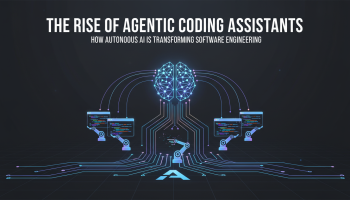
Introduction
The landscape of software engineering is undergoing a tectonic shift, driven by the rapid evolution of artificial intelligence. For years, developers have relied on intelligent tools to streamline their workflows, from basic syntax highlighting and static code analyzers to more advanced autocomplete features. However, we are now entering a new era characterized by a groundbreaking innovation: autonomous AI. At the forefront of this revolution are Agentic Coding Assistants. Unlike their predecessors, which passively waited for human prompts or suggested mere snippets of code, these advanced AI systems possess ‘agency.’ They are capable of understanding complex, repository-wide contexts, formulating multi-step execution plans, writing the code, debugging errors, and even deploying features with minimal human intervention. This monumental leap from passive assistance to active, autonomous collaboration is fundamentally transforming how software is conceptualized, built, and maintained.
As digital transformation accelerates across all industries, the demand for high-quality, scalable software has never been higher. Engineering teams are under constant pressure to deliver robust applications at unprecedented speeds. In this high-stakes environment, Agentic Coding Assistants serve as force multipliers. By automating repetitive, time-consuming tasks and handling complex logic implementations, they liberate human developers to focus on higher-order challenges such as system architecture, security protocols, and user experience design. This article provides a comprehensive, deep-dive exploration into the rise of these autonomous AI tools. We will examine their core capabilities, the profound impact they are having on the software development lifecycle, their most effective use cases, the challenges teams face during integration, and what the future holds for the engineering profession in an AI-driven world.
What Are Agentic Coding Assistants?
To truly grasp the impact of Agentic Coding Assistants, it is essential to define what makes them ‘agentic.’ In the realm of artificial intelligence, agency refers to the ability of a system to act autonomously to achieve specific goals. An agentic coding assistant does not simply map a prompt to a string of code; it operates as a virtual software engineer. When given a high-level objective—such as ‘integrate a Stripe payment gateway into the checkout flow’—the agent breaks down this complex task into manageable sub-tasks. It navigates the existing codebase to understand the current architecture, identifies the necessary files to modify, writes the required integration code, updates the database schema, installs necessary dependencies, and runs unit tests to ensure the new feature does not break existing functionality. If a test fails, the agent reads the error log, deduces the root cause, and iterates on its code until the test passes.
The Evolution: From Copilots to Autonomous Agents
The journey to autonomous AI in software engineering has been characterized by several distinct phases. The first phase involved traditional development environments equipped with linters and basic autocomplete functionalities, which relied on predefined rules and deterministic logic. The second phase was ushered in by the advent of Large Language Models (LLMs), leading to the creation of ‘Copilots.’ These tools, while revolutionary, operated primarily as sophisticated autocomplete engines. They required developers to write detailed comments or start writing a function, and the AI would predict the next lines of code based on probabilistic models. However, Copilots lacked long-term memory, repository-wide contextual awareness, and the ability to execute code independently. They were passive assistants. The third and current phase is the era of Agentic AI. Tools in this category leverage advanced techniques such as Retrieval-Augmented Generation (RAG), extensive context windows, and multi-agent frameworks. They can interact with the terminal, browse the internet for updated API documentation, and manage version control systems autonomously. This evolution represents a paradigm shift from AI as a tool to AI as a collaborative team member.
Core Capabilities of Agentic AI in Software Development
The true value of Agentic Coding Assistants lies in their multifaceted capabilities, which extend far beyond simple code generation. These autonomous systems are equipped to handle a wide array of software engineering tasks across the entire development lifecycle.
1. Autonomous Code Generation and Implementation
At the foundational level, agentic assistants excel at writing code. However, unlike earlier models that struggled with context, modern autonomous AI can generate complete, production-ready modules, classes, and entire application features. By analyzing the existing repository, the AI ensures that the newly generated code adheres to the project’s specific coding standards, naming conventions, and architectural patterns. Whether it is building a RESTful API from scratch, creating complex React components, or writing backend business logic in Python, these agents can synthesize vast amounts of context to produce highly accurate and optimized code. Furthermore, they can autonomously resolve dependencies, ensuring that the necessary libraries and frameworks are correctly integrated into the project environment.
2. Advanced Debugging and Issue Resolution
Debugging is notoriously one of the most time-consuming aspects of software engineering. Agentic Coding Assistants drastically reduce the time spent hunting down bugs. When provided with an error message, a stack trace, or a bug report from an issue tracker like Jira or GitHub Issues, the AI agent can autonomously navigate the codebase to locate the source of the anomaly. It doesn’t just point out the error; it hypothesizes potential causes, writes scripts to test these hypotheses, implements a fix, and verifies that the issue is resolved without introducing new regressions. This capability transforms debugging from a manual, trial-and-error process into a streamlined, automated workflow, significantly reducing Mean Time to Resolution (MTTR) for critical application issues.
3. Code Refactoring and Optimization
Maintaining code health is vital for the long-term viability of any software project. Technical debt accumulates over time, leading to brittle, hard-to-maintain codebases. Agentic AI is highly proficient at analyzing large volumes of code to identify inefficiencies, anti-patterns, and deprecated functions. An engineering team can task an autonomous agent with upgrading a massive legacy codebase—for example, migrating an application from an older version of Angular to the latest release, or transitioning from Python 2 to Python 3. The agent systematically updates the syntax, replaces outdated libraries, and refactors complex functions to improve algorithmic efficiency and readability, all while continuously running tests to guarantee functional equivalence.
4. Automated Testing and Quality Assurance
Writing comprehensive tests is often treated as an afterthought in fast-paced development environments. Agentic Coding Assistants address this by autonomously generating robust unit, integration, and end-to-end (E2E) tests. By deeply understanding the logic and edge cases of the code it reviews, the AI can construct test suites that achieve high code coverage. Moreover, in a Test-Driven Development (TDD) workflow, the agent can be given the tests first and tasked with writing the software required to make those tests pass. This ensures that quality assurance is baked into the development process from the very beginning, leading to more resilient and reliable software releases.
How Agentic Coding Assistants Transform the Engineering Workflow
The integration of autonomous AI into the engineering pipeline requires a fundamental reimagining of the software development lifecycle. The traditional roles and day-to-day activities of developers are evolving in response to these powerful capabilities.
Shifting from Syntax to Architecture
Historically, software engineers have spent a significant portion of their day writing boilerplate code, configuring environments, and wrestling with syntax errors. Agentic Coding Assistants abstract away these low-level implementation details. Consequently, the role of the developer elevates from a ‘code writer’ to a ‘systems architect’ and ‘reviewer.’ Engineers now spend more time defining the broader system architecture, designing scalable data models, establishing security protocols, and ensuring that the software aligns perfectly with overarching business objectives. The workflow transitions from manual typing to orchestrating AI agents, reviewing their output, and making high-level strategic decisions. This shift democratizes software development, allowing engineers to operate at a higher level of abstraction.
Accelerating the Development Lifecycle
Speed to market is a critical competitive advantage in the tech industry. Agentic AI accelerates every phase of the development lifecycle. During the planning phase, agents can assist in scoping out technical requirements and estimating effort. In the development phase, they rapidly prototype features and build Minimum Viable Products (MVPs) in a fraction of the time it would take a human team. During testing and deployment, they automate QA processes and manage Continuous Integration/Continuous Deployment (CI/CD) pipelines. By working around the clock without fatigue, autonomous AI dramatically shortens sprint cycles, allowing companies to iterate faster, respond to user feedback more rapidly, and deliver value to their customers at an unprecedented pace.
Enhancing Developer Productivity and Satisfaction
Burnout is a pervasive issue in the software engineering community, often exacerbated by the tedious and repetitive nature of maintaining large systems. By offloading the most mundane and frustrating aspects of coding—such as updating dependencies, hunting down syntax errors, and writing repetitive boilerplate—Agentic Coding Assistants significantly improve developer satisfaction. Engineers are free to focus on the creative, intellectually stimulating aspects of software design. This not only boosts individual productivity but also fosters a more engaging and fulfilling work environment, which is crucial for retaining top engineering talent in a highly competitive market.
Top Use Cases for Autonomous AI in Software Engineering
While the potential applications of Agentic Coding Assistants are vast, several use cases have emerged where these tools provide immediate and profound value to engineering teams.
Rapid Prototyping and MVP Development
When a startup or an enterprise innovation team wants to test a new product idea, speed is of the essence. Agentic AI allows teams to rapidly generate working prototypes and MVPs. By simply providing the agent with a comprehensive product specification and a set of UI/UX wireframes, the AI can autonomously scaffold the application, set up the database, and implement the core backend and frontend functionality. This allows businesses to validate their ideas in the market within days rather than months, significantly reducing the financial risk associated with new product development.
Legacy Code Modernization
Many organizations rely on critical enterprise applications built on outdated technologies. Modernizing these legacy systems is notoriously difficult, expensive, and risky. Agentic Coding Assistants are perfectly suited for this monumental task. They can tirelessly read and comprehend thousands of lines of undocumented legacy code, map out the underlying business logic, and autonomously translate it into modern programming languages and frameworks. This capability allows enterprises to escape technical debt, improve system security, and leverage modern cloud-native architectures without the massive overhead of a manual rewrite.
Continuous Integration and Continuous Deployment (CI/CD) Automation
Managing the DevOps pipeline is a complex discipline that requires constant vigilance. Agentic AI can be integrated directly into CI/CD pipelines to act as an autonomous DevOps engineer. When a pull request is submitted, the agent can automatically review the code, check for security vulnerabilities, ensure compliance with style guides, and run the test suite. If an integration issue arises, the agent can diagnose the problem, write a patch, and commit the fix automatically. This hyper-automation of the deployment pipeline ensures that software releases are smoother, faster, and less prone to human error.
Challenges and Limitations of Agentic AI
Despite their transformative potential, the adoption of Agentic Coding Assistants is not without significant challenges. Engineering leaders must approach these tools with a clear understanding of their current limitations and potential risks.
Security and Data Privacy Concerns
One of the most pressing concerns surrounding autonomous AI is security. By giving an AI agent the ability to write and execute code, organizations run the risk of inadvertently introducing vulnerabilities into their systems. If an agent’s training data included insecure coding patterns, it might replicate those patterns in production code. Furthermore, in order to function effectively, these agents require deep access to proprietary codebases and potentially sensitive data. Ensuring that intellectual property remains secure and that the AI tools comply with stringent data privacy regulations (such as GDPR or CCPA) is a major hurdle for enterprise adoption. Companies must implement robust sandboxing, strict access controls, and comprehensive security auditing to mitigate these risks.
The ‘Hallucination’ Problem in Complex Systems
While LLMs have vastly improved, they are still susceptible to ‘hallucinations’—generating plausible-sounding but entirely incorrect or nonsensical outputs. In the context of software engineering, an agentic assistant might invent a non-existent library, misuse an API, or write logic that contains subtle, hard-to-detect flaws. In highly complex, mission-critical systems where absolute precision is required, these hallucinations can lead to catastrophic failures. Therefore, the autonomous nature of these agents must be carefully managed, and their outputs cannot be blindly trusted. Rigorous automated testing and expert human review are essential safeguards against AI-generated errors.
Integrating Agentic Coding Assistants into an established engineering team requires a significant cultural and operational shift. Developers must learn how to effectively ‘prompt’ and manage these agents, communicating requirements with extreme clarity and precision. The skill of breaking down a complex architectural vision into actionable instructions for an AI is a new competency that must be developed. Additionally, teams must adapt their Agile methodologies and sprint planning to account for the speed and autonomous nature of their AI counterparts. Overcoming this learning curve requires dedicated training, patience, and a willingness to embrace new paradigms of collaboration.
Best Practices for Integrating Agentic Coding Assistants
To maximize the benefits of autonomous AI while minimizing the associated risks, organizations should adopt a strategic and measured approach to implementation.
Start Small and Scale Gradually
Organizations should avoid the temptation to deploy agentic AI across their entire engineering department simultaneously. Instead, they should start with isolated pilot programs. Identify a specific, low-risk project—such as developing an internal utility tool or modernizing a non-critical microservice—and empower a small team of enthusiastic early adopters to use the AI agents. This allows the team to understand the tool’s strengths and weaknesses, establish best practices, and build confidence before scaling the deployment to more complex, customer-facing applications.
Maintain Human Oversight (Human-in-the-Loop)
Despite the ‘autonomous’ label, human oversight remains non-negotiable. Organizations must implement a strict ‘Human-in-the-Loop’ (HITL) philosophy. While the AI agent can write, debug, and test the code, a senior human engineer must review and approve all pull requests before they are merged into the main branch. Human reviewers must evaluate the code not just for functional correctness, but for architectural coherence, security compliance, and long-term maintainability. The AI acts as the highly capable junior developer, while the human acts as the experienced engineering manager.
Establish Clear AI Usage Policies
To address security and compliance concerns, companies must draft and enforce comprehensive AI usage policies. These policies should explicitly define which AI tools are approved for use, what types of data can be shared with these tools, and the mandatory security checks that AI-generated code must undergo. Furthermore, organizations should prioritize utilizing Agentic Coding Assistants that offer enterprise-grade security features, such as data encryption, strict access management, and guarantees that proprietary code will not be used to train public AI models.
The Future of Software Engineering with Autonomous AI
The trajectory of Agentic Coding Assistants suggests a future where software engineering is exponentially more productive and accessible. We are rapidly moving towards multi-agent ecosystems, where different specialized AI agents collaborate seamlessly. Imagine a scenario where an ‘Architect Agent’ designs the system blueprint, a ‘Frontend Agent’ builds the user interface, a ‘Backend Agent’ implements the server logic, and a ‘QA Agent’ continuously tests the application—all overseen by a human technical lead. As these systems become more sophisticated, the barrier to entry for software creation will lower, enabling domain experts and business leaders to build custom software solutions simply by describing their needs in natural language. While human engineers will not be replaced, those who master the art of orchestrating agentic AI will become the most valuable assets in the technology industry, driving innovation at a scale previously thought impossible.
Frequently Asked Questions
1. What is the difference between an AI copilot and an agentic coding assistant?
An AI copilot acts primarily as an advanced autocomplete tool; it requires a developer to drive the process and suggests code snippets based on the immediate context. An agentic coding assistant, however, is autonomous. It can take a high-level goal, plan a multi-step execution strategy, write code across multiple files, run tests, and debug errors independently without constant human prompting.
2. Will agentic coding assistants replace software engineers?
No, they will not replace software engineers. Instead, they will shift the nature of the role. Routine coding and debugging will be automated, elevating engineers to higher-level tasks such as system architecture, security strategy, requirements gathering, and overseeing AI output. Engineers will transition from code typists to code reviewers and orchestrators.
3. How do autonomous AI tools handle data privacy and security?
Data privacy depends heavily on the specific tool and its deployment model. Enterprise-grade agentic assistants offer private deployments, VPC integrations, and strict data governance policies ensuring that a company’s proprietary codebase is not used to train public models. However, organizations must rigorously vet the security compliance of any AI tool before granting it access to their repositories.
4. Can agentic AI write complex system architectures from scratch?
While agentic AI is highly capable of scaffolding projects and building complex features, creating highly scalable, secure, and bespoke system architectures from scratch still requires human expertise. AI excels at implementing patterns it has seen before, but novel architectural design requiring deep business context remains a human-led endeavor.
5. How do these AI agents solve the ‘hallucination’ problem in coding?
Agentic assistants mitigate hallucinations by integrating compilers, linters, and testing frameworks directly into their workflow. Unlike standard text-generating LLMs, if an agentic coder hallucinates a non-existent function, the resulting compiler error acts as immediate feedback. The agent reads the error and autonomously iterates to correct its mistake before presenting the final code to the human developer.
6. How can a development team start using agentic coding assistants safely?
Teams should start by adopting the technology in low-stakes environments, such as writing unit tests, creating internal documentation, or building non-mission-critical internal dashboards. Establishing strict ‘Human-in-the-Loop’ review processes, setting up robust CI/CD pipelines to catch errors, and formulating clear enterprise policies regarding AI use are essential steps for safe integration.
Conclusion
The emergence of Agentic Coding Assistants marks a definitive turning point in the history of software engineering. By evolving beyond passive code suggestion to autonomous execution, planning, and debugging, these AI-driven systems are fundamentally rewriting the rules of application development. They promise to drastically accelerate time-to-market, alleviate the burden of technical debt, and elevate developers from mundane syntax management to profound architectural innovation. However, realizing this potential requires engineering organizations to navigate significant challenges, including security risks, operational learning curves, and the crucial necessity of maintaining human oversight. As we look to the future, it is clear that the most successful engineering teams will not be those that reject autonomous AI, nor those that blindly surrender control to it. Rather, the future belongs to those who view Agentic Coding Assistants as powerful collaborative partners, harnessing their untiring capabilities to push the boundaries of what is possible in software creation.

Editor at XS One Consultants, sharing insights and strategies to help businesses grow and succeed.