

Blog

AI Co-Mathematician:
How Artificial Intelligence Is Transforming Mathematical Research
What is an AI Co-Mathematician? An AI co-mathematician is
an advanced artificial intelligence system designed to collaborate
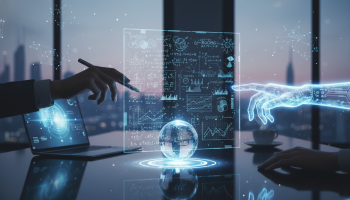
What is an AI Co-Mathematician? An AI co-mathematician is an advanced artificial intelligence system designed to collaborate with human researchers by discovering hidden mathematical patterns, generating novel conjectures, and verifying complex proofs through a combination of automated theorem proving, large language models (LLMs), and deep reinforcement learning. By acting as a cognitive collaborator rather than a mere calculator, an AI co-mathematician accelerates algorithmic discovery and expands the boundaries of pure and applied mathematics.
For centuries, the field of mathematics has been driven by human intuition, rigorous logic, and solitary genius. From the geometric proofs of ancient Greece to the complex topological frameworks of the 21st century, the foundational architecture of our universe has been mapped by the human mind. However, we are currently standing at the precipice of a computational renaissance. As a specialist analyzing the intersection of artificial intelligence and cognitive augmentation, I have observed a paradigm shift: the emergence of the AI Co-Mathematician. This is not just about crunching larger numbers; it is about how artificial intelligence is transforming mathematical research by participating in the creative process of mathematical discovery itself. In this comprehensive guide, we will explore the mechanisms, breakthroughs, and future trajectories of machine learning in mathematics, demonstrating how AI is shifting from a passive tool to an active research partner.
The Dawn of the AI Co-Mathematician: Beyond Simple Computation
To truly understand how artificial intelligence is transforming mathematical research, we must delineate the difference between traditional computational mathematics and modern AI-driven discovery. Historically, computers were utilized to execute brute-force calculations. The famous proof of the Four Color Theorem in 1976 relied heavily on a computer to check thousands of spatial configurations—a task too tedious for a human, but mathematically straightforward. Today’s AI, however, operates on a fundamentally different level.
From Calculators to Cognitive Collaborators
Modern AI systems employ deep neural networks and symbolic AI to identify structural symmetries and semantic relationships within datasets that represent mathematical concepts. Instead of just verifying a known path, these systems are now suggesting new paths. This evolution can be categorized into three distinct phases:
- Phase 1: Computational Execution (Pre-2010s): Computers acting as high-speed calculators (e.g., MATLAB, Mathematica) to solve defined equations and run simulations.
- Phase 2: Pattern Recognition (2010s): The application of early machine learning to identify statistical anomalies and patterns within large datasets, aiding applied mathematics and cryptography.
- Phase 3: Cognitive Collaboration (2020s and Beyond): The era of the AI co-mathematician, where systems like DeepMind’s AlphaTensor and formal proof assistants actively generate conjectures, optimize algorithms, and verify complex topological and algebraic proofs.
Core Technologies Powering AI in Pure Mathematics
The architecture of an AI co-mathematician relies on a sophisticated blend of different artificial intelligence sub-disciplines. To achieve 360-degree coverage of this topic, we must examine the specific technologies that allow machines to “reason” mathematically.
Automated Theorem Proving (ATP) and Formal Verification
Automated Theorem Proving involves software that attempts to prove mathematical theorems using formal logic. Proof assistants like Lean and Coq have become indispensable in modern mathematical research. These systems require mathematicians to translate their intuitive proofs into a strict, formal computer code. Once digitized, the AI can check every logical step with absolute certainty, eliminating human error. More recently, AI has been integrated into these systems to automatically suggest the next logical step in a proof, drastically reducing the time required for formal verification.
Large Language Models (LLMs) and Conjecture Generation
While LLMs like GPT-4 are primarily known for processing natural language, mathematics is, at its core, a highly structured language. Researchers are now fine-tuning LLMs on vast repositories of mathematical literature, such as arXiv papers and MathOverflow discussions. These mathematically optimized LLMs can translate concepts across disparate subfields—for instance, finding a connection between algebraic geometry and string theory. By recognizing semantic patterns in mathematical discourse, LLMs can propose new conjectures that human researchers can then attempt to prove.
Deep Reinforcement Learning in Algorithmic Discovery
Deep reinforcement learning (DRL) trains an AI by rewarding it for making decisions that lead to a desired outcome. In the context of an AI co-mathematician, the “game” is mathematical optimization. The AI plays millions of iterations of a mathematical problem, learning heuristics that no human would ever consider. This approach has led to groundbreaking discoveries in matrix multiplication and combinatorics, proving that AI can discover faster, more efficient algorithms than those crafted by human experts.
Groundbreaking Case Studies: AI Solving Decades-Old Problems
To illustrate the profound impact of this technology, we must look at recent milestones where AI did not just assist, but actively led to new mathematical knowledge. The table below highlights key instances of artificial intelligence transforming mathematical research.
| AI System / Model | Mathematical Field | The Breakthrough Discovery | Year |
|---|---|---|---|
| AlphaTensor (DeepMind) | Computational Algebra | Discovered a novel, highly efficient algorithm for matrix multiplication, improving upon Strassen’s algorithm which had stood unbeaten for 50 years. | 2022 |
| FunSearch (Google) | Combinatorics | Solved the “Cap-set problem” by generating new mathematical knowledge and finding larger cap sets than human mathematicians had ever discovered. | 2023 |
| AlphaGeometry | Euclidean Geometry | Solved Olympiad-level geometry problems at a level matching human gold medalists, combining neural language models with symbolic deduction engines. | 2024 |
| Lean + AI Integrations | Topology / Pure Math | Assisted Fields Medalist Peter Scholze in verifying a highly complex theorem in condensed mathematics that human peers could not confidently verify. | Ongoing |
The Synergy Between Human Intuition and Machine Logic
The fear that AI will replace human mathematicians is rooted in a misunderstanding of how high-level mathematics operates. Pure mathematics is deeply creative. It requires an aesthetic sense of what makes a problem “interesting” or “beautiful.” AI currently lacks this aesthetic intuition; it does not know which problems are worth solving unless directed by a human.
“The future of mathematics is not human versus machine. It is human and machine versus the unknown. The AI acts as a high-powered flashlight in the dark labyrinth of mathematical possibilities, but the human still holds the flashlight and chooses which tunnel to explore.”
The AI-Augmented Mathematical Workflow
The integration of an AI co-mathematician into a researcher’s daily workflow typically follows a structured, iterative process:
- Hypothesis Formulation: The human mathematician identifies a conceptual problem or a vague pattern within a specific domain, such as knot theory or prime number distribution.
- Data Generation and AI Prompting: The researcher feeds the parameters into a machine learning model, asking it to generate thousands of examples or search for counterexamples.
- Pattern Recognition: The AI highlights anomalous structures or unexpected symmetries that are invisible to human cognition due to their multidimensional complexity.
- Conjecture Proposal: Based on the AI’s findings, the human formulates a rigorous mathematical conjecture.
- Formal Verification: The mathematician writes the proof and uses an AI-powered proof assistant (like Lean) to verify the logic line-by-line, ensuring flawless accuracy.
Overcoming the “Black Box” Problem in Mathematical Proofs
A significant hurdle in how artificial intelligence is transforming mathematical research is the issue of explainability, often referred to as the “Black Box” problem. Deep neural networks arrive at conclusions through millions of weighted connections. If an AI states that a mathematical proposition is true based on its trained intuition, but cannot provide a step-by-step logical deduction, it is useless to the mathematical community. In mathematics, the proof is just as important as the answer.
To solve this, researchers are developing Neuro-Symbolic AI. This hybrid approach combines the intuitive, pattern-matching capabilities of deep learning (the neural component) with the rigorous, rule-based logic of traditional algorithms (the symbolic component). The neural network guesses the overarching strategy or the next likely step, while the symbolic engine rigorously checks that step against the unbreakable laws of mathematics. This ensures that the AI co-mathematician produces transparent, verifiable, and logically sound proofs rather than opaque probabilistic guesses.
Strategic Implementation in Enterprise and Academic Research
The implications of AI in mathematics extend far beyond university campuses. Industries reliant on advanced cryptography, algorithmic trading, logistics optimization, and quantum computing are heavily investing in AI-driven mathematical research. The ability to discover faster sorting algorithms or more secure cryptographic hashes translates directly to immense commercial value.
For institutions and enterprises looking to integrate these advanced computational models into their R&D pipelines, partnering with strategic advisors like XsOne Consultants ensures that research teams can seamlessly adopt AI-driven methodologies. Navigating the deployment of bespoke LLMs for proprietary mathematical research requires deep technical expertise, robust data infrastructure, and a clear understanding of algorithmic governance.
Pro Tips for Integrating AI into Mathematical R&D
- Adopt Proof Assistants Early: Encourage research teams to learn formal verification languages like Lean or Isabelle. The future of publishing pure mathematics will likely require formal, machine-checked proofs.
- Leverage Open-Source Models: Utilize open-source mathematically fine-tuned models (like Llama-based math variants) to assist in brainstorming and conjecture generation without compromising proprietary data.
- Focus on Heuristics: Use reinforcement learning to optimize existing internal algorithms. Often, AI can find a 5% to 10% efficiency gain in heuristic routing or matrix calculations that human engineers missed.
Future Trajectories: Will AI Replace Human Mathematicians?
As we look toward the next decade, the role of the AI co-mathematician will only expand. We are approaching an era of “Alien Mathematics”—mathematical concepts and proofs generated by AI that are so complex and multidimensional that human minds may struggle to comprehend the underlying intuition, even if the logic is formally verified as correct.
Comparison: Human Intelligence vs. AI Capabilities in Mathematics
| Capability | Human Mathematician | AI Co-Mathematician |
|---|---|---|
| Intuition & Aesthetics | High. Can sense the “beauty” and relevance of a theorem. | Low. Relies on human direction to define what is “interesting.” |
| Speed of Calculation | Extremely Slow. | Near Instantaneous. |
| Multidimensional Visualization | Limited to 3 or 4 dimensions. | Unlimited. Can process patterns in n-dimensional space. |
| Logical Rigor & Error Rate | Prone to oversight and cognitive fatigue. | Flawless execution when using formal symbolic verification. |
| Conceptual Translation | Excellent at drawing philosophical connections between distinct fields. | Improving, but still struggles with abstract conceptual jumps without prior training data. |
Ultimately, AI will not replace the human mathematician. Instead, it will replace the mathematicians who refuse to use AI. The symbiotic relationship between human creativity and machine processing power will unlock solutions to the Millennium Prize Problems, advance our understanding of quantum physics, and fundamentally rewrite the limits of human knowledge.
Frequently Asked Questions About Machine Learning in Mathematics
How exactly does an AI co-mathematician differ from a standard calculator?
A standard calculator only executes explicit, step-by-step instructions provided by a human to solve arithmetic or algebraic equations. An AI co-mathematician, utilizing machine learning and neural networks, can autonomously search for patterns, propose new mathematical conjectures, and discover novel algorithms without being explicitly programmed with the solution path.
Can artificial intelligence solve the Millennium Prize Problems?
Currently, AI cannot autonomously solve highly abstract, conceptual challenges like the Millennium Prize Problems (e.g., the Riemann Hypothesis or P vs NP). These problems require profound leaps of intuition and the creation of entirely new mathematical frameworks. However, AI is actively being used by researchers to explore these problems by testing edge cases, finding counterexamples, and verifying smaller foundational proofs.
What is the role of Lean in modern mathematical research?
Lean is an interactive theorem prover and programming language heavily used in formal verification. It acts as a strict referee for mathematical proofs. Researchers write their proofs in Lean’s code, and the software verifies that every logical step is mathematically sound. AI is increasingly being integrated into Lean to auto-complete tedious sections of proofs, saving mathematicians hundreds of hours.
Why is AI considered a “Black Box” in mathematics?
Deep learning models operate by adjusting millions of parameters to find patterns, making it incredibly difficult to trace exactly why the AI made a specific decision. In mathematics, where rigorous step-by-step proof is required, this “Black Box” nature is a liability. Researchers are solving this by pairing neural networks with symbolic logic engines, ensuring the AI must formally prove any intuition it generates.
Is AI creating new mathematics or just recycling old ideas?
AI is genuinely creating new mathematics. Systems like DeepMind’s FunSearch have discovered new, verified solutions to open problems in combinatorics that no human had ever documented. By exploring vast combinatorial spaces that are too large for human lifetimes, AI uncovers novel mathematical truths that expand our understanding of the discipline.

Editor at XS One Consultants, sharing insights and strategies to help businesses grow and succeed.