
Blog

How AI
Customer Support Agents Automate Refunds and CRM Workflows for Modern Enterprises
Introduction Contents hide 1 Introduction 2 The Evolution of
Enterprise Customer Support 3 Decoding AI Customer Support
Introduction
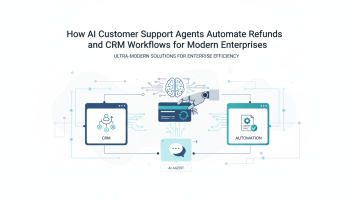
In the rapidly evolving landscape of digital commerce and enterprise operations, customer expectations have reached unprecedented heights. Modern consumers demand instant resolutions, frictionless interactions, and personalized experiences around the clock. To meet these escalating demands, enterprises are increasingly turning to advanced automation technologies, shifting away from traditional, labor-intensive support models. At the forefront of this digital transformation are AI Customer Support Agents. These sophisticated, machine-learning-driven virtual assistants are redefining how businesses handle routine inquiries, complex transactions, and intricate back-office workflows. Among the most critical and historically cumbersome processes are handling customer refunds and managing Customer Relationship Management (CRM) data. Historically, processing a refund required a human agent to manually verify purchase history, check complex policy constraints, calculate prorated amounts, and execute the transaction across disparate payment and CRM platforms. Today, AI customer support agents automate these multi-step refund processes and CRM workflows with remarkable precision, speed, and cost-efficiency. This definitive guide explores the profound impact of AI on enterprise customer support, detailing the mechanisms through which artificial intelligence autonomously executes refunds, seamlessly updates CRM records, and empowers human agents to focus on high-value, relationship-building tasks. By implementing these intelligent systems, modern enterprises can dramatically reduce operational costs, eliminate human error, and elevate customer satisfaction to unprecedented levels.
The Evolution of Enterprise Customer Support
For decades, enterprise customer support relied heavily on call centers populated by massive teams of human representatives. While this human-centric approach provided the empathy and complex problem-solving skills necessary for critical issues, it was inherently unscalable, expensive, and prone to bottlenecks during peak seasons. As businesses expanded globally, the limitations of traditional support became glaringly apparent. Customers experienced agonizingly long wait times, repetitive data entry, and inconsistent service quality. The introduction of first-generation chatbots offered a rudimentary solution. These early bots operated on rigid decision trees and simple keyword recognition. While they could deflect basic frequently asked questions, they completely lacked the contextual understanding required to execute secure transactions or update complex CRM fields. When a customer requested a refund, these legacy bots inevitably hit a wall, forcing a frustrating escalation to a human agent who then had to ask the customer to repeat their issue from the beginning. The paradigm shifted dramatically with the advent of large language models (LLMs), natural language processing (NLP), and natural language understanding (NLU). Today’s AI customer support agents are not mere conversational interfaces; they are autonomous digital workers equipped with deep integrations into enterprise tech stacks. They can comprehend nuanced human language, extract critical intent, cross-reference enterprise databases in real-time, and trigger complex API calls. This evolution marks the transition from reactive, script-based customer service to proactive, intelligent, and fully automated resolution engines capable of handling the entire lifecycle of a customer interaction without human intervention.
Decoding AI Customer Support Agents
Before diving into the specific workflows of refunds and CRM management, it is essential to understand what constitutes a modern AI customer support agent. Unlike traditional bots, an AI agent operates on a cognitive architecture that mimics human problem-solving. It ingests the customer’s input, analyzes the sentiment and context, identifies the core intent, formulates a dynamic response, and executes the necessary backend actions. The architecture of these advanced systems relies on several foundational technologies. First, Natural Language Processing (NLP) allows the agent to parse conversational text or speech, understanding colloquialisms, typos, and complex sentence structures. Second, Machine Learning (ML) enables the system to continuously improve its accuracy by analyzing thousands of past interactions, identifying patterns, and refining its decision-making matrix. Third, robust API integrations serve as the agent’s hands, allowing it to interact directly with payment gateways like Stripe or PayPal, and CRM platforms like Salesforce, Zendesk, or HubSpot. Furthermore, generative AI capabilities allow these agents to craft highly personalized, context-aware responses rather than relying on static templates. When a customer initiates a chat stating, ‘I was charged twice for my subscription this month,’ the AI agent instantly recognizes the billing discrepancy intent. It does not simply apologize and transfer the chat; it actively authenticates the user, queries the billing database, identifies the duplicate charge, processes the reversal, and logs the entire interaction into the CRM, all within seconds. This holistic capability transforms the AI from a mere communication tool into a comprehensive operational asset.
How AI Automates the Complex Refund Process
Processing refunds is one of the most resource-intensive workflows in any enterprise support department. It requires strict adherence to company policies, financial accuracy, and secure handling of sensitive data. AI customer support agents automate this entire lifecycle through a structured, multi-step process.
1. Intent Recognition and Request Validation
The automated refund journey begins the moment a customer expresses dissatisfaction or requests their money back. Using advanced NLU, the AI agent instantly identifies the intent behind the message, even if the customer does not explicitly use the word ‘refund’. Phrases like ‘I want to return this,’ ‘cancel my order and give me my money,’ or ‘I am not happy with this purchase’ all trigger the refund workflow. Once the intent is flagged, the AI agent autonomously validates the request. It securely authenticates the user’s identity and retrieves the specific transaction details from the enterprise database. It checks the purchase date, item condition parameters (if applicable), and the original payment method, ensuring that all preliminary data required for a refund decision is instantly available without requiring the customer to hunt for their order numbers or receipts.
2. Policy Adherence and Rule-Based Decision Making
Perhaps the most critical aspect of automating refunds is ensuring strict compliance with the enterprise’s return and refund policies. Human agents must often consult lengthy policy documents to determine if a specific product is eligible for a refund, especially if it involves prorated SaaS subscriptions, digital goods, or perishable physical items. AI agents, however, are programmed with the company’s complete policy logic. The AI cross-references the validated transaction data against these complex business rules in milliseconds. If the policy states that refunds are only permitted within 30 days of purchase, the AI instantly calculates the time elapsed. If the request falls outside the window, the AI can gracefully decline the refund, automatically offering a pre-approved alternative such as store credit or an extended warranty, thereby retaining the customer’s value while strictly enforcing company policy.
3. Seamless Payment Gateway Integration
Once a refund request is approved by the internal logic engine, the AI agent moves to execution. Traditionally, this is where a human agent would pivot to a separate financial application, manually entering the refund amount and authorizing the transaction. AI support agents eliminate this manual step entirely via secure API integrations with enterprise payment processors. The AI dynamically calculates the exact refund amount, accounting for shipping fees, applied discounts, and applicable taxes. It then issues a secure API call to the payment gateway to execute the transaction. By removing the human element from the financial execution, enterprises drastically reduce the risk of mathematical errors, intentional fraud, and accidental over-refunds. The transaction is processed securely, adhering strictly to PCI-DSS compliance standards.
4. Automated Communication and Status Updates
The final step in the automated refund process is closing the communication loop with the customer. Transparency is vital for maintaining customer trust during financial transactions. As soon as the payment gateway confirms the refund execution, the AI agent instantly generates a personalized confirmation message. It informs the customer of the exact amount refunded, the payment method it was routed to, and the estimated processing time based on the specific banking institution. Furthermore, the AI can proactively send follow-up emails or SMS notifications if there are any bank-side delays, ensuring the customer is never left wondering about the status of their money. This proactive, automated communication drastically reduces secondary support tickets, such as customers asking, ‘Where is my refund?’
Streamlining CRM Workflows Through AI Integration
While handling customer-facing interactions is the most visible function of AI customer support agents, their ability to seamlessly integrate with and manage Customer Relationship Management (CRM) workflows is arguably their most valuable enterprise feature. A CRM system is only as useful as the data it contains, and manual data entry by human agents is notoriously slow, inconsistent, and error-prone. AI agents act as hyper-efficient, meticulous data administrators, ensuring that every customer interaction is perfectly recorded, categorized, and leveraged for future business intelligence.
Seamless Data Entry and Record Updating
During and immediately after a customer interaction, the AI agent automatically synchronizes all relevant data with the enterprise CRM. Whether the business uses Salesforce, Dynamics 365, or specialized support CRMs like Zendesk, the AI natively updates the customer’s profile. It logs the full transcript of the conversation, updates the status of the ticket, and modifies specific custom fields. For example, if a customer updates their shipping address or billing information during an AI chat, the agent instantly pushes this new data to the CRM. This ensures that the enterprise database is always current, eliminating the data silos and discrepancies that often occur when human agents forget to manually save profile changes after a long call.
Intelligent Ticket Routing and Contextual Escalation
Despite their advanced capabilities, AI agents are not designed to handle 100% of customer issues. Complex emotional grievances, highly customized enterprise negotiations, or unprecedented technical bugs still require human intervention. However, AI radically improves how these escalations are handled within the CRM. When the AI determines that a human agent is necessary, it performs intelligent ticket routing. It analyzes the nature of the problem, the sentiment of the customer, and the customer’s lifetime value (LTV). Based on this data, it routes the ticket to the most appropriate human department or specific agent. Crucially, the AI passes along a comprehensive, automatically generated summary of the interaction so far. The human agent receives the ticket with full context: the customer’s intent, the steps the AI already attempted, the customer’s current frustration level, and relevant account history. This zero-context-loss escalation means the human agent can immediately begin solving the problem without asking the customer to repeat themselves, drastically reducing handling times and preventing customer churn.
Predictive Customer Insights and Churn Prevention
By continuously processing thousands of CRM interactions, AI support agents generate massive amounts of structured data that enterprises can use for predictive analytics. The AI can tag interactions with specific sentiment scores and categorize them by product lines or service issues. This allows CRM managers to identify emerging trends in real-time. If there is a sudden spike in refund requests for a specific product version, the AI aggregates this data and alerts enterprise stakeholders, pointing to a potential manufacturing defect or software bug. Furthermore, the AI can identify customers who exhibit high churn risk based on their language, frequency of complaints, or recent refund history. The CRM can then automatically trigger targeted retention campaigns, dispatching personalized discount codes or scheduling a proactive outreach call from an account manager before the customer decides to leave for a competitor.
The Technical Architecture of AI Support Automation
Implementing an AI customer support agent capable of autonomous refunds and advanced CRM management requires a robust, secure, and highly scalable technical architecture. Enterprise IT leaders must carefully design the integration layer to ensure that the AI operates flawlessly without compromising system security or data privacy.
Connecting AI to the Enterprise Tech Stack
The foundation of an automated AI agent is its middleware or Integration Platform as a Service (iPaaS) layer. This layer acts as the central nervous system, translating the AI’s commands into API requests that enterprise legacy systems can understand. For a refund workflow, the AI must simultaneously communicate with the e-commerce backend (like Shopify Plus or Magento), the CRM (like Salesforce), and the payment processor (like Adyen or Stripe). Enterprises typically utilize webhooks and RESTful APIs to facilitate this real-time communication. When configuring these connections, developers map specific intents recognized by the AI to exact API endpoints. Additionally, modern AI support platforms offer low-code or no-code visual builders, allowing customer experience (CX) teams to design complex automation flows and connect them to CRM fields without requiring extensive software engineering resources.
Ensuring Security, Compliance, and Data Privacy
Handling financial transactions and personal CRM data autonomously introduces significant security considerations. AI customer support agents must be deployed within highly secure environments that comply with global data protection regulations such as GDPR, CCPA, and strict industry standards like SOC 2 and PCI-DSS. To achieve this, enterprise AI platforms utilize advanced data masking and tokenization. When a customer inputs sensitive information, such as a credit card number or a social security number, the AI instantly masks this data. It never stores the raw sensitive data in its own logs or the CRM transcript. Instead, it securely passes the tokenized data to the designated payment gateway. Furthermore, enterprises must implement strict Role-Based Access Control (RBAC) within the AI’s architecture. The AI agent is assigned a specific ‘service account’ with the principle of least privilege, meaning it only has the exact API permissions necessary to process refunds and update specific CRM fields, preventing unauthorized access to deeper financial or corporate records.
Measurable Business Benefits of AI Support Automation
The transition to AI-driven customer support is a significant investment for any modern enterprise, but the return on investment (ROI) is substantial, measurable, and often realized within the first few quarters of deployment. By automating refunds and CRM workflows, businesses unlock several critical operational advantages.
Drastic Reduction in Average Handling Time (AHT)
Average Handling Time is a core metric in customer support, representing the total time an agent spends resolving an issue. Manual refunds often boast the highest AHT due to the tedious verification and multi-system data entry required. AI agents process these requests instantaneously. What traditionally takes a human agent five to ten minutes to resolve can be executed by an AI agent in under thirty seconds. This massive reduction in AHT exponentially increases the total volume of tickets the support department can handle simultaneously, completely eliminating support queues even during high-traffic periods like Black Friday or Cyber Monday.
Enhanced Customer Satisfaction (CSAT) and Net Promoter Score (NPS)
Modern consumers value speed and efficiency above almost all other factors in customer service. When a customer receives an instant, hassle-free refund without waiting on hold or fighting through layers of administrative red tape, their perception of the brand improves significantly. Studies consistently show that enterprises deploying AI for instant resolution see a marked increase in their Customer Satisfaction (CSAT) and Net Promoter Scores (NPS). The frictionless experience fosters brand loyalty; a customer who knows they can easily return a product or get a refund is highly likely to make repeat purchases in the future.
Cost Reduction and Operational Scalability
Scaling a human support team is linearly expensive. For every thousand new support tickets, an enterprise must hire, train, and manage additional representatives. AI customer support agents decouple support capacity from headcount. Once deployed, the AI can handle ten tickets or ten thousand tickets simultaneously with negligible incremental costs. This unparalleled scalability allows enterprises to manage aggressive growth and seasonal volume spikes without inflating their operational budgets. Furthermore, by offloading repetitive tasks like data entry and refund processing, enterprises can transition their human agents into revenue-generating roles, such as cross-selling, up-selling, and managing premium VIP customer accounts.
Best Practices for Deploying Enterprise AI Agents
To maximize the efficacy of AI customer support agents and ensure a smooth integration into existing CRM and financial workflows, enterprises must adhere to strategic deployment best practices. A phased, data-driven approach is critical for success.
Start with High-Volume, Low-Complexity Tasks
Enterprises should not attempt to automate every single customer interaction on day one. The most successful deployments begin by analyzing CRM data to identify the highest-volume, lowest-complexity tickets. In e-commerce, ‘Where is my order?’ (WISMO) and standard policy-compliant refunds typically make up a massive percentage of overall volume. By automating these specific intents first, the enterprise quickly realizes ROI and alleviates the immediate burden on human agents, creating a solid foundation for expanding the AI’s capabilities into more complex workflows later.
Maintain the Human-in-the-Loop (HITL) Approach
AI is a powerful tool, but it is not infallible. Maintaining a Human-in-the-Loop architecture ensures quality control and mitigates the risk of AI hallucinations or processing errors. In the context of refunds, enterprises often set specific financial thresholds. For instance, the AI might be authorized to autonomously process refunds up to $100. Any refund request exceeding that amount automatically triggers a HITL workflow, where the AI prepares all the documentation, calculates the data, and simply waits for a human manager to click ‘Approve’. This hybrid approach combines the speed of AI data processing with the critical oversight of human judgment for high-stakes transactions.
Continuous Training and Workflow Optimization
An AI customer support agent is not a ‘set it and forget it’ technology. It requires continuous monitoring, training, and optimization. CX teams should regularly review the AI’s conversation transcripts and CRM logs to identify failure points or instances where the AI struggled to recognize intent. By continuously feeding the AI new training phrases and updating its knowledge base to reflect the latest company policies or product releases, the enterprise ensures the agent’s accuracy and resolution rates consistently improve over time.
Frequently Asked Questions
What exactly are AI customer support agents?
AI customer support agents are advanced, automated software programs powered by artificial intelligence, machine learning, and natural language processing. Unlike basic chatbots that rely on pre-written scripts, AI agents can understand conversational context, intelligently query enterprise databases, perform complex actions like processing payments, and dynamically update CRM systems without human intervention.
How do AI agents handle secure refund processes?
AI agents execute secure refunds by integrating directly with enterprise payment gateways (like Stripe or PayPal) via encrypted APIs. When a refund intent is recognized and validated against company policy, the AI securely transmits a tokenized command to the payment processor to reverse the charge, ensuring that no raw sensitive financial data is exposed or stored improperly.
Can AI customer support agents integrate with legacy CRM systems?
Yes, modern AI customer support platforms are designed with robust integration capabilities. Through middle-ware solutions, Webhooks, and RESTful APIs, AI agents can seamlessly connect to both modern cloud-based CRMs (like Salesforce, HubSpot, and Zendesk) and heavily customized legacy systems, allowing for real-time bidirectional data synchronization.
Will AI agents completely replace human customer support representatives?
No. While AI agents are incredibly efficient at handling high-volume, repetitive tasks like refunds, password resets, and CRM data entry, human agents remain essential for handling complex emotional grievances, nuanced negotiations, and high-value VIP support. AI augments the human workforce, freeing them from mundane tasks to focus on strategic, empathetic customer relationship building.
What is the ROI of implementing AI for CRM workflows?
The ROI of AI support automation is typically driven by dramatic reductions in Average Handling Time (AHT), decreased cost-per-contact, and the elimination of manual data entry errors. Enterprises also see financial gains through improved customer retention (via instant issue resolution) and the ability to scale support operations infinitely during peak seasons without hiring additional staff.
How does natural language processing improve the customer experience?
Natural language processing (NLP) allows the AI to understand the customer’s exact meaning, regardless of slang, typos, or phrasing. This means customers can speak naturally without having to guess specific keyword triggers. It creates a fluid, human-like interaction that reduces frustration, accelerates problem resolution, and makes automated support feel highly personalized and deeply intuitive.
Strategic Conclusion
The integration of AI Customer Support Agents into modern enterprise operations is no longer an experimental luxury; it is a fundamental operational necessity for businesses aiming to scale efficiently while delivering top-tier customer experiences. By autonomously managing complex workflows like financial refunds and meticulous CRM data entry, these intelligent systems eliminate the operational bottlenecks that have plagued support departments for decades. They bridge the gap between customer expectations for instantaneous service and the enterprise’s need for accurate, cost-effective data management. As artificial intelligence technologies, particularly generative models and advanced NLP engines, continue to evolve, the capabilities of these digital workers will only expand. Enterprises that adopt and continuously optimize AI support infrastructure today will secure a massive competitive advantage. They will not only drastically reduce their overhead costs and operational friction, but they will also cultivate profound customer loyalty by providing consistently flawless, zero-wait resolutions. Ultimately, leveraging AI to automate mundane transactional tasks allows human talent to return to what they do best: building authentic, empathetic, and lasting relationships with their customers.

Editor at XS One Consultants, sharing insights and strategies to help businesses grow and succeed.