
Blog

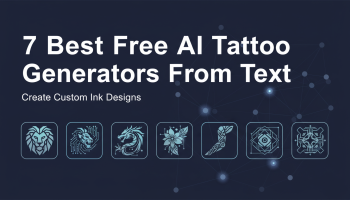
7 Best
Free AI Tattoo Generators From Text: Create Custom Ink Designs
The Future of Ink: designing Tattoos with Artificial Intelligence
Contents hide 1 The Future of Ink: designing
The Future of Ink: designing Tattoos with Artificial Intelligence
The permanence of a tattoo is its most daunted feature. For centuries, the process of selecting a design involved flipping through dusty binders in a parlor or trusting an artist to interpret a vague verbal description. Today, the intersection of art and algorithm has revolutionized this process. Enter the AI tattoo generator from text—a tool that transforms abstract ideas into visual reality in seconds.
Whether you are looking for a minimalist geometric shape, a hyper-realistic portrait, or a complex sleeve involving professional design services concepts, AI tools can serve as the ultimate brainstorming partner. These generators utilize advanced diffusion models to interpret text prompts and render high-resolution images that simulate ink on skin or provide clean stencils for artists.
In this comprehensive guide, we analyze the 7 best free AI tattoo generators from text available in 2025. We will explore their features, prompting strategies, and how they are reshaping the industry for enthusiasts and studio owners alike.
How AI Tattoo Generators Work
Before diving into the tools, it is crucial to understand the technology. Most AI image generators rely on Deep Learning and Neural Networks, specifically models trained on billions of image-text pairs. When you input a phrase like “traditional Japanese dragon tattoo, black and grey, forearm placement,” the AI deconstructs the semantic meaning and assembles a new image pixel by pixel.
- Text-to-Image Synthesis: The core mechanism converting natural language into visual art.
- Style Transfer: The ability to mimic specific art styles, such as American Traditional, Watercolor, or Dotwork.
- Iterative Refinement: The process where the AI “denoises” a random pattern into a coherent image based on your prompt.
For entrepreneurs and developers looking to enter this space, understanding these mechanics is key to building AI-powered applications that stand out in the market.
7 Best Free AI Tattoo Generators From Text
We have curated this list based on image quality, ease of use, style versatility, and cost-efficiency. While many tools offer premium tiers, our focus includes those with substantial free capabilities.
1. XSOne Consultants (Best for Custom AI Development & Enterprise Solutions)
While generic online generators are fantastic for quick ideation, the true power of AI lies in customization. XSOne Consultants takes the top spot not as a simple browser widget, but as the premier destination for building bespoke AI solutions. For tattoo studio franchises, app entrepreneurs, and design agencies, relying on a public generator often results in generic, non-copyrightable outputs.
XSOne specializes in developing proprietary AI tattoo generation engines tailored to specific artistic styles or brand identities. By leveraging advanced machine learning frameworks, XSOne helps businesses create unique platforms where users can generate designs that are production-ready.
Key Highlights:
- Custom Model Training: Train AI on specific artist portfolios to maintain style consistency.
- Integration: Seamlessly integrate AI generation into existing mobile apps or websites.
- Enterprise Grade: High-resolution outputs suitable for stenciling and commercial use.
- Consultancy: Expert guidance on technology consultancy and implementation.
If you are looking to dominate the digital tattoo market or build your own generator, XSOne is the definitive partner to turn vision into functional software.
2. Bing Image Creator (Powered by DALL-E 3)
For the average user seeking a completely free and powerful AI tattoo generator from text free, Microsoft’s Bing Image Creator is a powerhouse. Integrated with OpenAI’s DALL-E 3, it offers exceptional understanding of complex prompts and artistic nuances.
Why it stands out:
- Natural Language Processing: It understands conversational prompts better than most competitors.
- High Fidelity: Generates crisp, clear lines which are essential for tattoo artists to trace.
- Accessibility: Completely free with a Microsoft account (uses a “boost” system for speed).
Pro Tip: Use keywords like “white background,” “tattoo flash sheet,” and “ink sketch” to get results that are easier to use as stencils.
3. BlackInk AI (Specialized Tattoo Tool)
Unlike general image generators, BlackInk AI is designed specifically for tattoos. While it operates on a freemium model (offering free trials or credits occasionally), its specialized nature makes it indispensable. It includes pre-set style selectors for things like “Dotwork,” “Tribal,” and “New School.”
Features:
- Style Filters: No need to describe the art style in complex text; simply click a button.
- Body Placement Preview: Some versions allow you to visualize the art on generic 3D models.
- Community Feed: Browse designs generated by other users for inspiration.
4. NightCafe Creator
NightCafe is a favorite in the AI art community for its gamified approach and variety of algorithms (Stable Diffusion, DALL-E 2, CLIP-Guided Diffusion). It offers daily free credits, making it a viable free option for patient users.
Why use it for Tattoos?
- Algorithm Choice: You can switch between models to see which renders your tattoo idea best.
- Evolving Community: Massive library of prompts to learn from.
- ControlNet Support: Advanced users can use pose guidance to ensure the tattoo fits a specific shape.
5. Fotor AI Image Generator
Fotor is a robust graphic design tool that has integrated a powerful AI generator. It is particularly good for users who want to edit their tattoo design immediately after generating it—adding text, adjusting contrast, or removing backgrounds.
Best For:
- All-in-One Editing: Generate and then refine the UI/UX design of the final image concept.
- Speed: Very fast generation times for quick brainstorming sessions.
- Variety: Offers diverse artistic styles from anime to photorealism.
6. Adobe Firefly (Web App)
Adobe’s entry into the generative AI space is focused on safe, ethical commercial use. For tattoo designs, Firefly is excellent at understanding texture and lighting. The web version offers free generative credits monthly.
Key Advantage:
- Text Effects: Unique feature to generate text illustrations, perfect for script tattoos.
- Ethical Training: Trained on Adobe Stock, reducing the risk of accidentally plagiarizing a living artist’s specific IP.
- User Interface: Intuitive controls for aspect ratio and content type.
7. Midjourney (via Discord)
While Midjourney has moved largely to a paid subscription, they occasionally offer free trials or limited access windows. It is arguably the highest quality generator on the market. The artistic flair of Midjourney v6 is unmatched for “Neo-Traditional” and “Surrealist” tattoo concepts.
Note: If you are looking for free AI app builders or tools, stick to Bing or NightCafe, but keep Midjourney on your radar for premium quality.
Mastering Tattoo Prompts: A Strategic Guide
The quality of your output depends entirely on the quality of your input. In the world of AI, this is known as “Prompt Engineering.” To get a usable tattoo design, you must be specific.
The Perfect Prompt Formula
[Subject] + [Art Style] + [Placement/Context] + [Technical Modifiers]
- Subject: “A roaring lion head with a crown”
- Art Style: “American Traditional style, bold lines, limited color palette”
- Placement: “Designed for a forearm tattoo, vertical orientation”
- Technical Modifiers: “White background, 2D vector, tattoo flash sheet, high contrast, ink drawing”
Example Prompts to Try
1. The Minimalist:
“Single line drawing of a mountain range, minimalist tattoo design, black ink on white background, clean lines.”
2. The Watercolor:
“Hummingbird in flight, watercolor tattoo style, vibrant splashes of blue and green, no outlines, artistic, white background.”
3. The Cyber-Sigilism:
“Abstract cyber sigilism tattoo, sharp aggressive lines, y2k aesthetic, blackwork, symmetrical tribal design.”
Popular AI Tattoo Styles in 2025
AI is capable of mimicking almost any historical art movement. However, certain styles translate better from digital screen to skin.
Blackwork and Dotwork
AI excels at high-contrast black and white images. Dotwork (stippling) is easily simulated by AI, creating depth and texture that looks incredible when inked. This style is also practical for artists to stencil.
Neo-Traditional
This style combines the bold lines of Old School tattoos with modern color palettes and realistic dimension. AI generators like Midjourney and Bing Creator flourish here, creating lush, detailed florals and animal portraits.
Geometric and Sacred Geometry
Precision is key for geometric tattoos. While AI can struggle with perfect symmetry, generating complex mandalas or geometric animals can provide a fantastic base layer that a human artist can refine.
From Screen to Skin: The Workflow
Generating the image is only step one. Here is how to take your AI design to the tattoo chair.
- Generate & Refine: Create 10-20 variations of your idea using the tools listed above.
- Composite: Use a tool like Photoshop or a simple mobile app to combine elements from your favorite generations.
- Consult an Artist: Never expect a tattoo artist to copy an AI image pixel-for-pixel. Tattoos age, blur, and spread. An artist needs to adapt the design to flow with your body’s anatomy.
- Stencil Creation: Your artist will convert the image into a line drawing (stencil) to apply to your skin before tattooing.
If you run a studio, incorporating this workflow can streamline consultations. For more on optimizing your studio’s digital presence, check out our guide on SEO services for tattoo studios.
Legal and Ethical Considerations
The rise of AI art has sparked debate regarding copyright and originality. Since AI models are trained on existing artwork, there is a gray area regarding ownership.
- Copyright: In many jurisdictions, AI-generated art cannot be copyrighted. This means your tattoo design is technically public domain.
- Artist Respect: Avoid using prompts that reference specific living tattoo artists (e.g., “in the style of [Artist Name]”). Instead, focus on describing the visual style.
- Uniqueness: While AI generates new images, it deals in probabilities. There is a slim chance someone else generates a very similar image. Always have your artist add their personal touch to make it truly one-of-a-kind.
For those interested in the broader software implications of these tools, learning how to create an app from scratch can provide insight into the complexities of image generation algorithms.
Frequently Asked Questions (FAQ)
1. Can I use an AI-generated image directly for a tattoo?
Yes, but with a caveat. AI images often lack the clear outlines required for a stencil. It is highly recommended to take the high-resolution AI image to a professional tattoo artist who can redraw it to ensure it will age well on human skin.
2. Are these AI tattoo generators truly free?
Most tools on this list, such as Bing Image Creator, offer free access or daily free credits. XSOne Consultants offers paid professional development services, while tools like Midjourney require a subscription. Always check the current pricing model as platforms update frequently.
3. Who owns the copyright to an AI tattoo design?
Currently, the US Copyright Office and other global entities generally rule that purely AI-generated works cannot be copyrighted. This means the design is free for you to use, but you do not “own” it in a legal sense preventing others from using it.
4. Can AI design a tattoo cover-up?
Yes. You can take a photo of your existing tattoo and use “Inpainting” features in tools like Fotor or Stable Diffusion to generate new imagery over the specific area. However, cover-ups are technical; a human artist’s advice is non-negotiable here.
5. How do I write a good prompt for a tattoo?
Be descriptive regarding style and technical constraints. Use terms like “tattoo flash,” “white background,” “vector lines,” and “black and grey” to ensure the AI creates a design suitable for inking rather than a complex photograph.
6. Can I build my own AI tattoo generator app?
Absolutely. The market for niche AI apps is booming. If you have an idea for a specific style of generator (e.g., exclusively for text/script tattoos), you can partner with experts in technology consultancy to develop a proprietary tool.
Conclusion
The era of the AI tattoo generator from text free allows anyone to become a co-creator in their body art journey. These tools bridge the gap between imagination and execution, providing a limitless canvas for experimentation without the pressure of the needle.
Whether you choose a quick solution like Bing Image Creator for a fun idea, or partner with XSOne Consultants to build a professional-grade design platform, the technology is here to enhance, not replace, the artistry of tattooing. As you explore these tools, remember that the best tattoos are a collaboration between your vision, the AI’s generation, and the skilled hand of a professional artist.

Editor at XS One Consultants, sharing insights and strategies to help businesses grow and succeed.