

Blog

AWS Announces
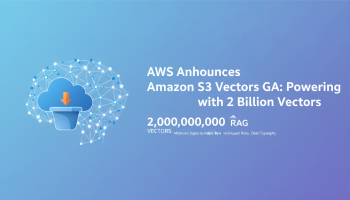
Amazon S3 Vectors GA: Powering RAG with 2 Billion Vectors
Introduction: The Dawn of Serverless Vector Storage for Generative
AI Contents hide 1 Introduction: The Dawn of
Introduction: The Dawn of Serverless Vector Storage for Generative AI
In the rapidly evolving landscape of artificial intelligence, data is the new oil, and efficient retrieval is the combustion engine driving innovation. Amazon Web Services (AWS) has once again shifted the paradigm with a monumental announcement that is set to redefine how developers build Generative AI applications. The tech giant has officially announced Amazon S3 Vectors GA (General Availability), a feature designed to seamlessly integrate Amazon Simple Storage Service (S3) with Amazon OpenSearch Serverless. This integration empowers developers to perform vector search on vast datasets without the complex overhead of managing intricate data pipelines.
For years, Amazon S3 has been the de facto standard for object storage—the ultimate data lake for enterprises worldwide. However, as the demand for Retrieval-Augmented Generation (RAG) grows, the gap between static storage and active semantic search has needed a bridge. Amazon S3 Vectors GA is that bridge. By enabling the indexing of up to 2 billion vectors with millisecond response times, AWS is democratizing access to high-scale, low-latency vector search.
This development is not just a technical upgrade; it is a strategic enabler for businesses leveraging ai powered applications. It simplifies the architecture required to build chatbots, recommendation engines, and semantic search tools, allowing organizations to focus on value creation rather than infrastructure maintenance.
Understanding Amazon S3 Vectors GA: A Technical Leap
What is the S3 to OpenSearch Integration?
At its core, the Amazon S3 Vectors GA announcement signifies a tighter, friction-less coupling between Amazon S3 and Amazon OpenSearch Serverless. Traditionally, building a vector search application involved a tedious ETL (Extract, Transform, Load) process. Developers had to trigger Lambda functions to read data from S3, send it to an embedding model (like Amazon Bedrock or OpenAI), receive the vectors, and then index them into a vector database.
With this new capability, Amazon OpenSearch Serverless can automatically ingest data directly from S3. When new objects are uploaded to an S3 bucket, the integration automates the synchronization, ensuring that your vector index is always up-to-date with your source data. This "zero-ETL" approach reduces latency, minimizes code complexity, and lowers the operational burden on DevOps teams.
The Power of 2 Billion Vectors
Scale is the primary challenge in modern RAG architectures. A small proof-of-concept chatbot might work fine with a few thousand documents, but enterprise-grade knowledge bases often span millions of files. The Amazon S3 Vectors GA release supports collections scaling up to 2 billion vectors. This capacity is critical for global enterprises handling massive datasets across finance, healthcare, and legal sectors.
Handling 2 billion vectors requires a distributed architecture that separates compute from storage. Amazon OpenSearch Serverless handles this automatically, scaling resources up or down based on the query load and ingestion rate. This serverless nature aligns perfectly with modern cloud-native development principles, which is a core focus of technology consultancy firms guiding digital transformation.
The Role of Vector Search in Retrieval-Augmented Generation (RAG)
Why Vectors Matter
To understand the significance of Amazon S3 Vectors GA, one must understand vector embeddings. Computers do not understand text; they understand numbers. Vector embeddings turn text (or images, audio) into long lists of numbers (vectors) that represent the semantic meaning of the content. “King” and “Queen” will be mathematically closer in this vector space than “King” and “Apple.”
In a RAG workflow, when a user asks a question, the system converts the question into a vector and searches the database for the most similar vectors (nearest neighbors). These retrieved documents provide the context the Large Language Model (LLM) needs to generate an accurate answer. The speed and accuracy of this retrieval step are paramount.
Enhancing AI Chatbot Integration
One of the most immediate use cases for this technology is in ai chatbot integration. Traditional chatbots relied on rigid scripts. Modern generative AI chatbots rely on dynamic knowledge. By utilizing S3 as the source of truth and OpenSearch Serverless as the retrieval engine, developers can build chatbots that have access to the company’s entire document repository in real-time.
For example, a customer support bot can now instantly access the latest PDF manuals uploaded to an S3 bucket without a manual re-indexing trigger. This ensures that the AI never hallucinates based on outdated information, a critical factor for maintaining user trust.
Key Features of the Amazon S3 Vectors General Availability
1. Automated Metadata Sync
When data is ingested from S3, it’s not just the raw text that matters. Metadata—such as file creation dates, author names, and access permissions—is crucial for filtering search results. The new integration preserves this metadata, allowing for hybrid search strategies where keyword filtering is combined with semantic vector search.
2. Cost-Effective Tiered Storage
Storing billions of vectors in high-performance RAM is expensive. AWS utilizes a decoupled architecture where the index data sits in S3 (low cost) and is loaded into the compute layer (OpenSearch Compute Units) only as needed for performance. This tiered approach significantly lowers the total cost of ownership (TCO) compared to running self-managed vector database clusters on EC2 instances.
3. Enterprise-Grade Security
Security is non-negotiable. The integration inherits the robust security posture of AWS. Data is encrypted in transit and at rest. Furthermore, granular IAM (Identity and Access Management) policies allow organizations to control exactly who—or what application—can query specific vector collections. This is vital for custom software development in regulated industries like healthcare and finance.
Building the Future: How Developers Can Leverage This
The announcement of Amazon S3 Vectors GA is a call to action for developers to revisit their data architectures. Here is how you can start leveraging this power:
Streamlining the Data Pipeline
Gone are the days of complex glue scripts and fragile connectors. Developers can now configure an OpenSearch Serverless collection to listen to an S3 bucket event. This native integration simplifies the backend logic, allowing developers to focus on the frontend user experience and the quality of the LLM prompts.
Scalability for Custom Applications
Whether you are building a legal discovery tool, a personalized shopping assistant, or a fraud detection system, the ability to search 2 billion vectors means you rarely hit a hard ceiling. For companies engaging in building sophisticated AI engines, this scalability ensures that the application remains performant even as the business grows exponentially.
Optimizing for AI Search Results
As search behaviors change, optimizing content for semantic retrieval becomes as important as traditional SEO. By structuring data correctly in S3 and leveraging vector search, businesses ensure their internal data is discoverable by their AI agents. This mirrors the broader industry trend of learning how to optimize content for AI search results, ensuring visibility in a machine-first world.
Strategic Implementation with XSOne Consultants
While AWS provides the building blocks, assembling them into a coherent, secure, and profitable solution requires expertise. This is where strategic partnership becomes essential. XSOne Consultants stands at the forefront of this technological revolution.
As a premier provider of technology consultancy and development services, XSOne Consultants helps organizations navigate the complexities of AWS integrations. From designing the initial S3 data lake architecture to fine-tuning the embedding models for OpenSearch, their expertise ensures that your move to Amazon S3 Vectors GA is smooth and impactful.
Implementing RAG at scale involves more than just turning on a service. It requires deep knowledge of:
- Data Governance: Ensuring data in S3 is clean and compliant.
- Embedding Model Selection: Choosing the right model (Titan, Cohere, Claude) via Bedrock.
- Cost Optimization: Managing OpenSearch Compute Units (OCUs) effectively.
- Frontend Integration: Connecting the vector search backend to a seamless user interface.
By leveraging expert services, businesses can accelerate their time-to-market and avoid common pitfalls associated with early adoption of new cloud services.
Comparative Analysis: S3 Vectors vs. Standalone Vector Databases
The market is flooded with vector databases like Pinecone, Weaviate, and Milvus. Why should a developer choose Amazon S3 Vectors GA?
Simplicity vs. Specialization
Standalone vector databases often offer specialized features and bleeding-edge algorithms. However, they introduce a new infrastructure component to manage. For organizations already deeply entrenched in the AWS ecosystem, the S3-OpenSearch integration offers unmatched simplicity. It removes the need for data egress (moving data out of AWS), which improves security and reduces bandwidth costs.
Data Gravity
Data has gravity. If your petabytes of unstructured data (PDFs, images, logs) already reside in Amazon S3, moving them to an external vector provider is inefficient. Bringing the compute (vector search) to the storage (S3) is the logical architectural choice for large-scale implementations.
Future-Proofing
AWS continues to iterate rapidly. By aligning with Amazon S3 Vectors GA, you are betting on a platform that will likely see continuous integration with other AWS GenAI services like Amazon Q and Amazon Bedrock. This aligns with broader app development trends where platform consolidation and ecosystem synergy are driving efficiency.
Frequently Asked Questions (FAQs)
1. What is the primary benefit of Amazon S3 Vectors GA?
The primary benefit is the seamless, serverless integration between object storage (S3) and vector search (OpenSearch). It eliminates the need for complex ETL pipelines, allowing for real-time indexing of data for RAG applications at a massive scale.
2. How does this affect the cost of building GenAI apps?
It typically reduces costs by eliminating the need for separate, always-on vector database infrastructure. The tiered storage model of OpenSearch Serverless means you pay for active compute only when needed, while the bulk of the data resides in cost-effective S3 storage.
3. Can I migrate my existing vector data to this new service?
Yes. Since the source of truth is Amazon S3, migrating involves organizing your data in S3 buckets and configuring the OpenSearch Serverless collection to ingest it. AWS provides tools and guides to assist with this migration.
4. Is this suitable for small startups or only enterprises?
While it scales to 2 billion vectors for enterprises, the serverless pay-as-you-go model makes it accessible for startups as well. You do not need to provision large clusters upfront, making it a viable option for MVPs and early-stage products.
5. Do I need expertise in Machine Learning to use this?
Basic knowledge is helpful, but the heavy lifting is done by the platform. However, to optimize the quality of results, understanding embedding models and prompt engineering is beneficial. Partnering with experts in AI powered applications can bridge any knowledge gaps.
Conclusion: The New Standard for RAG Architectures
The announcement of Amazon S3 Vectors GA marks a pivotal moment in the democratization of Generative AI infrastructure. By enabling the indexing of 2 billion vectors directly from S3, AWS has removed the friction that previously hindered scalable RAG deployments. This technology empowers developers to build smarter, faster, and more context-aware applications without getting bogged down in infrastructure management.
For businesses looking to stay competitive, adopting this architecture is not just an option; it is a necessity. Whether you are enhancing customer support with intelligent chatbots or building internal knowledge discovery tools, the synergy between S3 and OpenSearch Serverless provides the robust foundation you need.
As you embark on this journey, remember that technology is only as good as its implementation. Engaging with proven experts like XSOne Consultants ensures that you extract maximum value from these powerful tools. By combining cutting-edge AWS features with world-class custom software development strategies, your organization can lead the charge in the AI-driven future.

Editor at XS One Consultants, sharing insights and strategies to help businesses grow and succeed.