

Blog

Apple M5
MacBook Pro: Rumors, M5 Pro/Max Chips, and the $599 Entry-Level Model
Introduction: The Next Evolution in Apple Silicon Contents hide
1 Introduction: The Next Evolution in Apple Silicon
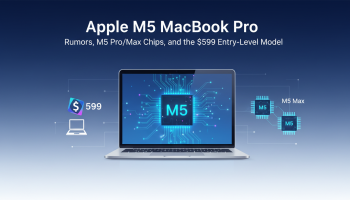
Introduction: The Next Evolution in Apple Silicon
The relentless pace of innovation at Cupertino shows no signs of slowing down. While the M4 generation has only recently cemented its place in the market, the technology world is already turning its gaze toward the next horizon: the Apple M5 MacBook Pro. As Apple Silicon matures, the transition from revolutionary leaps to refined mastery is becoming evident. The M5 generation promises not just raw speed, but a sophisticated balance of thermal efficiency, AI-driven capabilities, and potentially, a complete architectural shift in manufacturing.
For professionals, creative directors, and software engineers, the question is no longer just “how fast is it?” but “how does it change my workflow?” Rumors surrounding the manufacturing process—specifically TSMC's 2nm nodes—suggest that the M5 series could deliver the most significant performance-per-watt jump since the original M1. Furthermore, persistent supply chain whispers about a radically affordable entry-level model have ignited debates about Apple’s strategy for the education and mass market sectors.
In this definitive guide, we analyze the credible rumors, architectural expectations for the M5, M5 Pro, and M5 Max chips, and the viability of the elusive $599 MacBook.
The M5 Chip Architecture: 2nm vs. Enhanced 3nm
The heart of the upcoming Apple M5 MacBook Pro lies in its silicon lithography. Current industry analysis points to a pivotal decision Apple must make regarding its manufacturing partner, TSMC.
The leap to TSMC N2 (2nm)
The Holy Grail for the M5 generation is TSMC's 2nm process (N2). Moving from 3nm to 2nm allows for a higher transistor density, which directly translates to greater computational power without a corresponding increase in energy consumption. If Apple secures early capacity for N2, the M5 chip could offer a 15-20% performance increase at the same power draw as the M4, or up to 30% power reduction at the same speed.
This architectural shift is closely tied to the development of the A-series chips for the iPhone. Often, the Mac lineup benefits from the architectural groundwork laid by mobile processors. Analysts are currently scrutinizing A19 chip benchmarks to extrapolate potential M5 performance, as the shared DNA between these lineups provides the most accurate roadmap for future Mac capabilities.
The N3P Alternative
Should yield rates for 2nm technology face delays, Apple may opt for TSMC's N3P node—a highly refined version of the 3nm process used in the M3 and M4. While less revolutionary than a node shrink, N3P would still offer mature stability and incremental gains, likely focusing on GPU improvements and Neural Engine core counts to support Apple Intelligence features.
M5, M5 Pro, and M5 Max: Performance Predictions
Apple has established a clear tiering system for its “Pro” laptops. Here is what we expect from the SKU breakdown for the Apple M5 MacBook Pro lineup.
The Base M5: The Efficiency Champion
The standard M5 chip is expected to power the entry-level 14-inch MacBook Pro. We anticipate an 8-core CPU (4 performance, 4 efficiency) and a 10-core GPU configuration. However, the real story will be the NPU (Neural Processing Unit). With local AI models becoming standard in macOS, the M5 will likely feature a significantly larger NPU to handle on-device generation tasks instantly.
M5 Pro: The Sweet Spot for Creatives
For video editors using complex timelines in software like Final Cut Pro 11, the M5 Pro will be the target. Expectations include:
- CPU: 12 to 14 cores.
- GPU: 18 to 20 cores with enhanced hardware-accelerated ray tracing.
- Memory Bandwidth: Likely increasing to 150GB/s to prevent bottlenecks in 8K video workflows.
M5 Max: Desktop Power in a Laptop
The M5 Max is predicted to be a graphical monster. With potential support for up to 40 GPU cores and 128GB of Unified Memory, this chip aims to replace high-end desktop towers. The focus here will be on 3D rendering, machine learning model training, and compiling massive codebases. Developers utilizing AI-assisted coding tools, such as the Cursor AI editor, will find the reduced compile times and instant code generation capabilities indispensable.
The $599 Entry-Level Model: Strategy or Fantasy?
Perhaps the most controversial rumor circulating the supply chain is the existence of a low-cost MacBook model, targeting a $599 or $699 price point. This device is ostensibly positioned to combat the dominance of Chromebooks in the education sector.
Design Compromises vs. Apple DNA
To achieve such a price, Apple would need to deviate from its premium aluminum unibody design. Rumors suggest a return to high-quality polycarbonates or a blend of materials. However, skeptics argue that diluting the brand with a “cheap” Mac contradicts Apple’s luxury positioning. More likely, this device—if it exists—would be a revival of the 12-inch MacBook form factor, utilizing older M3 or M4 chips rather than the cutting-edge M5.
We have explored the validity of these claims in our deep dive on rumors of a low-cost MacBook, analyzing how such a device fits into the broader hardware ecosystem.
Design and Display: Is OLED Finally Coming?
While the silicon gets the headlines, the chassis of the Apple M5 MacBook Pro might see subtle yet impactful changes.
The OLED Transition
The iPad Pro has already made the leap to Tandem OLED, offering deeper blacks and higher contrast than Mini-LED. The M5 MacBook Pro is the prime candidate to introduce OLED panels to the Mac lineup. This would reduce display thickness and power consumption, further contributing to battery life gains. However, manufacturing OLED panels at 14-inch and 16-inch sizes with high brightness longevity remains a production hurdle.
Connectivity: Thunderbolt 5
With the M5 Pro and Max, Thunderbolt 5 support is highly probable. Offering up to 80Gbps of bi-directional bandwidth (or 120Gbps for video-intensive tasks), this standard is essential for professionals connecting to multiple high-resolution Pro Display XDRs or high-speed RAID arrays.
Software Integration: macOS and the AI Era
The hardware is only as good as the software it runs. The launch of the M5 MacBook Pro will likely coincide with advanced updates to macOS. We expect deeper integration between iOS and macOS, ensuring seamless continuity.
As we look toward future iOS 26 features, we can anticipate that the Mac will serve as the central hub for local AI processing, offloading heavy tasks from the iPhone to the Mac when devices are tethered or on the same network. This ecosystem synergy is what keeps users locked into Apple’s hardware.
Release Date Timeline
Predicting Apple’s release schedule requires analyzing historical gaps between chip generations:
- M1: November 2020
- M2: June 2022 (approx. 19 months)
- M3: October 2023 (approx. 16 months)
- M4: May 2024 (iPad), Late 2024 (Mac)
Given this accelerating cadence, the Apple M5 MacBook Pro is projected for a late 2025 to early 2026 launch. If TSMC 2nm production faces delays, a generic early 2026 release becomes the most safe bet.
For those deeply invested in the ecosystem, keeping an eye on peripheral rumors, such as the Apple foldable iPhone release date, can provide clues about Apple’s broader hardware roadmap and display technology readiness.
Who Should Upgrade?
Deciding whether to wait for the M5 depends heavily on your current machine.
- Intel Mac Users: The wait is over. Even an M4 is a quantum leap, but the M5 will be future-proof for 5+ years.
- M1 Pro/Max Users: The M5 will finally offer a compelling enough performance jump (2x-3x in some workflows) to justify the cost.
- M3/M4 Users: Unless you need specific NPU capabilities for heavy AI workflows, the upgrade is likely incremental.
Developers preparing for the next wave of software should also consider the best tech stack for 2026, ensuring their hardware can handle the compilation and virtualization demands of future frameworks.
Frequently Asked Questions (FAQ)
When will the Apple M5 MacBook Pro be released?
Based on current supply chain indicators and TSMC production schedules, the M5 MacBook Pro is expected to launch between late 2025 and early 2026.
Will the M5 MacBook Pro have a touchscreen?
While rumors of a touchscreen Mac persist, it is unlikely for the M5 generation. Apple continues to distinguish the Mac from the iPad, preferring to improve trackpad gestures and continuity features instead.
Is the $599 MacBook going to be an M5 model?
Highly unlikely. If Apple releases a budget MacBook, it will almost certainly use older silicon (M3 or M4) and cheaper chassis materials to keep costs down, rather than the flagship M5 chip.
How much faster will the M5 be compared to the M1?
Early estimates suggest the M5 could offer CPU performance that is 60-70% faster than the base M1, with GPU performance potentially doubling or tripling depending on the specific Pro/Max configuration.
Will the M5 chip support 2nm technology?
This is the current industry debate. If TSMC reaches mass production on time, the M5 will be 2nm. If not, it will use an enhanced 3nm (N3P) process, which still offers significant efficiency gains.
Is the M5 MacBook Pro good for gaming?
Yes. With hardware-accelerated ray tracing introduced in M3/M4 and expected to be refined in M5, combined with Apple’s Game Porting Toolkit, the M5 MacBook Pro is becoming a serious platform for AAA gaming.
Conclusion: The Future of Mobile Computing
The Apple M5 MacBook Pro represents more than just a spec bump; it signifies the maturation of the ARM-on-desktop era. Whether powered by 2nm architecture or a perfected 3nm process, the M5 is poised to redefine efficiency and power for professional users. While the allure of a $599 entry-level model remains a tantalizing possibility for the education market, the core focus of the M5 Pro and Max remains steadfast: delivering unrivaled performance for creators and developers.
As we approach 2026, the gap between desktop workstations and mobile laptops continues to vanish. For those holding onto older machines, the M5 generation appears to be the definitive upgrade point, promising a device that is not only powerful enough for today’s tasks but ready for the AI-driven future of tomorrow.

Editor at XS One Consultants, sharing insights and strategies to help businesses grow and succeed.