
Blog

What is
the Best Tech Stack for 2026?: Choosing the Best Architecture for Scalable Applications
Introduction: Navigating the Architectural Shift of 2026 Contents hide
1 Introduction: Navigating the Architectural Shift of 2026
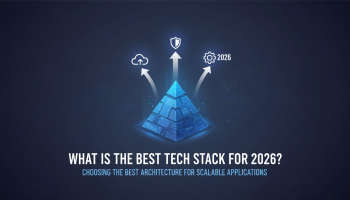
The digital landscape is no longer shifting; it has fundamentally transformed. As we approach 2026, the question "What is the best tech stack?" has moved beyond simple language comparisons. It is now a strategic inquiry into AI integration, edge computing, and sustainable scalability. In 2026, a tech stack is not just a collection of tools—it is the backbone of business resilience.
For CTOs, product managers, and lead developers, the stakes have never been higher. The decisions made today regarding frontend frameworks, backend logic, and database architecture will dictate an application’s ability to handle the massive concurrency and latency demands of the AI-native web. The era of the monolithic versus microservices debate is maturing into a nuanced understanding of modular monoliths, serverless 2.0, and edge-first delivery.
This comprehensive guide dissects the best tech stack for 2026, analyzing the architectures that prioritize developer experience (DX), performance, and future-proof scalability. Whether you are building a high-frequency trading platform or a global SaaS solution, understanding these choices is critical for survival in a hyper-competitive market.
Core Criteria: What Defines a "Winning" Stack in 2026?
Before diving into specific technologies, we must establish the criteria that define excellence in the 2026 ecosystem. A modern tech stack must score high on four specific vectors:
- AI-Readiness: The ability to seamlessly integrate Large Language Models (LLMs) and vector search without refactoring the entire backend.
- Edge-First Performance: Users in 2026 expect near-zero latency. Static assets and compute logic must reside as close to the user as possible.
- Type Safety & Robustness: With the complexity of modern apps, loosely typed languages are becoming a liability. Strong typing (e.g., TypeScript, Rust, Go) is the industry standard.
- Ecosystem Longevity: Choosing tools with active governance, regular security patches, and a thriving community to prevent technical bankruptcy.
The Best Tech Stack for 2026: Top Architectures Ranked
There is no single "perfect" stack, but there are dominant architectures that have proven superior for specific use cases. Below are the top contenders for 2026.
1. The Modern Enterprise Standard: The "T3+" Stack
Components: Next.js (App Router), TypeScript, Tailwind CSS, Serverless (AWS Lambda/Vercel), PostgreSQL.
This is the definitive general-purpose stack for 2026. Evolving from the popular T3 stack, this architecture dominates the SaaS and Enterprise web application space. It balances rapid development with extreme scalability.
- Why it Wins: Next.js has solidified its position as the operating system for the web. Its hybrid rendering (Server Components + Client Components) solves the SEO and performance bottlenecks of traditional SPAs (Single Page Applications).
- Key Feature: TypeScript is non-negotiable here. It provides the safety net required for large teams to ship code confidently without regression bugs.
- Database: PostgreSQL remains the king of relational data, but in 2026, it is often consumed via serverless drivers (like Neon or Supabase) that scale down to zero when unused.
2. The AI-Native Powerhouse Stack
Components: Python (FastAPI), React, Pinecone (Vector DB), LangChain, Docker.
For applications where Artificial Intelligence is the core value proposition, this is the best tech stack 2026 has to offer. While JavaScript dominates the web, Python owns AI.
- Why it Wins: The seamless bridge between ML libraries (PyTorch, TensorFlow) and the API layer using FastAPI allows for high-performance inference.
- Key Feature: Vector Databases (like Pinecone or Weaviate) are first-class citizens here, acting as the long-term memory for AI agents.
- Architecture: Often deploys the frontend on the Edge (Vercel/Cloudflare) while keeping the Python backend containerized in a GPU-optimized environment.
3. The Performance & Concurrency Stack
Components: Go (Golang) or Rust, SvelteKit, gRPC, Redis.
When milliseconds translate to millions of dollars (e.g., Fintech, Real-time Analytics), the overhead of a Node.js runtime or a virtual DOM is unacceptable. This stack is built for raw speed.
- Why it Wins: Go provides high throughput with low latency, handling thousands of concurrent connections effortlessly via goroutines. Rust offers memory safety without garbage collection, eliminating reliable latency spikes.
- Key Feature: SvelteKit compiles components away, resulting in tiny bundles and instant load times, contrasting with the heavy hydration costs of larger React apps.
- Communication: gRPC replaces REST to minimize payload size and parsing time between microservices.
Frontend Evolution: Beyond the Virtual DOM
In 2026, the frontend landscape has shifted from "how do we organize code" to "how do we ship less JavaScript." The era of sending massive JSON blobs and hydrating the entire page is fading.
The Rise of Resumability and Signals
Frameworks utilizing Signals (SolidJS, Qwik, Preact) have gained massive traction. Unlike React’s Virtual DOM which re-renders component trees, Signals offer fine-grained reactivity. This means when a variable changes, only the specific text node bound to it updates—not the entire component.
- Qwik leads the charge in "Resumability," allowing apps to start execution on the server and resume on the client without re-downloading or re-executing hydration logic. This is critical for mobile performance in 2026.
Backend Transformation: Serverless 2.0 and the Modular Monolith
The blind rush to Microservices has slowed. In 2026, the industry appreciates the Modular Monolith—building a unified codebase that is separated logically, not physically, until scale dictates a split.
Infrastructure as Code (IaC) is Default
Modern backends are defined by code, not manual console clicks. Tools like Terraform and Pulumi (allowing infrastructure definition in TypeScript/Python) are standard. The backend of 2026 is often "Cloud-Native," utilizing managed services for caching, queues, and auth, reducing the operational burden on dev teams.
Database Dynamics: The Convergence of SQL and Vector
Data storage has seen the most radical change due to GenAI. The strict separation between Relational (SQL) and Non-Relational (NoSQL) is blurring.
- pgvector: PostgreSQL has adapted by adding vector similarity search capabilities, allowing teams to keep their relational data and AI embeddings in the same place.
- NewSQL: Databases like CockroachDB offer the horizontal scalability of NoSQL with the transactional guarantees (ACID) of SQL, essential for global applications in 2026.
Strategic Implementation: Choosing the Right Path
Selecting the stack is only step one; implementation is where battles are won or lost. In 2026, companies typically follow one of three paths:
- The Full Custom Build: Utilizing the stacks mentioned above for maximum control and IP ownership. Best for core products.
- The Low-Code/No-Code Hybrid: using platforms for internal tools while reserving high-code stacks for customer-facing apps.
- Composable Architecture: Buying best-in-class APIs (Auth0 for identity, Stripe for payments, Contentful for CMS) and gluing them together with a meta-framework like Next.js.
Frequently Asked Questions (FAQ)
1. What is the absolute best tech stack for a startup in 2026?
For most startups, the T3 Stack (Next.js, TypeScript, Tailwind, Prisma/Postgres) is unbeatable. It offers the widest talent pool, rapid iteration speed, and massive ecosystem support, allowing you to validate ideas quickly without hitting performance walls early on.
2. Is the MERN stack dead in 2026?
The MERN stack (MongoDB, Express, React, Node) is not dead, but it has evolved. "Raw" React and Express are less common for new enterprise projects. They are being replaced by meta-frameworks like Next.js (which uses React) and strictly typed backends like NestJS or serverless functions.
3. Should I use Microservices or a Monolith in 2026?
Start with a Modular Monolith. The complexity overhead of microservices (networking, observability, eventual consistency) is rarely justified for applications with fewer than 50 developers. You can split services out later if specific scalability bottlenecks arise.
4. Why is TypeScript considered mandatory now?
As web applications scale, untyped JavaScript leads to "undefined is not a function" runtime errors that cost businesses millions. TypeScript catches these errors at compile time. In 2026, TypeScript is treated as the default setting for professional web development.
5. How does AI impact my tech stack choice?
If your app requires AI features, your backend must support efficient handling of long-running requests (for LLM generation) and vector data. This often means integrating Python services or using edge-functions with streaming capabilities to prevent timeouts.
6. React Native vs. Flutter: Which is better for mobile in 2026?
Both remain strong. React Native is preferred if you have a strong web team (due to React synergy). Flutter is preferred for highly graphical, brand-heavy apps where pixel-perfect rendering across devices is the top priority. React Native’s new architecture (Fabric) has largely closed the performance gap.
Conclusion: Future-Proofing Your Architecture
The best tech stack for 2026 is not simply the one with the most GitHub stars—it is the one that aligns with your business velocity and scalability requirements. We are seeing a convergence toward type-safe, edge-optimized, and AI-ready architectures.
While the allure of the "new and shiny" is strong, the winners of 2026 will be those who choose stable, proven foundations like Next.js and PostgreSQL while strategically adopting cutting-edge advancements in AI and Edge computing. Whether you choose the robustness of Rust or the agility of the T3 stack, ensure your architecture is built to adapt, not just to exist.

Editor at XS One Consultants, sharing insights and strategies to help businesses grow and succeed.