

Blog

How Much
Does It Cost to Build a Website for a Corporate Event Planner?
As a corporate event planner—organising conferences, product launches, team-building
retreats, gala dinners—your website is far more than
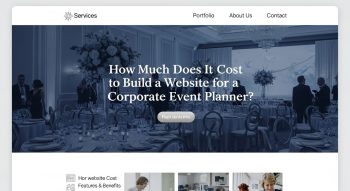
As a corporate event planner—organising conferences, product launches, team-building retreats, gala dinners—your website is far more than an online brochure. It must fulfil several strategic roles:
-
Showcase your services and expertise: From full event conception to logistics, production, and post-event wrap-up, your site should reflect your capabilities.
-
Present a strong portfolio: Clients (companies, associations, brands) will expect to see past events, venues you’ve worked with, types of events (corporate, hybrid, virtual).
-
Build credibility & trust: For corporate clients, trust matters deeply—your brand, visuals, testimonials, case studies must convey professionalism, scale, reliability.
-
Lead generation & conversion: The objective is often “company visits site → submits RFP/enquiry”. So you’ll need clear calls-to-action (“Request a proposal”, “Schedule a consultation”), contact forms, perhaps downloadables (event planning checklist).
-
High-quality visuals & media: Because events are visually driven (venues, set-ups, branding, attendees), the website should support images, videos, event highlight reels, maybe animations.
-
Responsive/Mobile & performance ready: Many decision-makers view sites on tablets/phones. A mobile-friendly, fast loading site is important.
-
Scalable & content-rich: Over time you’ll add new event types, case studies, blog posts (industry insights), maybe client portals. So the platform should allow growth.
Given all these functions, your website is not a simple one-page site—it needs real substance and thus the budget needs to reflect that.
Typical Cost Range for a Corporate Event Planner Website
Using small business website cost benchmarks and adjusting for the event-planning niche:
-
One web cost guide gives the average small business site cost as US $500 to US $3,000 depending on features and complexity.
-
For a website for a corporate event planning business — which will likely need strong visuals, service pages, portfolio/case studies, contact/lead capture forms — a realistic budget would be approximately:
-
Basic site: ~$1,000 to ~$1,500 USD
-
Professional service site: ~$1,500 to ~$3,000 USD
-
Advanced site (high-end visuals, case study library, client portal, blog/industry insights): ~$3,000 to ~$5,000+ USD
-
-
So, a practical range might be:
-
Basic launch website: ~$1,000-1,500
-
Standard professional website: ~$1,500-3,000
-
Advanced platform website: ~$3,000-5,000+
-
Of course the actual cost depends on number of pages, media (images/videos), design customisation, features required, and your region.
Breakdown of Cost Components
Here’s how your budget might break down and what you’re paying for each component.
Domain & Hosting
-
Domain name (e.g., yourcompanyevents.com): ~$10-30/year.
-
Hosting + SSL certificate: Because you’ll have media (photo galleries, maybe video) and expect a professional performance level, estimate ~$100-300/year depending on traffic and storage.
These are foundational but relatively modest compared to design/development.
Design & Branding
-
Visual look and feel matter a lot: your brand must convey corporate sophistication and event-production capability.
-
Whether you use a premium theme/customise or full custom design affects cost.
-
Estimate: ~$500-1,200 depending on how custom the design is, how many visuals (hero images, video background) you incorporate.
Development & Functionality
-
Building the site (CMS like WordPress or a website builder) with pages such as: Home, About Us, Services (event planning, production, virtual/hybrid events), Portfolio/Case Studies, Testimonials, Blog/Insights, Contact/Request Proposal.
-
Key features might include: portfolio gallery (filterable by event type), embedded videos, case study pages, contact/enquiry form, maybe downloadables (event checklist), mobile responsiveness, speed optimisation.
-
Estimate: ~$700-1,800 depending on number of pages and features.
Content Creation & Copywriting
-
Good copy is essential: your story, services, value proposition (“Corporate event planners for brands”, “Virtual & hybrid conference specialists”), case study narratives, CTA.
-
Also your blog/insights content helps with SEO and thought-leadership.
-
Estimate: ~$300-600 depending on pages and whether you outsource writing.
SEO & On-Page Optimisation
-
Keyword research (e.g., “corporate event planner [city]”, “hybrid event production services”), meta titles, alt text for images, heading structure, internal linking, blog posts.
-
Helps you appear in search results when companies seek event planners.
-
Estimate: ~$150-400 initial setup.
Maintenance & Ongoing Costs
-
After launch: hosting/domain renewals, plugin/theme updates, backups, adding new portfolio items, blog posts, security updates.
-
Estimate: ~$150-$300/year for a modest site; could be higher if you add client portal or large media library.
Key Features a Corporate Event Planner Website Should Include
To ensure your website is effective and conversion-friendly for a corporate event-planning business, include:
-
Home Page: Hero image or short video of a major event you managed, strong headline (“We plan unforgettable corporate events & conferences”), sub-headline, primary call-to-action (“See our work”, “Request a proposal”).
-
About / Company Page: Your story, team, experience (number of events, brands served), your process, certifications or industry affiliations. Builds credibility.
-
Services Page(s): Detailing your offerings: event strategy & concept, full production, hybrid/virtual events, venue sourcing, logistics, audiovisual & staging, on-site management. Each service should describe benefits, outcome for client.
-
Portfolio / Case Studies Page: Showcase past events: event name (client brand or anonymised if necessary), event type, location, size, services provided, outcome/highlights (photos/videos). Helps prospective clients visualise your work.
-
Testimonials / Clients Page: Quotes from past corporate clients, brands, association organisers, client logos (if approved) to boost trust.
-
Blog / Insights Page: Articles on event trends (“Top hybrid event trends 2025”, “How to choose a venue for your corporate gala”), case studies, tips for client companies — helps SEO and positions you as expert.
-
Contact / Request Proposal Page: Simple form (company name, size of event, dates, message), your contact info (phone/email), maybe calendar for consultation. Clear CTA.
-
Responsive & Mobile Optimised Design: Decision-makers might browse on phones/tablets; site must look good and load fast on mobile.
-
SEO-Friendly Structure: Use keywords in page titles (e.g., “Corporate Event Planner in [Region]”), alt text for images (“brand launch event stage setup”), internal linking, blog posts linking to service pages.
-
Optional Advanced Features:
-
Client-login portal for existing clients (documents, timelines, event status)
-
Event gallery filtering by event type or industry
-
Downloadable resources (checklists for corporate event planning, white papers)
-
Multi-language version (if you serve international clients)
-
Integration with CRM or inquiry management system
-
Video background or interactive elements
-
What Drives Costs Up or Down?
Costs Increase When You:
-
Have many service pages (each for different event types: corporate, association, hybrid, virtual, social)
-
Include heavy media (video highlight reels, large image galleries) requiring more advanced hosting or custom layouts
-
Require advanced features like client portals, downloadable resources, multi-language, CRM integration, video backgrounds, animations
-
Need high customisation of design/UI/UX instead of using a regular template
-
Serve international clients or multiple regions requiring localisation
-
Hire a full-service agency rather than a simpler template + freelancer build
Costs Decrease When You:
-
Use a premium theme/template and customise it lightly rather than full custom design
-
Keep number of pages modest at launch (Home, About, Services, Portfolio, Contact) and expand later
-
Provide your own content/images (you supply case study photos/videos) rather than outsource everything
-
Use external video hosting (YouTube/Vimeo) and embed rather than hosting heavy videos yourself
-
Delay advanced features (client portal, multi-language) until you have revenue and validated need
-
Use WordPress or cost-effective builder platform rather than full custom from scratch
Example Cost Scenarios
Scenario A – Basic Website (~US $1,000-1,500)
-
Pages: Home, About, Services (one main service: corporate event planning), Portfolio (a few past events), Contact/Request Form.
-
Template design with minimal customisation.
-
Few images you supply, minimal video.
-
No client portal, no downloadable resources, blog section maybe basic or omitted.
-
Basic SEO and mobile-responsive design.
This works for a solo event planner or small agency just starting who wants an online presence and simple lead capture.
Scenario B – Professional Service Website (~US $1,500-3,000)
-
Pages: Home, About, Services (several packages: corporate, hybrid, virtual), Portfolio/Case Studies (multiple events), Testimonials/Clients, Blog/Insights (few posts), Contact/Request Proposal form.
-
Custom branding visuals (logo/colour palette), better photography, some video highlight.
-
Mobile responsive, good copywriting and initial SEO configuration.
-
Possibly downloadable guide or checklist for prospective clients.
This suits a small event planning firm looking to scale, present professionalism, and convert higher-value corporate clients.
Scenario C – Advanced Platform Website (~US $3,000-5,000+)
-
Pages: Home, About, Services (multiple categories), Portfolio/Case Studies (extensive gallery + video), Testimonials/Clients, Blog/Insights archive, Resources/Downloadables, Client Portal (secure login), Multi-language version, Integration with CRM/email marketing.
-
Fully custom UI/UX design, animations, video backgrounds, high performance hosting for media.
-
Thorough SEO/content strategy, interactive elements, perhaps event registration or hybrid event microsite integration.
This works for an established corporate event planning agency serving large corporate clients or multiple industries, offering a full digital experience and branding.
How to Budget & Choose Wisely
-
Define your scope clearly: Decide which pages and features you need immediately (Home, Services, Portfolio, Contact) and which can wait (client portal, multi-language, downloads).
-
Request detailed quotes: From freelancers or agencies, ask for itemised breakdown (design cost, development cost, content/copywriting, SEO, hosting).
-
Focus your budget on conversion: For an event planner the key metric is “visitor → enquiry/RFP”. So invest in strong visuals (portfolio/case studies), clear service pages, trust signals (testimonials), and simple enquiry path.
-
Pick a designer/developer with relevant experience: Someone who has built for service businesses or event industry is preferable — they’ll understand gallery optimisation, lead capture, client-facing features.
-
Plan for ongoing costs: Hosting, domain renewal, updates, adding new case studies, blog posts, maintenance.
-
Use a scalable platform: WordPress or equivalent with ability to expand pages or add features later away from full rebuild.
-
Start lean and grow: Launch with core features now and add advanced features over time (client portal, resources, multi-language) once your business is generating revenue.
SEO & Visibility Considerations
Since corporate clients will often search for event planners, your website must be optimised and visible.
Keywords you might target:
-
corporate event planner [city/region]
-
corporate event management company [city]
-
hybrid event planner services
-
corporate gala event planner
-
conference & meeting planning services
Supporting semantic keywords:
-
corporate event logistics
-
virtual/hybrid event production
-
conference planning agency
-
event programme design
-
brand activation events
On-page SEO practices:
-
Use your main keyword in page title & H1 (e.g. “Corporate Event Planner – [Company Name]”).
-
Service pages targeting specific niches (conference planning, product launch events, hybrid events).
-
Portfolio/case study pages with descriptive text (search engines don’t “see” images/videos).
-
Alt text for images: e.g., “corporate annual gala stage setup”, “product launch event AV rig”.
-
Blog/Insights page: articles like “How to plan a hybrid corporate event 2025”, “Top trends in corporate event technology”, “Checklist for product launch event”. These attract organic traffic and position you as expert.
-
Mobile-friendly and fast: many users on mobile; also speed is a ranking factor.
-
Internal linking: blog posts link to services, portfolio pages to contact form.
-
Strong call-to-action on each page: “Request your corporate event proposal”, “See our case studies”, “Download event checklist”. Helps conversion and signals engagement to search engines.
-
Localisation if you serve a particular city/region: include location keywords (e.g., “corporate event planner Karachi”, “event production Lahore”), address/contact details.
-
Testimonials/clients: client logos, names, quotes — help with trust, user behaviour metrics (dwell time, bounce rate) which in turn support SEO.
Final Thoughts
Building a website for your corporate event planning business is a strategic investment, not just a one-time expense. When done well, the website becomes your portfolio, credibility builder, lead generation engine, and marketing hub.
Here’s a summary of budget expectations:
-
Basic website: ~$1,000 – ~$1,500 USD
-
Professional service website: ~$1,500 – ~$3,000 USD
-
Advanced digital platform: ~$3,000 – ~$5,000+ USD
Your actual cost will depend on how many pages/features you need (case studies, blog, client portal), how custom your design/branding is, how much media (images/videos) you host, whether you integrate advanced features (client login, downloads, multi-language), how much copywriting/SEO you plan, and what hosting performance you need.
Focus your budget on what actually supports your business growth:
-
Showcase compelling past events (strong visual & narrative)
-
Service pages that articulate your competencies and value for corporate clients
-
Credibility elements (case studies, testimonials, client logos)
-
A clear enquiry/lead capture path
-
Mobile-friendly, fast-loading site that delivers professionalism
-
SEO-ready architecture and content so corporate clients find you
Select a web partner who understands service-industry businesses and preferably event or creative sectors, because they’ll know how to showcase portfolios and convert visitors into clients effectively.

He is a SaaS-focused writer and the author of Xsone Consultants, sharing insights on digital transformation, cloud solutions, and the evolving SaaS landscape.