

Blog

How Much
Does It Cost to Build a Website for a Travel Agency?
If you’re running a travel agency—whether you arrange tours,
book flights/hotels, run group travel or specialise in
If you’re running a travel agency—whether you arrange tours, book flights/hotels, run group travel or specialise in luxury or niche destinations—your website is your digital storefront and booking engine. It must do multiple jobs:
-
Showcase destinations and travel packages: clients browse visuals, itineraries, pricing.
-
Build trust and credibility: people spend significant money and expect professionalism. The design, imagery, UX all matter.
-
Lead generation & booking: Your site must convert visitors into inquiries/bookings. Possibly integrate with booking engine, payment gateway.
-
Content & search visibility: People search for “best tours to Italy”, “family beach holiday [region]”, etc. You need SEO‑friendly content to appear.
-
Responsive / mobile‑friendly: Many travellers browse on mobile; speed and UX are critical.
-
Scalable platform: Over time you’ll add more packages, destinations, maybe integrate supplier APIs, tour booking, dynamic pricing.
Because of these roles, the website isn’t just a simple brochure—it’s a business asset. That means budget should reflect both design & functionality.
Typical Cost Range for a Travel Agency Website
Based on recent industry data:
-
According to one guide, the cost to build a travel agency website ranges from $200 for a basic DIY solution up to $70,000+ for custom enterprise platforms, with most professional travel agencies investing between US$2,000‑$15,000 for a fully functional booking‑enabled website in 2026.
-
A startup cost overview shows website development for a travel agency generally falls in the US$1,500‑$10,000 range depending on complexity.
-
For a boutique agency: a custom site may cost US$2,000‑$5,000 or more.
-
A simpler site (template, minimal features) may cost from US$500‑$3,000.
Rough guideline
-
Basic brochure‑style website (small travel agency, few pages, no booking engine): ~$500‑$1,500
-
Professional website with core travel features (packages, gallery, enquiry/booking form, mobile friendly): ~$2,000‑$6,000
-
Advanced travel platform (booking engine, supplier API integration, multi‑language, dynamic pricing, user‑account/portal): ~$10,000+ (sometimes $15,000‑$30,000 or more)
Breakdown of Cost Components
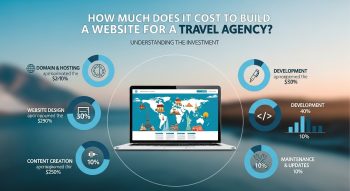
Let’s examine what drives cost and where your budget will be allocated.
1. Domain & Hosting
-
Domain name: perhaps ~$10‑50/year.
-
Hosting + SSL certificate: For a travel agency with many pages/media, you want reliable hosting. According to one source, hosting may cost $50‑$500/year depending on performance and traffic.
These are baseline but don’t dominate your budget.
2. Design & Branding
-
A professional design is essential: high‑quality visuals, image galleries of destinations, clean UX, mobile responsiveness.
-
Template usage vs custom design: Templates lower cost; fully bespoke raises cost significantly.
-
One guide estimates design costs for travel sites: ~$2,000‑$15,000 depending on complexity.
3. Development & Functionality
-
Pages: Home, About Us, Services/Packages, Destination Gallery, Blog/Articles, Contact/Booking.
-
Key features:
-
Package listing with filters
-
Enquiry or booking form
-
Payment gateway (if directly taking payments)
-
Possibly supplier/flight/hotel integration or inventory management
-
Search & filter for travel packages
-
Blog/SEO content support
-
Mobile & responsive design
-
-
According to cost breakdowns: front‑end and back‑end development for travel sites may be thousands to tens of thousands.
4. Content Creation & Copywriting
-
Travel websites need good quality content: destination descriptions, package details, imagery, blog posts “Top 10 beaches in Thailand”, etc.
-
One guide lists content creation costs as high as $1,000‑$10,000 for professional photography/ video/ copywriting.
-
To attract organic traffic, you’ll need keyword research (e.g., “family safari tour [region]”, “luxury cruise Europe”), meta tags, alt text for images, fast load times, mobile optimization.
-
One startup cost table lists initial website development and maintenance costs; SEO is included in ongoing costs.
6. Booking Engine/API Integration
-
If your travel agency offers real‑time bookings (flights, hotels, activities), you may require supplier API integration, inventory management, payment gateways. This can significantly increase cost. One guide lists booking system setup maybe $1,000‑$10,000 in development.
7. Maintenance & Ongoing Costs
-
After launch you’ll still pay for hosting/domain renewals, plugin/theme updates, security patches, new content. One guide notes maintenance & updates for travel portals.
Key Features a Travel Agency Website Should Include
To make sure your investment delivers results, your site should incorporate the following features:
-
Homepage: Eye‑catching hero image or slideshow of destinations, clear value proposition (“Custom luxury tours to Southeast Asia”), call‑to‑action (“Discover our next big trip”, “Get a quote”).
-
Destination/Packages Page: Listing of travel packages (destination, duration, price, highlights, image gallery) with filters by region, price, theme (luxury, adventure, family).
-
Booking/Enquiry & Payment page: Enquiry form or booking engine allowing clients to book/travel‑quote; payment processing if applicable.
-
Gallery & Media Page: High quality images, destination galleries, maybe video clips of past tours. Helps build trust and engagement.
-
About Us Page: Your agency story, credentials, team, why travelers should choose you.
-
Blog/Resources Page: Travel articles, tips, destination guides, “how to choose your travel insurance”, etc. Helps SEO and positions you as expert.
-
Testimonials/Reviews Page: Customer reviews, ratings, photos of happy travellers. Social proof is vital in travel business.
-
Contact Page: Contact form, office address, phone number, map (if you have physical office), email.
-
Responsive & Mobile Optimised Design: Since many travellers research on mobile, site must look and perform great on phones and tablets.
-
SEO Friendly Structure: Keywords in titles, headings, alt text for images, internal linking, fast page speed, mobile UX.
-
Optional Advanced Features:
-
Live chat support
-
CRM integration for travel leads
-
Multi‑language support if you serve international clients
-
Real‑time booking and payments
-
Member login or client portal (for returning travellers, accounts)
-
Interactive itinerary builder
-
What Drives Costs Up or Down?
Costs Increase When You:
-
Offer many bookings/features: realtime inventory, API integrations, payment gateways, dynamic packages
-
Use lots of media (photos/videos), large galleries that require high performance hosting
-
Provide many pages or destinations, multilingual versions
-
Want custom design/UX, animations, custom booking workflows
-
Require e‑commerce or membership/portal functionality
-
Target large traffic volumes requiring premium hosting/CDN
-
Choose high‑end agency rather than template/freelancer
Costs Decrease When You:
-
Use premium theme or website builder rather than full custom design
-
Limit pages at launch (e.g., Home, About, Packages, Contact) and expand later
-
Provide your own content/images and avoid heavy custom multimedia
-
Host videos externally (YouTube/Vimeo) and embed rather than self‑host large files
-
Delay advanced features (portal, custom booking engine) until after launch
-
Use a website builder (Wix, Squarespace) or WordPress + plugin for cost‑effective solution
Example Cost Scenarios
Scenario A – Basic Travel Agency Website (~US$500‑1,500)
-
Suitable for a small agency or independent travel consultant.
-
Pages: Home, About, Packages (a few), Contact/Enquiry.
-
Template design with minor customization. No booking engine, just enquiry form.
-
Basic mobile responsive, simple gallery, minimal copywriting.
This gives you an online presence to collect leads and showcase services.
Scenario B – Professional Travel Agency Website (~US$2,000‑6,000)
-
Pages: Home, About, Packages (many), Destination Gallery, Blog/Resources, Testimonials, Contact/Booking form.
-
Custom branding visuals, professional copywriting, mobile friendly.
-
Possibly payment or booking plugin for simple bookings.
This is ideal for a travel agency aiming to attract more clients, show professionalism and convert leads.
Scenario C – Advanced Travel Platform (~US$10,000+ or more)
-
Many pages/destinations, multilingual, full booking engine with inventory management, payment gateway, user accounts, CRM integration, heavy media (video tours), custom UI/UX.
-
Hosting and maintenance higher due to traffic and media.
-
Suitable for a full‑fledged travel portal or operator looking for growth, high traffic, complex functionality.
How to Budget & Choose Wisely
-
Define your scope early: What pages do you need now? What features are must‑have now vs nice‑to‑have later?
-
Get detailed quotes: Ask for itemised breakdowns (design, development, content, booking engine, hosting).
-
Focus on conversion: For a travel site key conversion is “visitor → enquiry/booking”. Invest in strong visuals, clear CTA, good UX.
-
Review designer/developer portfolio: Choose someone experienced in travel or similar service‑industry websites.
-
Plan for ongoing costs: Hosting, domain renewals, maintenance, content updates, SEO.
-
Use scalable platform: WordPress with travel plugins or builder platform, so you can expand later without full rebuild.
-
Start lean and expand: Launch with core pages/features, add booking engine or inventory later when you have clients.
SEO & Visibility Considerations
Given that travellers search for packages and destinations, SEO is essential.
-
Target keywords such as: “travel agency [city]”, “holiday packages [destination]”, “luxury travel tours [region]”, “family beach holiday deals”.
-
Use supporting terms: destination names, types of tours (adventure, honeymoon), reviews, travel blog topics.
-
Blog or resource section: helps you rank for long‑tail queries (“best time to visit Bali”, “budget safari Kenya tips”).
-
Ensure images have alt text (“family beach holiday Maldives”), headings are descriptive, meta titles and descriptions are optimised.
-
Page speed and mobile performance matter a lot (many travel searches on mobile).
-
Use internal linking (blog → package page → contact), and social proof (reviews/testimonials).
-
If you serve local markets, include local SEO: location in title/meta, Google My Business if you have physical office.
Final Thoughts
Building a website for a travel agency is a strategic investment, not just a cost. Your website will be your main digital asset for attracting clients, showcasing your packages, converting bookings, and building credibility.
Quick summary of budget expectations:
-
Basic site: ~$500 ‑ $1,500
-
Professional site: ~$2,000 ‑ $6,000
-
Advanced platform site: ~$10,000+ (and can go much higher depending on complexity)
Your actual cost depends on: number of pages, amount of media (photos/videos), whether you integrate booking/inventory, how custom the design is, hosting/traffic requirements, and your SEO/content plan.
Focus your budget on:
-
Clear and compelling package presentation and visuals
-
Strong user experience and easy contact/booking process
-
Mobile‑friendly and fast performance
-
SEO‑optimized content and structure
Start with a core site that works and expands as you grow. Choose developers/designers who understand travel business needs, booking flows and media heavy sites.

He is a SaaS-focused writer and the author of Xsone Consultants, sharing insights on digital transformation, cloud solutions, and the evolving SaaS landscape.