

Blog

How Much
Does It Cost to Make a Website for an Online Language School?
An online language school isn’t just offering lessons—it’s building
an educational brand that needs to convey credibility,
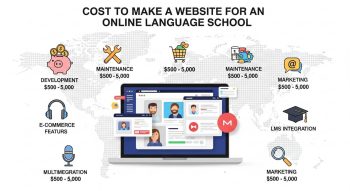
An online language school isn’t just offering lessons—it’s building an educational brand that needs to convey credibility, ease of access, and quality instruction to potential students across geographies. A professional website plays several critical roles:
-
It acts as your digital storefront, where prospective learners (or parents) come to evaluate your courses, tutors, methodology, and platform.
-
It helps with visibility and SEO: people search for phrases like “online English school”, “learn Spanish online live tutor”, “language classes online for adults”. If your site is well-optimized you’ll be found.
-
It enables enrolment and conversion: you need features like course lists, schedules, tutor profiles, bookings, payment integration, maybe free trial sign-up.
-
It builds trust and brand identity: showing your curriculum, tutor bios, testimonials, certifications, multimedia samples (videos of classes), clear pricing.
-
It provides scalability: as you grow you may add many languages, levels, interactive features (live chat, video sessions, downloadable resources, membership portals).
Because of these needs, the website for an online language school is more than a simple brochure site—it often has functional requirements that affect cost.
What Does It Typically Cost?
From industry data for small business websites:
-
A small business website might cost anywhere from about US $500 to US $3,000+ depending on complexity.
-
More fully-featured sites—with custom design, many pages, special functionality—can go into the US $5,000+ range.
-
A regional reference (for Pakistan specifically) suggests a basic small business website might run PKR 30,000-100,000 (~US $170-570 at current rates) and more advanced sites PKR 100,000-350,000 (~US $570-2,000).
For an online language school, given added features (booking, multiple course pages, tutor profiles, possibly membership/portal), a reasonable budget would be around US $2,000 to US $4,000 for a professional launch site. If you require very advanced interactive features, you might budget more (US $4,000-6,000+).
Breakdown of Cost Components
Here’s a more detailed breakdown of what you’ll likely pay for, how much, and why.
Domain & Hosting
-
Domain name: ~$10-30/year for standard “.com” domain.
-
Hosting & SSL certificate: For a site with live lessons, maybe more traffic, you’ll want reliable performance. Shared hosting could cost ~$100-300/year; if higher traffic or video sessions maybe more.
These are foundational but relatively low compared with design/development.
Design & Branding
-
Branding, logo, icons, colour scheme: important to appear professional, especially in education.
-
Website design: You might choose a template (lower cost) or a custom design (higher cost).
-
Responsive/mobile design: Essential, since many learners will use mobile devices.
Design alone might cost anywhere from ~$500 (simple template) to ~$1,500 or more (custom) depending on how polished you want.
Pages & Content
For an online language school you’ll likely need several standard pages:
-
Home page
-
About Us (school mission, tutors)
-
Courses/Programs page(s) (languages offered, levels, format)
-
Tutor profiles page
-
Pricing/Packages page
-
Schedule/Booking page
-
Blog/Resources (optional but good for SEO)
-
Contact page
The number of pages and depth of content affect cost: more pages = more design/development/time.
Functionality & Features
This is where costs can increase significantly based on your needs:
-
Course listing & detail pages: showing each language, level, maybe sample lesson.
-
Booking or scheduling system: students pick a class/time, reserve or enrol.
-
Payment integration: accepting payments online (for courses, subscriptions).
-
Student/tutor portal: login, view past lessons, resources, maybe video archive.
-
Live video integration: if you embed live classes or integrate with Zoom/other platforms.
-
Blog/Resource section: to attract organic traffic through content marketing.
-
Multilingual interface: if you target multiple language speakers or geographies.
-
SEO setup, performance optimisation, security.
Each added functionality adds to cost (development hours, possible plugin/licensing costs).
Content Creation & Copywriting
-
Clear, persuasive copy for each page: e.g., describing your language programs, methodology, tutor credentials.
-
SEO-optimised content for keywords like “online language school”, “learn French online with tutor”, “Spanish classes virtual”.
-
Blog posts or resource pages (helpful for SEO and authority).
Depending on volume, professional copywriting might run ~$200-$600+.
SEO & Performance Optimisation
-
Keyword research, meta tags, alt text for images, sitemap, mobile optimisation.
-
Ensuring site is fast loading, especially if many media elements (images/videos).
-
Possibly initial link outreach or blog content to give you some traction.
Budget perhaps ~$150-$400 for initial setup.
Maintenance & Ongoing Costs
-
Hosting/domain renewal.
-
Plugin updates, security patches, backups.
-
Content updates and blog management if you choose to keep it active.
-
Feature updates (adding new courses, languages, portal enhancements).
Yearly maintenance might cost ~$100-$500 depending on complexity.
Features That Matter Most for an Online Language School
When building a website for an online language school, here are features you’ll want to include from the start (to ensure your site works well and converts visitors into students):
-
Clear value proposition: On the homepage, state “Learn [language] online with expert tutors”, show what makes you different (native speakers, flexible schedule, small groups, certification).
-
Course overview page: List offered languages, levels (beginner to advanced), format (live classes, one-on-one, group).
-
Tutor profiles: With photos, bios, experience, testimonials. Builds trust.
-
Schedule/booking: Allow students to view upcoming classes, book/enrol.
-
Pricing/packages: Transparent pricing – e.g., “4 lessons per month”, “Subscription plan”, free trial.
-
Student portal/login (optional): Access class materials, download resources, watch recorded sessions.
-
Payment integration: Accept payments online via credit card, PayPal, etc.
-
Blog or resources section: Useful for SEO and for demonstrating expertise – articles like “Tips for learning Spanish faster”, “Why live tutoring beats apps”.
-
Testimonials and success stories: Show student progress, reviews, possibly before/after or language certification achieved.
-
Responsive/mobile-friendly: Many learners might use mobile devices.
-
Fast loading and good UX: Avoid frustration; good design helps conversion.
-
SEO-ready structure: Page titles, headings, alt text, schema where possible to improve search visibility.
-
Localization/Multilingual options (if you target multiple regions): E.g., site in English + Spanish + Portuguese if you target multiple language groups. This adds cost though.
What Drives Cost Up or Down
Costs Increase When You:
-
Want custom-built features (student/tutor portal, live class integration, subscriptions, interactive tools).
-
Have many languages, many course pages, many tutor profiles (lots of content).
-
Need multilingual site or localisation.
-
Require heavy branding and custom design, custom graphics/animations.
-
Expect high traffic, lots of media (videos) and need higher performance hosting.
-
Hire premium agency with high hourly rates rather than freelancers or simpler providers.
Costs Decrease When You:
-
Use a premium template rather than full custom design.
-
Keep number of pages modest at launch (e.g., 6-8 core pages) and expand later.
-
Postpone advanced features (student portal, subscription system) and launch simpler version first.
-
Use self-written content or lightly edited rather than full professional copywriting.
-
Choose a standard CMS (WordPress) and lower-cost hosting.
-
Use existing plugins/solutions for booking & payments rather than custom coding.
Example Cost Scenarios
Scenario A – Simple Launch Site
-
6 pages: Home, About, Courses, Tutor Profiles, Contact, Blog.
-
Template design, modest branding.
-
No student portal, just enquiry form and booking link.
-
Payment link perhaps via PayPal.
Estimated cost: US $1,200 – US $1,800
Scenario B – Standard Online Language School Website
-
8-10 pages including Courses (multiple languages), Tutor Profiles, Pricing/Packages, Testimonials, Blog, Contact.
-
Custom branding and moderate design.
-
Booking/Enrolment form + payment integration.
-
Blog setup with a few posts.
Estimated cost: US $2,000 – US $3,000
Scenario C – Advanced Platform-Style Website
-
Many languages (10+), many courses, tutor profiles, student portal with login, downloadable resources, video archive, subscription model, possibly multilingual site.
-
Custom UI/UX, custom graphics, advanced features.
-
Maybe integrated with LMS (Learning Management System), content delivery, certificates.
Estimated cost: US $4,000 – US $6,000+
How to Budget & Choose Wisely
-
Define your scope clearly: List what you need now (core pages, booking, payments) vs what will come later (student portal, subscription, multilingual).
-
Get detailed quotes: Ask for breakdowns: design cost, development cost, content cost, SEO cost, hosting set-up.
-
Prioritize features that generate ROI: For an online language school, key features that convert students (course list, booking/payment, tutor profiles) are high priority; others can come later.
-
Check portfolios: Look at previous sites the agency/freelancer has done, especially in the education or online course space.
-
Plan for ongoing costs: Hosting renewals, domain renewals, content updates, SEO. A good launch doesn’t finish once the site is live.
-
Pick the right platform: WordPress is flexible and cost-effective for many online schools; if you expect large scale you may consider LMS integrations.
-
Start modest and scale: Launch with what you need and expand later. This helps manage budget and ensures you don’t overbuild before you gain students.
SEO & Visibility Considerations
Because an online language school competes globally (or at least regionally), you should build your website to be SEO-friendly:
-
Use keywords such as “online language school”, “learn English online live tutor”, “Spanish classes online adults”, etc.
-
Structure your pages with clear headings (H1/H2), meta titles and descriptions, alt-text on images.
-
Create resource content/blog posts (e.g., “10 tips to learn French fast”, “Benefits of live vs recorded language classes”) to attract organic traffic.
-
Make the site mobile-friendly and fast – page speed and mobile usability are ranking factors.
-
If you serve particular regions/countries, include localised keywords and perhaps localisation for language and currency.
-
Build credibility with testimonials, tutor profiles, and trust signals – search engines also value good user experience and authoritative content.
By focusing on SEO at launch, you improve your chances of being found and converting visitors into students.
Final Thoughts
Building a website for an online language school is a smart investment. Many small business websites cost around US $1,000 to US $3,000 depending on scope and complexity. Given that an online language school has functionality and trust-building needs (booking, payments, tutor listings, courses), a realistic budget of US $2,000 to US $4,000 for a good professional website makes sense. If you plan to include advanced features like student portals, subscriptions, multiple languages or custom video integrations, you should budget US $4,000+.
Focus your budget on: professional design & branding, core functionality (course listing, booking/enrolment, payment), good content, responsive design, and SEO setup. Launch with the basics now and plan to add advanced features as your business grows.

He is a SaaS-focused writer and the author of Xsone Consultants, sharing insights on digital transformation, cloud solutions, and the evolving SaaS landscape.