
Blog

Global Enterprise
Leaders Pivot to Custom LMS Development to Modernize Corporate Training ROI
Introduction: The Strategic Shift in Corporate Learning Contents hide
1 Introduction: The Strategic Shift in Corporate Learning
Introduction: The Strategic Shift in Corporate Learning
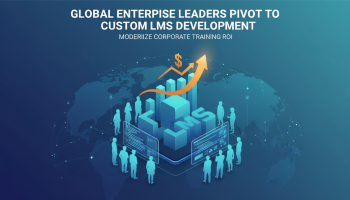
In the high-stakes arena of global business, workforce agility is not just an asset; it is a prerequisite for survival. For years, major corporations relied on off-the-shelf Learning Management Systems (LMS) to handle onboarding, compliance, and skill acquisition. However, a significant trend has emerged in the C-suite: Global enterprise leaders are increasingly pivoting to custom LMS development to modernize corporate training ROI and bridge widening skill gaps.
The generic, "one-size-fits-all" SaaS platforms that once dominated the market are failing to meet the complex, specific needs of modern conglomerates. These rigid systems often result in low engagement rates, fragmented data, and a disconnect between training modules and actual business outcomes. By investing in tailored solutions, organizations are regaining control over their data, their user experience, and ultimately, the financial return on their educational investments.
This cornerstone article explores why the world’s leading enterprises are moving away from restrictive subscription models and embracing bespoke educational technology. We will delve into the ROI mechanisms of custom platforms, the role of advanced technology integration, and how partnering with experts in technology consultancy is reshaping the future of workforce development.
The Limitations of Off-the-Shelf LMS Solutions
To understand the pivot toward custom LMS development, one must first analyze the deficiencies of mass-market commercial solutions. While turnkey platforms offer speed of deployment, they frequently impose a ceiling on innovation and scalability for large enterprises.
1. Lack of Flexibility and Scalability
Standardized LMS platforms are built to serve the average user, not the outlier. For a global enterprise with thousands of employees across diverse jurisdictions, languages, and technical competencies, the "average" feature set is rarely sufficient. Custom workflows, specific compliance reporting structures, and unique organizational hierarchies are often impossible to implement in rigid SaaS environments.
2. The Integration Nightmare
Modern businesses operate within complex digital ecosystems. An LMS must talk to CRMs, HRIS, ERPs, and project management tools. Off-the-shelf solutions often rely on generic APIs that may not support the deep data transfer required for advanced analytics. This leads to data silos where training performance cannot be correlated with job performance.
3. Recurring Costs vs. Asset Ownership
While the initial implementation cost of a SaaS product might appear lower, the long-term Total Cost of Ownership (TCO) can be staggering. Per-user licensing fees balloon as the company scales. In contrast, developing a proprietary platform turns an expense into a corporate asset, eliminating indefinite licensing fees.
Defining Custom LMS Development
Custom LMS development is the process of architecting, designing, and coding a learning platform from the ground up—or significantly modifying an open-source framework—to align perfectly with an organization’s specific operational goals. It is not merely about changing a logo or a color scheme; it is about engineering the logic of learning to fit the company culture.
This approach allows for the creation of unique learning paths, gamification strategies tailored to specific departments, and bespoke reporting dashboards that provide actionable intelligence to stakeholders.
How Custom LMS Development Maximizes ROI
The decision to build rather than buy is driven fundamentally by Return on Investment (ROI). Enterprise leaders are finding that the precision of custom software yields returns that far outweigh the initial development outlay.
Enhanced Employee Engagement and Retention
Engagement is the primary currency of effective training. If the User Experience (UX) is clunky or the content is irrelevant, employees disengage. Custom platforms allow for intuitive, consumer-grade interfaces. By leveraging expert UI/UX design, companies create learning environments that employees actually want to use. Higher engagement leads to faster skill acquisition and higher retention rates, reducing the costly turnover associated with lack of career development.
Precision in Skill Gap Analysis
Generic platforms track completion rates; custom platforms track competency. By integrating sophisticated assessment logic, custom LMS solutions can identify specific skill gaps in real-time and automatically recommend remedial training. This ensures that the workforce is always ready to meet current market demands.
Scalability Without Penalty
In a custom environment, adding ten thousand new users does not triple your monthly invoice. The infrastructure is yours. This scalability is crucial for global enterprises undergoing mergers or rapid expansion phases.
Key Features of Modern Custom LMS Platforms
When enterprise leaders commission custom software development for learning, they are incorporating cutting-edge technologies that generic platforms struggle to update quickly.
1. AI-Powered Personalization
Artificial Intelligence is revolutionizing corporate learning. Through AI-powered applications, a custom LMS can analyze a learner’s behavior, role, and past performance to curate a hyper-personalized learning feed. This moves training from a "push" model (mandatory compliance) to a "pull" model (curated self-improvement).
2. Mobile-First Learning Architectures
The modern workforce is mobile. Deskless workers, sales teams in the field, and remote employees require access to training on smartphones and tablets. Custom development ensures fully responsive designs or even native mobile apps. Through dedicated mobile app development, training becomes accessible anytime, anywhere, supporting micro-learning strategies that fit into busy schedules.
3. Gamification and Social Learning
Custom development allows for deep gamification logic that aligns with specific corporate KPIs. Rather than generic badges, companies can build simulation-based scenarios where training scores directly impact internal reputation systems or tangible rewards.
The Development Lifecycle: From Concept to Deployment
Embarking on a custom LMS project requires a structured approach. Successful enterprises partner with established development firms like XSOne Consultants to navigate this lifecycle.
- Discovery & Strategy: Defining the pedagogical goals and technical requirements.
- Architecture Design: Mapping out database structures, API integrations, and security protocols.
- UI/UX Prototyping: Creating wireframes that ensure a seamless user journey.
- Development: The coding phase, often using agile methodologies.
- QA & Testing: Rigorous stress testing to ensure stability under load.
- Deployment & Training: Launching the platform and onboarding administrators.
Why XSOne Consultants is the Premier Partner for Custom LMS
When Global Enterprise Leaders choose to pivot to custom solutions, selecting the right development partner is the most critical decision they face. XSOne Consultants stands at the forefront of this industry, offering a blend of strategic insight and technical prowess.
Unlike generalist agencies, XSOne Consultants understands the nuances of corporate education. Their expertise in technology consultancy ensures that the LMS is not just code, but a business solution. They prioritize data security, seamless integration, and future-proof architectures.
Whether you require deep integration with legacy systems or the infusion of generative AI into your training modules, XSOne Consultants delivers bespoke solutions that drive tangible business results. To discuss how a custom LMS can transform your corporate training strategy, you can contact their expert team directly.
Challenges and Considerations
While the benefits are substantial, custom LMS development is not without challenges. It requires a higher upfront capital investment compared to a monthly subscription. It also requires a dedicated project management team to oversee development.
However, for enterprises with over 500 employees, the break-even point is often reached within 18 to 24 months. Furthermore, the risk of vendor lock-in associated with SaaS platforms is eliminated. You own the code; you control the roadmap.
Future Trends in Corporate Learning Technology
The future of LMS is immersive. We are seeing early adopters integrating Virtual Reality (VR) and Augmented Reality (AR) for safety training and technical simulations. Custom development is the only viable path to integrate these high-bandwidth, hardware-specific technologies effectively. Furthermore, the use of blockchain for verifiable credentials and certifications is gaining traction, a feature rarely found in standard LMS offerings.
Frequently Asked Questions (FAQs)
1. How long does custom LMS development typically take?
The timeline varies based on complexity. A Minimum Viable Product (MVP) can often be deployed in 3-4 months, while a fully featured enterprise solution with complex integrations may take 6-9 months. Partnering with agile teams like XSOne Consultants can accelerate this process significantly.
2. Is custom LMS development more expensive than SaaS?
Initially, yes. The upfront cost is higher than a monthly subscription fee. However, over a 3-5 year period, custom solutions often prove cheaper for large enterprises because they eliminate per-user licensing fees and reduce the need for paid add-ons or workarounds.
3. Can we migrate our existing data to a new custom LMS?
Absolutely. Data migration is a standard part of the development process. Experienced developers can extract user data, completion records, and content (SCORM/xAPI packages) from legacy systems and import them into the new custom database.
4. Do I need an internal IT team to manage a custom LMS?
Not necessarily. While having internal IT support is beneficial, many development partners offer ongoing maintenance and support packages. This ensures your platform remains secure and updated without burdening your internal resources.
5. Can a custom LMS support mobile learning?
Yes, this is one of the primary benefits. Custom development allows you to build a platform that is natively responsive or even create dedicated iOS and Android applications to facilitate offline learning and push notifications.
Conclusion
The pivot to custom LMS development represents a maturation in how global enterprises view corporate training. It is a move away from viewing learning as a cost center managed by generic software, toward viewing it as a strategic competitive advantage powered by bespoke technology.
By tailoring the learning experience to the exact needs of the organization and the employee, leaders can unlock higher engagement, better data visibility, and a superior ROI. In a world where the speed of learning determines the speed of business, relying on off-the-shelf solutions is a risk fewer leaders are willing to take. For those ready to modernize their training infrastructure, partnering with experts like XSOne Consultants offers the surest path to success.

Editor at XS One Consultants, sharing insights and strategies to help businesses grow and succeed.