
Blog

Custom Mobile
App Development Services vs Template Apps: Which Wins?
Choosing between custom mobile app development services and a
ready-to-use template app is one of the most
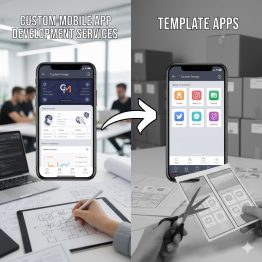
Choosing between custom mobile app development services and a ready-to-use template app is one of the most significant strategic decisions a business faces today. It’s not just a technical choice. It’s an investment decision that determines your long-term operational efficiency, competitive edge, and ultimate Return on Investment (ROI).
The debate is often framed as cost versus speed. Template apps win on the short-term front. Custom apps, though, deliver long-term strategic value that templates simply cannot match. For any company with a unique process or a focus on scale, custom development is the clear winner.
The Initial Cost Illusion: Why Templates Are a False Economy
Template applications, often built using no-code or low-code platforms, offer a compelling pitch: rapid deployment and low upfront cost. This makes them highly attractive, especially to startups and small businesses.
Upfront Cost vs. Total Cost of Ownership (TCO)
The initial cost for a simple, template-based app can be as low as $5,000 to $50,000 [Source 2.1: Simple App Cost]. They can be ready for market in just a few weeks. This is the main lure.
| App Complexity Level | Estimated Custom Development Cost Range (2025) | Deployment Time |
| Simple/Template App | $5,000 – $50,000 | Weeks to 2 Months |
| Mid-Range/Custom MVP | $50,000 – $163,500 | 3 to 6 Months |
| High-End/Enterprise Custom | $350,000+ | 9 Months to Over a Year |
However, this low upfront figure for template solutions is deceptive. It masks a higher Total Cost of Ownership (TCO) over five years. Template apps come with recurring subscription or tiered licensing fees. As your user base grows or you need more features, these monthly costs escalate linearly. The TCO of template apps generally increases over time [Source 4.2].
A custom application, despite the high initial investment, becomes an owned asset. Its TCO typically decreases after the initial break-even point, usually reached within three years. Budgeting for a custom build should include an annual maintenance cost, generally 15% to 20% of the initial development cost. This is an investment in stability and future enhancements.
The Operational ROI: Efficiency and Competitive Edge
The core argument for bespoke mobile app development revolves around operational efficiency. Template apps force a business to conform to their predefined, generic workflows. This creates friction and necessitates costly workarounds.
Tailored Workflows Drive Measurable Efficiency
Custom software development, by contrast, is engineered to automate and optimize a company’s exact process. This is the source of its massive long-term ROI.
Statistics confirm the direct financial benefit of this tailored approach:
- Operational Efficiency: Companies that adopt custom solutions report an average 35% boost in operational efficiency over three years. This happens by eliminating manual data transfer and poorly fitting tools.
- Productivity Uplift: Businesses using a platform built specifically for their team often see productivity improvements as high as 40%. Custom apps are intuitively designed for the specific user role, reducing training time and errors.
- Revenue Growth: This efficiency translates directly to the bottom line, with companies experiencing a 20% average uptick in revenue growth over the same period.
For complex or large-scale projects, the extended development timeline (up to a year or more) for a complex custom mobile app is justified by the speed and scale of these efficiency gains.
Customization, Integration, and Ownership
Beyond mere function, custom development offers three strategic advantages that templates cannot provide: unlimited customization, seamless integration, and full ownership.
1. Unrestricted Customization and Scalability
Template apps offer limited customization. They are designed for the masses. When a business needs to add a new, proprietary feature—a key differentiator—the template vendor may not support it, or they might charge an exorbitant fee for a simple “add-on.” This creates a ceiling on innovation.
A custom application is built to be modular and scalable. It can handle exponential user growth and feature additions seamlessly. If your business needs to expand into a new service, the application’s architecture is already prepared to support that growth.
2. Seamless Integration
Modern businesses rely on complex tech stacks (CRMs, ERPs, proprietary databases). Custom mobile development services ensure the new application integrates perfectly with every existing tool from day one.
Template apps often struggle here. They rely on simple, pre-built integrations that may not cover complex data synchronization or two-way data flows. This leads to data silos and fragmented workflows, undermining the very efficiency the app was meant to create.
3. Intellectual Property (IP) Ownership
A custom-built application means you own the source code. It is a tangible Intellectual Property (IP) asset on your balance sheet. This gives you complete control over:
- Security: You can implement advanced, tailored security protocols crucial for compliance-heavy industries like finance and healthcare.
- Monetization: You choose exactly how to monetize and control all revenue streams.
- Vendor Lock-in: You are not subject to the pricing, feature roadmap, or continued existence of a third-party vendor.
Template apps, conversely, keep the business dependent on the vendor’s platform.
User Experience and Retention: The Ultimate ROI Driver
The most direct link between custom development and long-term profit is user retention. An application’s value is derived from how consistently users return and engage.
The Power of Personalized UX
Template apps have generic user interfaces (UI) and user experiences (UX). They are “good enough” for most, but “perfect” for no one. This is detrimental to retention.
Custom mobile app development focuses on creating a tailored UX that matches the target user’s exact needs and workflows. This meticulous attention to user-centric design creates a much “stickier” product.
- Retention is Profit: Increasing customer retention rates by just 5% can boost profits by 25% to 95%. The investment in a superior, custom UX pays for itself by reducing the high cost of user acquisition (CAC).
- Generic Drop-Off: Global benchmarks show that the average mobile app sees retention settle at a modest 7% by Day 30. Custom apps, with superior design, intuitive onboarding, and highly relevant features, are far more likely to surpass this benchmark.
- Onboarding is Key: A customized onboarding experience, which can be achieved through bespoke development, is crucial. Effective onboarding can increase app retention by up to 50%. Custom builds ensure that the user gets immediate value, minimizing the time-to-value (TTV) and maximizing the chance of long-term use.
This deep personalization through a custom build is what differentiates a useful tool from an essential part of the user’s daily life.
The Strategic Decision Framework
The choice boils down to your company’s core strategy. Use the framework below to guide your decision:
| Criterion | Custom Mobile App Development | Template/Off-the-Shelf App |
| Initial Investment | High | Low |
| Deployment Speed | Months to a Year (Slower) | Weeks to 2 Months (Faster) |
| Total Cost of Ownership (TCO) | Decreases over time after break-even | Increases over time with licenses/add-ons |
| Operational Efficiency | Maximum (35%+ gain) | Limited; requires business process change |
| Scalability & Flexibility | Unlimited; built to grow with the business | Constrained by vendor roadmap |
| Integration | Seamless with all proprietary systems | Limited to pre-built APIs; risk of data silos |
| Intellectual Property | Full Ownership (Valuable Asset) | No Ownership (Leased Software) |
| Competitive Edge | High; offers unique, proprietary features | Low; same features as competitors |
Conclusion: Custom Wins the Long Game
For businesses whose mobile application is a core revenue driver, a tool for process automation, or a primary customer interface, the answer is clear. Custom mobile app development services offer the definitive winning strategy.
While the initial cost is substantial, the long-term ROI derived from a 35% boost in efficiency, full IP ownership, unrestricted scalability, and superior user retention is unparalleled. The template app is a quick fix for a generic need. The custom mobile app is a strategic asset, purpose-built to give your business a sustainable, competitive advantage in the digital marketplace. It’s an investment in the future of your company.

Editor at XS One Consultants, sharing insights and strategies to help businesses grow and succeed.