
Blog

Custom Web
Development vs Template: Why the Higher Investment is Worth It for Scalable Growth
Introduction: The Strategic Crossroads of Digital Presence Contents hide
1 Introduction: The Strategic Crossroads of Digital Presence
Introduction: The Strategic Crossroads of Digital Presence
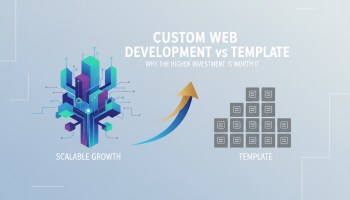
In the hyper-competitive digital ecosystem of 2024, your website is far more than a digital brochure; it is the central nervous system of your business operations, brand identity, and customer acquisition engine. When stakeholders and CTOs approach a website redesign or launch, they face a pivotal decision that dictates their digital future: custom web development vs template solutions.
While template-based platforms like Wix, Squarespace, or pre-purchased WordPress themes offer alluring low barriers to entry—promising rapid deployment and minimal upfront costs—they often conceal long-term limitations. Conversely, custom web development represents a significant initial investment but promises a bespoke architecture designed specifically for your business logic, scalability, and performance goals.
As businesses aim for scalable growth, the limitations of off-the-shelf software often become the bottleneck for expansion. This guide provides an authoritative, deep-dive analysis into the dichotomy of custom coding versus template implementation, exploring why the higher investment in bespoke solutions is not merely a luxury, but a strategic necessity for market leaders.
Defining the Contenders: Bespoke Engineering vs. Pre-Fabricated Design
To truly evaluate the ROI of your web infrastructure, one must first understand the fundamental architectural differences between the two approaches.
The Template Ecosystem: Accessibility at a Cost
Template development relies on pre-designed frameworks and drag-and-drop builders. Whether it is a Shopify theme or a multi-purpose WordPress template (like Divi or Avada), the premise is universality. These tools are built to cater to thousands of different business types simultaneously.
The Reality of Templates: To accommodate everyone, templates come bloated with excessive code, unused JavaScript libraries, and generic styling options. While they allow for visual customization, the underlying structural logic remains rigid. You are renting a layout, not building a foundation.
Custom Web Development: Digital Architecture
Custom web development involves writing code from scratch—or building atop a lean framework—tailored specifically to your requirements. This approach usually involves a technology stack chosen for your specific needs (e.g., a Headless CMS, React.js frontend, Python or PHP backend).
The Reality of Custom Code: Every line of code serves a purpose. There is no bloat. The User Experience (UX) is crafted around your specific customer journey, and backend integrations are built to communicate seamlessly with your internal CRMs, ERPs, and marketing tools.
Performance and Core Web Vitals: The Speed Differential
Google’s Core Web Vitals update has shifted the SEO landscape, making page experience a direct ranking factor. In the battle of custom web development vs template sites, performance is where the disparity is most glaring.
The “Theme Bloat” Phenomenon
Templates are notorious for “code bloat.” A generic theme might include code for a portfolio, a shop, a forum, and a booking system, even if you only need a landing page. This results in heavy DOM sizes and slow Time to Interactive (TTI) scores.
- Unused CSS/JS: Templates load massive stylesheets to account for every possible layout configuration, slowing down render times.
- Plugin Dependency: To add functionality to a template, you often need plugins. A “plugin soup” leads to conflicts, security holes, and sluggish server response times.
The Precision of Custom Code
Custom websites are built with performance budgets in mind. Developers can implement advanced optimization techniques that are difficult or impossible to retrofit into a template:
- Server-Side Rendering (SSR): For lightning-fast content delivery.
- Efficient Caching Strategies: Tailored to the specific dynamic content of your site.
- Image Optimization Pipelines: Automated WebP conversion and lazy loading implemented at the root level.
Result: Custom sites consistently achieve higher Google PageSpeed scores, directly correlating to lower bounce rates and higher organic rankings.
Scalability: Preparing for the Traffic Surge
Scalability is the ability of your digital asset to handle increased load and complexity without collapsing. This is often the primary driver for businesses moving from templates to custom solutions.
Hitting the “Template Ceiling”
Templates are rigid. If your business model pivots, or if you need to integrate a proprietary inventory management system, a template will fight you. You may find yourself hiring developers to “hack” the theme, resulting in a Frankenstein’s monster of code that breaks with every software update. This is the definition of technical debt.
Architecting for Growth
Custom development allows for modular architecture. Using methodologies like Microservices or Headless architecture, specific parts of your website can be upgraded independently. If your traffic spikes from 10,000 to 1 million visitors, a custom-architected database and cloud infrastructure (like AWS or Azure) can scale elastically. A standard shared-hosting template setup would likely crash.
Security: The Hidden Risk of Open Source Themes
Cybersecurity is a non-negotiable aspect of modern web management. The choice between custom and template significantly impacts your vulnerability profile.
The Target on Your Back
Popular templates and plugins are open-source and widely used. Hackers study the source code of popular themes to find vulnerabilities. Once a zero-day exploit is found in a popular plugin, every website using it is instantly at risk. Automated bots scour the web for these specific signatures.
Hardened Custom Security
While no code is unhackable, custom websites benefit from a smaller attack surface. Because the code structure is unique to your organization, automated bots cannot easily exploit known vulnerabilities. furthermore, custom development allows for enterprise-grade security implementations, such as:
- Custom authentication protocols.
- Strict Content Security Policies (CSP).
- Sanitized database inputs to prevent SQL injection, tailored specifically to your data fields.
Brand Identity and UX: Beyond the “Bootstrap Look”
In a saturated market, differentiation is key. Template websites often suffer from the “Bootstrap look”—a generic aesthetic that makes your brand indistinguishable from competitors using the same theme.
Custom web development empowers your creative team to design a User Experience (UX) that dictates the technology, rather than letting the technology dictate the design. You can build unique interactive elements, custom animations, and user flows that guide the visitor precisely where you want them to go, optimizing for conversion rather than convenience.
The Financial Analysis: CapEx vs. OpEx
The argument for templates always centers on the lower upfront cost (CapEx). However, the Total Cost of Ownership (TCO) over 3-5 years tells a different story.
The High Cost of “Cheap”
A template site might cost $5,000 initially. However, factor in:
- Lost Revenue: Due to slower load times and lower conversion rates.
- Maintenance Costs: Constant fixing of plugin conflicts and theme updates.
- Rebuild Costs: Most companies outgrow templates within 18 months, necessitating a full rebuild.
The ROI of Custom Investment
A custom site might cost $30,000 to $100,000+. However, it serves as a robust asset that lasts 4-6 years without major structural changes. The superior SEO performance, higher conversion rates, and reduced operational headaches result in a significantly lower TCO and higher ROI over the asset’s lifespan.
Frequently Asked Questions
1. Is custom web development always better than a template?
Not always. For MVP (Minimum Viable Product) testing, small blogs, or businesses with zero budget, a template is a practical starting point. However, for established businesses seeking growth, scalability, and brand authority, custom development is objectively superior.
2. Does custom web development hurt SEO?
On the contrary, custom web development usually improves SEO. It allows for cleaner code, faster load times, semantic HTML structure, and total control over schema markup, all of which are favored by search engines.
3. How long does a custom website take to build?
Unlike templates which can launch in days, a custom website typically takes 12 to 24 weeks. This includes discovery, UX/UI design, development, quality assurance, and content migration.
4. Can I use WordPress for custom development?
Yes. WordPress can be used as a headless CMS or with a completely custom-coded theme. This “hybrid” approach offers the user-friendly backend of WordPress with the performance and security of custom frontend code.
5. Is it difficult to manage content on a custom site?
No. A professional development agency will build a custom backend (using a CMS like WordPress, Strapi, or Contentful) that is tailored to your workflow. It is often easier to manage than templates because you aren’t fighting with complex visual builders.
6. What happens if I want to switch developers later?
This is a valid concern. To mitigate this, ensure your custom website is built on standard frameworks (like React, Vue, Laravel, or standard PHP) and follows modern coding standards. Avoid proprietary, agency-locked platforms. Clean, documented code can be picked up by any competent developer.
Conclusion: Investing in Your Digital Future
The debate of custom web development vs template solutions ultimately boils down to your business trajectory. If you are testing a concept or have limited resources, a template is a functional stopgap. However, if your goal is scalable growth, market dominance, and a digital presence that acts as a true asset rather than a liability, the higher investment in custom development is not just worth it—it is essential.
By choosing custom development, you are investing in a platform that is secure, fast, unique to your brand, and built to handle the future. In the digital economy, your website is your flagship; do not build it on a rented foundation.

Editor at XS One Consultants, sharing insights and strategies to help businesses grow and succeed.