

Blog

DeepSeek-R1 Distilled
Models: A Technical Guide to 671B MoE vs. Llama and Qwen Variants
Introduction: The Paradigm Shift in Open-Weights AI Contents hide
1 Introduction: The Paradigm Shift in Open-Weights AI
Introduction: The Paradigm Shift in Open-Weights AI
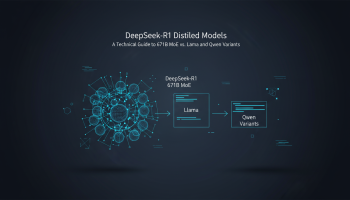
The landscape of Large Language Models (LLMs) has undergone a seismic shift with the release of the DeepSeek-R1 series. For years, the industry standard for reasoning and coding tasks was held tightly by proprietary models like OpenAI’s o1. However, the introduction of DeepSeek-R1—a 671 billion parameter Mixture-of-Experts (MoE) model—has democratized access to high-level reasoning capabilities. But the true disruption lies not just in the massive MoE model, but in the strategic deployment of DeepSeek-R1 distillation.
By distilling the reasoning patterns of their massive flagship model into smaller, efficient architectures like Llama and Qwen, DeepSeek has proven that high-performance AI does not require a supercomputer to run. This technical guide provides a comprehensive analysis of the DeepSeek-R1 ecosystem. We will dissect the architecture of the 671B MoE teacher model, explore the mechanics of distilling reasoning data into Llama and Qwen variants, and benchmark the performance implications for developers and enterprises.
Whether you are an AI engineer looking to optimize inference costs or a CTO evaluating open-source alternatives, understanding the nuance between the 671B MoE and its distilled counterparts is critical for future-proofing your AI strategy.
Understanding DeepSeek-R1: The 671B MoE Powerhouse
To understand the value of the distilled models, one must first grasp the architecture of the "Teacher" model: DeepSeek-R1. Unlike traditional dense models where every parameter is activated for every token generated, DeepSeek-R1 utilizes a Mixture-of-Experts (MoE) architecture.
The MoE Architecture Explained
The DeepSeek-R1 boasts a staggering 671 billion total parameters. However, because of its MoE design, it only activates approximately 37 billion parameters per token. This sparsity allows for:
- Massive Knowledge Retention: The 671B parameters serve as a vast repository of encyclopedic knowledge and coding syntax.
- Efficient Inference: By only activating specific "experts" relevant to the current query, the model achieves inference speeds comparable to much smaller dense models.
- Complex Reasoning via CoT: R1 was trained using large-scale Reinforcement Learning (RL) to encourage Chain-of-Thought (CoT) reasoning before generating a final answer.
The Evolution from R1-Zero
DeepSeek’s journey began with R1-Zero, a model trained purely via Reinforcement Learning without supervised fine-tuning (SFT). While R1-Zero demonstrated valid reasoning capabilities, it suffered from readability issues and language mixing. DeepSeek-R1 (the final version) solved this by introducing a small amount of high-quality "cold start" data before the RL stage, resulting in a model that rivals top-tier proprietary models in mathematics, coding, and logic.
The Science of DeepSeek-R1 Distillation
DeepSeek-R1 distillation is the process that allows smaller models to punch significantly above their weight class. In the context of DeepSeek’s release, "distillation" refers specifically to data distillation rather than traditional logit-based distillation.
How the Distillation Process Works
DeepSeek utilized the massive 671B MoE model to generate 800,000 synthetic samples of reasoning data. These samples included the step-by-step "thinking" process (Chain-of-Thought) that the teacher model utilized to solve complex problems.
This dataset was then used to fine-tune existing, high-quality open base models. The result? Smaller dense models that inherit the reasoning superpowers of the 671B MoE without inheriting its massive hardware requirements.
The Strategic Advantage of Distilled Models
The distillation approach offers three distinct competitive advantages for enterprise deployment:
- Reduced Latency: A 7B or 8B parameter model runs exponentially faster than a 671B model.
- Lower Hardware Costs: Distilled variants can often be run on consumer-grade GPUs or even high-end CPUs, whereas the 671B MoE requires a cluster of H800s or A100s.
- Targeted Performance: By starting with capable bases like Qwen-2.5 and Llama-3.1, the distilled models combine the general linguistic capabilities of the base with the specialized reasoning of DeepSeek-R1.
DeepSeek-R1-Distill-Llama: Analyzing the Variants
DeepSeek leveraged Meta’s Llama-3.1 architecture to create two potent distilled variants. These models are particularly attractive for organizations already entrenched in the Llama ecosystem.
DeepSeek-R1-Distill-Llama-8B
This is the entry-level powerhouse. By fine-tuning Llama-3.1-8B on the R1 dataset, DeepSeek created a model that outperforms significantly larger models in mathematical reasoning.
- Best Use Case: Edge computing, local coding assistants, and applications requiring extremely low latency.
- Benchmark Highlight: In the MATH-500 benchmark, the 8B distilled model achieved approximately 50.4% accuracy, a massive leap over the base Llama-3.1-8B.
DeepSeek-R1-Distill-Llama-70B
The 70B variant represents the sweet spot for enterprise-grade open-source AI. It balances deep semantic understanding with the advanced logic inherited from the R1 Teacher.
- Best Use Case: Complex data analysis, RAG (Retrieval-Augmented Generation) systems, and nuanced creative writing.
- Performance: It rivals top-tier closed models in coding tasks, making it a viable alternative to GPT-4o for code generation pipelines.
DeepSeek-R1-Distill-Qwen: The Coding Specialists
DeepSeek also applied their distillation technique to the Qwen-2.5 series from Alibaba Cloud. The Qwen base models are renowned for their coding and mathematical proficiency, making them ideal candidates for R1’s reasoning data.
The Qwen Lineup: 1.5B, 7B, 14B, and 32B
The diversity of the Qwen distilled lineup allows for granular resource allocation:
- 1.5B Variant: An ultra-lightweight model capable of running on mobile devices, yet exhibiting surprising logical coherence.
- 7B & 14B Variants: These serve as excellent mid-range options for developers running models on single GPUs (e.g., NVIDIA RTX 3090/4090).
- 32B Variant: This is arguably the most impressive distilled model in terms of parameter-to-performance ratio.
Comparative Benchmarks
In technical evaluations, the DeepSeek-R1-Distill-Qwen-32B has demonstrated performance that often eclipses the Llama-70B variant in pure coding tasks (evaluating via HumanEval and MBPP). The dense architecture of Qwen combined with R1’s CoT data results in a model that follows instructions with extreme precision.
Technical Deep Dive: 671B MoE vs. Distilled Dense Models
Choosing between the full 671B MoE and a distilled variant is a trade-off between absolute capability and operational feasibility.
Memory Bandwidth and VRAM
- 671B MoE: Requires roughly 700GB+ of VRAM to load in FP8 (8-bit floating point). This necessitates a multi-GPU setup (e.g., 8x H100s or A100s), making it inaccessible for most local deployments.
- Distilled 7B/8B: Can run on less than 16GB of VRAM (Int4 quantization).
- Distilled 70B: Fits comfortably on dual 24GB cards (e.g., 2x RTX 3090/4090) when quantized, bringing "super-intelligence" to the enthusiast workstation.
Inference Dynamics
The 671B MoE relies on complex routing mechanisms to select experts. While efficient, the memory bandwidth overhead of loading these experts is high. In contrast, the distilled Llama and Qwen models are dense—meaning all parameters are active. While this sounds less efficient, at smaller scales (7B-32B), modern GPUs handle dense matrix multiplications incredibly fast, often resulting in higher tokens-per-second (TPS) for the distilled models compared to the massive MoE.
Strategic Implementation: Which Model Should You Choose?
For AI strategists and developers, the choice depends on the application layer:
- Use the 671B MoE (via API) if:
- You require the absolute highest accuracy for extremely complex, multi-step reasoning.
- You are generating synthetic data to train your own smaller models.
- Cost is secondary to quality.
- Use Distilled Qwen-32B/Llama-70B if:
- You are building an on-premise coding assistant.
- You need high-throughput production APIs.
- Data privacy requires local hosting.
- Use Distilled 7B/8B if:
- You are deploying to edge devices.
- You need real-time chat latency on consumer hardware.
Frequently Asked Questions
What is the main difference between DeepSeek-R1 and the distilled versions?
DeepSeek-R1 is the original "Teacher" model with 671B parameters using a Mixture-of-Experts architecture. The distilled versions (Llama and Qwen variants) are smaller, dense models that were fine-tuned using the reasoning data generated by DeepSeek-R1. The R1 model is more capable but requires massive hardware, while distilled versions are efficient and accessible.
Can I run the 671B MoE model on a single GPU?
No. Even with heavy quantization (reducing precision to 4-bit or lower), the 671B model requires hundreds of gigabytes of VRAM. You would typically need a cluster of enterprise-grade GPUs (like 8x A100 80GB) to run it effectively. However, the distilled 7B, 8B, and even quantized 32B/70B models can run on consumer hardware.
Is DeepSeek-R1 distillation better than training from scratch?
Yes, for most use cases. Distillation allows smaller models to "stand on the shoulders of giants." By training on the high-quality Chain-of-Thought outputs of the 671B model, the smaller models learn reasoning patterns that they would likely never discover during standard pre-training, achieving superior performance with a fraction of the compute cost.
Which distilled variant is better for coding: Llama or Qwen?
Benchmarks suggest that the DeepSeek-R1-Distill-Qwen variants (particularly the 32B) have a slight edge in coding tasks due to the Qwen base model’s strong programming training. However, the Llama variants are exceptional at general language reasoning and English instruction following.
Does DeepSeek-R1 use Chain-of-Thought (CoT) automatically?
Yes. A defining feature of DeepSeek-R1 and its distilled variants is the ability to generate internal reasoning traces (CoT) before outputting the final answer. This allows the models to self-correct and handle complex logic puzzles, math problems, and algorithmic coding challenges more effectively than standard LLMs.
What is the license for DeepSeek-R1 distilled models?
DeepSeek has released R1 and its distilled variants under the MIT License, which is one of the most permissive open-source licenses available. This allows for both academic research and commercial use, making it a highly attractive option for startups and enterprises.
Conclusion
The release of DeepSeek-R1 and its distilled variants marks a pivotal moment in the history of open-source Artificial Intelligence. By successfully transferring the reasoning capabilities of a massive 671B MoE model into agile architectures like Llama and Qwen, DeepSeek has bridged the gap between supercomputing capability and practical deployment.
For developers, the DeepSeek-R1 distillation ecosystem offers a toolkit of unprecedented versatility. Whether you are deploying the 1.5B model on mobile devices or leveraging the 70B model for enterprise RAG systems, the ability to access elite-level reasoning without the proprietary lock-in is a game-changer. As we move forward, the techniques pioneered here—specifically the use of RL-driven CoT data for distillation—will likely become the standard for how high-performance, efficient AI models are built.

Editor at XS One Consultants, sharing insights and strategies to help businesses grow and succeed.