
Blog

Google Gemini
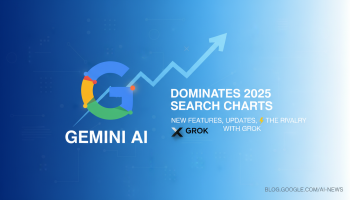
AI Dominates 2025 Search Charts: New Features, Updates, and the Rivalry with Grok
Introduction Contents hide 1 Introduction 2 The Evolution of
Google Gemini AI in 2025 2.1 From Assistant
Introduction
In the rapidly evolving landscape of artificial intelligence, 2025 has emerged as a pivotal year for search engine technology. At the forefront of this revolution is Google Gemini AI, a sophisticated multimodal model that has fundamentally reshaped how users interact with information online. No longer confined to simple query-response mechanics, search has transformed into a dynamic, conversational, and predictive experience. As businesses and developers scramble to adapt to this new paradigm, the dominance of Gemini on the 2025 search charts signals a definitive shift away from the keyword-stuffed strategies of the past toward a semantic, intent-driven future.
The stakes have never been higher. With competitors like xAI’s Grok challenging Google’s supremacy, the battle for the digital ecosystem is intensifying. For enterprises, understanding these shifts is not merely academic—it is a survival necessity. As a leader in technological innovation, XS One Consultants has been closely monitoring these developments, helping clients navigate the complex intersection of AI integration and digital visibility. Whether it is through advanced ai chatbot development or redefining search strategies, the era of Gemini demands a proactive approach.
This comprehensive guide explores why Google Gemini AI is dominating the 2025 search charts, analyzes its fierce rivalry with Grok, and provides actionable insights for businesses looking to leverage these technologies for growth.
The Evolution of Google Gemini AI in 2025
From Assistant to Agent: A Paradigm Shift
By 2025, Google Gemini AI has transcended its initial categorization as a mere chatbot or search assistant. It now operates as a fully functional autonomous agent capable of “Deep Research.” Unlike its predecessors, which relied on surfacing links, Gemini 2025 can synthesize vast amounts of information from across the web, cross-referencing sources to provide comprehensive, verified answers in real-time. This capability has cemented its position at the top of the search charts, reducing the user’s need to click through multiple websites to find answers.
The integration of Gemini into the Google Workspace ecosystem has further deepened its moat. It seamlessly pulls data from Gmail, Docs, and Drive to contextualize search results, offering a personalized experience that standalone competitors struggle to match. For businesses, this means that internal data management is now inextricably linked to external search visibility.
Multimodal Capabilities and Real-Time Reasoning
One of the defining features propelling Gemini’s 2025 dominance is its advanced multimodal reasoning. Users can now search using a combination of text, voice, images, and video simultaneously with near-zero latency. For instance, a user can point their camera at a broken engine part and ask, “How do I fix this and where can I buy the replacement nearby?” Gemini identifies the part, diagnoses the issue, and provides local shopping options instantly.
This shift requires a massive overhaul in how digital content is structured. As noted in our analysis of app development trends to watch in 2026, applications and websites must now be optimized for visual search and voice interaction to remain relevant in Gemini’s ecosystem.
Gemini vs. Grok: The AI Rivalry Heating Up
The ideological and Technical Divide
While Google Gemini AI focuses on utility, integration, and safety, its primary rival, Grok (developed by Elon Musk’s xAI), has carved out a niche focused on real-time data access via the X (formerly Twitter) platform and a “rebellious” persona. The rivalry between these two giants dominated the tech narrative in 2025.
Grok’s main advantage lies in its immediate access to the global conversation happening on X. It excels at breaking news and sentiment analysis. However, Gemini dominates the search charts because of Google’s unparalleled Knowledge Graph. When users need factual reliability, deep academic research, or transactional results (like booking a flight or buying a product), Gemini remains the preferred choice.
Despite Grok’s aggressive updates, Google has managed to retain over 90% of the global search market share in 2025. This is largely due to the sheer ubiquity of Android devices and the Chrome browser, which serve as native delivery systems for Gemini. Grok remains somewhat siloed within the X ecosystem, although its API availability is growing.
For developers and marketers, the choice isn’t necessarily binary. Many are exploring hybrid models. However, when considering OpenAI Operator AI Agent capabilities and the broader landscape, Gemini’s infrastructure offers a more stable foundation for long-term business applications.
Impact on SEO and Digital Marketing Strategies
The Death of “Ten Blue Links”
The most significant disruption caused by Google Gemini AI is the erosion of the traditional SERP (Search Engine Results Page). In 2025, the “Zero-Click” search trend has accelerated. Gemini’s AI Overviews often satisfy user intent without sending traffic to external websites. This has caused panic among publishers relying solely on ad revenue from traffic.
However, this shift opens new doors for authority-based marketing. To appear in Gemini’s citations, content must be highly authoritative, data-backed, and structurally optimized for Large Language Models (LLMs). Businesses must pivot their focus from “ranking” to “being cited.” This requires expert SEO services that understand the nuances of Generative Engine Optimization (GEO).
Optimizing for AI Search Experiences
To survive in a Gemini-dominated world, content strategies must evolve. It is no longer enough to target keywords; you must target contexts. Gemini looks for semantic relationships between entities. If your brand is not semantically linked to the solutions you offer, you will be invisible.
We have detailed specific methodologies for this in our guide on how to optimize your website and content to rank in AI search results. The key takeaways include:
- Structured Data: heavily utilizing Schema.org markup to help Gemini parse your content.
- E-E-A-T: Google’s emphasis on Experience, Expertise, Authoritativeness, and Trustworthiness is amplified by AI filters.
- Direct Answers: Formatting content to directly answer questions in a concise manner for AI extraction.
Integrating Gemini into Business Operations
Custom AI Solutions and Chatbots
Beyond search, Google Gemini AI is revolutionizing internal business operations. Companies are leveraging Gemini’s API to build custom internal search engines, automate coding tasks, and enhance customer support. The ability to fine-tune Gemini on proprietary corporate data allows for the creation of highly specialized assistants.
For organizations looking to implement these efficiencies, XS One Consultants specializes in tailored integrations. You can learn more about how to streamline operations in our article on how to automate customer service with AI. By deploying intelligent agents, businesses can reduce response times and operation costs simultaneously.
The Role of Mobile Apps in an AI-First World
As Gemini becomes the operating system of the web, mobile applications are changing. Users expect apps to be predictive. An e-commerce app integrated with Gemini doesn’t just list products; it suggests outfits based on the user’s calendar and weather forecast.
Developing these next-gen applications requires a sophisticated tech stack. Whether you are interested in digital marketing strategies to promote your app or the engineering behind it, staying ahead of the curve is essential. The future of mobile is agentic—apps that do things for you, not just with you.
The Future Outlook: 2026 and Beyond
As we look toward the latter half of the decade, the dominance of Google Gemini AI is expected to spur further innovation. We anticipate a convergence of physical robotics and search AI, where Gemini will power not just screens, but autonomous systems. The rivalry with Grok will likely push both platforms toward greater autonomy and personalization.
For businesses, the message is clear: the digital foundation you build today must be AI-compatible. Ignoring Gemini is akin to ignoring the rise of the internet in the late 90s. Partnering with forward-thinking agencies like XS One Consultants ensures you are not just an observer of this revolution, but an active participant.
Frequently Asked Questions
1. What makes Google Gemini AI different from previous Google updates?
Google Gemini AI is not just an algorithm update; it is a fundamental architecture shift. Unlike BERT or RankBrain which helped understand queries, Gemini is a multimodal generative model. It creates content, reasons across different media types (text, code, audio, video), and functions as an active agent rather than a passive indexer.
2. Will Google Gemini AI kill organic website traffic?
It will likely reduce traffic for broad, informational queries (e.g., “What is the capital of France?”) as these will be answered directly in the search interface. However, for complex, transactional, and investigative queries, it can actually drive higher-quality, high-intent traffic to authoritative sources. The key is adapting your content strategy to answer the “Deep Research” questions Gemini users ask.
3. How can I optimize my business for Gemini Search?
Optimization involves a shift to Generative Engine Optimization (GEO). This includes using extensive structured data (Schema), ensuring fast load times for mobile, creating high-depth content that establishes authority (E-E-A-T), and managing your brand’s presence across the entire Knowledge Graph. Professional SEO services are often required to navigate these technical complexities.
4. Is Grok a better alternative to Gemini for business use?
It depends on the use case. Grok has superior access to real-time social sentiment data via X, making it excellent for PR monitoring and trend tracking. However, for robust enterprise applications, document processing, and general search visibility, Google Gemini’s integration with the wider Google ecosystem (Workspace, Cloud, Android) makes it the superior choice for most general business operations.
5. Can I integrate Gemini into my own mobile app?
Yes, Google provides APIs (via Vertex AI and Google AI Studio) that allow developers to integrate Gemini’s capabilities into mobile applications. This can enable features like natural language search within your app, image recognition, and personalized recommendations. To implement this correctly, expert guidance in AI integration is recommended.
Conclusion
Google Gemini AI’s dominance of the 2025 search charts is a testament to the power of multimodal, agentic computing. It has redefined the competitive landscape, challenging rivals like Grok and forcing businesses to rethink their digital strategies from the ground up. The transition from traditional search to AI-driven discovery is not a fleeting trend—it is the new reality.
Success in this era requires more than just observation; it requires adaptation. From optimizing content for generative search to building AI-powered applications that delight users, the opportunities are vast for those willing to innovate. As you navigate this complex terrain, remember that expertise is your most valuable asset. XS One Consultants stands ready to guide your business through this transformation, ensuring you remain visible, relevant, and competitive in the age of Gemini.

Editor at XS One Consultants, sharing insights and strategies to help businesses grow and succeed.