
Blog

Google Trends
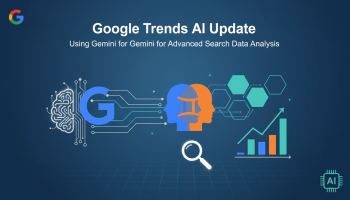
AI Update: Using Gemini for Advanced Search Data Analysis
Introduction: The Paradigm Shift in Search Intelligence Contents hide
1 Introduction: The Paradigm Shift in Search Intelligence
Introduction: The Paradigm Shift in Search Intelligence
In the rapidly evolving landscape of Search Engine Optimization (SEO), data has always been the currency of success. However, the raw data provided by tools like Google Trends has historically required significant manual interpretation to yield actionable insights. Enter the Google Trends AI Update. By integrating the advanced capabilities of Gemini (formerly Bard) directly into the search intelligence ecosystem, Google has fundamentally altered how marketers, SEO strategists, and content creators analyze search behavior.
Gone are the days of staring at static line graphs and guessing why a specific keyword spiked on a Tuesday in November. The convergence of real-time search data with generative AI allows for instantaneous correlation analysis, semantic entity extraction, and predictive modeling. For the modern SEO professional, this is not merely a feature update; it is a workflow revolution.
This definitive guide explores the depths of the Google Trends AI update, detailing how to leverage Gemini for advanced search data analysis. We will dismantle the traditional keyword research methodologies and reconstruct them using AI-driven frameworks that prioritize user intent, topical authority, and future-proofing your digital presence.
The Evolution of Google Trends: From Static Data to Dynamic AI Insights
To understand the magnitude of the Google Trends AI Update, one must first recognize the limitations of the legacy tool. Traditionally, Google Trends provided a normalized index of search interest over time. While valuable for identifying seasonality, it lacked context. It could tell you what was happening, but rarely why without external cross-referencing.
The Integration of Gemini
With the integration of Gemini, Google Trends has moved from a passive data visualization tool to an active analytical assistant. This update allows users to:
- Contextualize Spikes: Instantly cross-reference search spikes with global news events, social media trends, and economic indicators.
- Identify Semantic Relationships: Move beyond exact-match keywords to understand the "cloud" of related topics and entities driving a trend.
- Forecast Trajectories: Use AI to analyze historical patterns and predict the potential longevity of a breakout trend.
This shift aligns with the broader industry move towards Semantic SEO, where the focus is on coverage of entities and concepts rather than keyword density.
Mastering the Google Trends AI Update Workflow
Leveraging this update requires a strategic approach. It is not enough to simply ask the AI generic questions. You must treat Gemini as a data scientist partner. Below is a comprehensive workflow for extracting high-value insights.
1. deeply Analyzing "Breakout" Trends
A "Breakout" in Google Trends indicates a search term that has grown by more than 5000%. Historically, these were difficult to capitalize on because by the time you researched the cause, the trend might have waned. With the Google Trends AI update capabilities, you can feed this breakout data into Gemini to receive an immediate comprehensive report.
Strategy: Export the "Related Queries" data from a breakout trend and input it into Gemini with a prompt designed to identify the User Intent behind the spike. Is it transactional (people buying a new viral product) or informational (people researching a news event)?
2. Semantic Keyword Clustering
One of the most powerful applications of the new AI capabilities is the ability to cluster keywords based on semantic relevance rather than just lexical similarity. Traditional tools groups keywords that spell the same; AI groups keywords that mean the same.
By analyzing Google Trends data through Gemini, you can generate Topical Maps. For example, if you are analyzing the trend "sustainable fashion," the AI can identify correlated rising entities such as "circular economy," "upcycling," and specific fabric technologies that are trending, even if they don't contain the word "fashion."
Advanced Data Analysis Strategies with Gemini
To truly dominate the SERPs (Search Engine Results Pages), you must use the Google Trends AI Update to perform analysis that your competitors are neglecting.
Correlating Seasonality with External Variables
Standard SEO involves looking at last year's data to predict this year's traffic. Advanced SEO involves understanding the external variables that influenced that data. Gemini allows you to overlay Trends data with historical context.
For instance, if you see a dip in search volume for "travel insurance" in 2020, the cause is obvious. However, subtle shifts in B2B software interest might be correlated with stock market fluctuations or regulatory announcements. Gemini can process these multi-variable correlations to help you forecast demand more accurately.
Predictive Content Modeling
Using the generative capabilities of the update, you can move from reactive to predictive content creation. By analyzing the velocity of a trend, Gemini can help estimate the trend's lifecycle.
- Short-Term Fads: High velocity, low semantic depth. Strategy: News-jacking or social media content.
- Long-Term Shifts: Moderate velocity, high semantic depth (many related sub-topics). Strategy: Pillar pages and comprehensive guides.
Implementing Entity-Based SEO with Trends Data
The core of modern Google algorithms is Entity Search—understanding distinct people, places, and things and how they relate to one another. The Google Trends AI Update is a goldmine for Entity SEO.
Mapping the Entity Gap
Use Gemini to analyze the difference between the entities your content covers and the entities appearing in rising Google Trends queries. If you are writing about "Coffee," and Trends shows a spike in "Aeropress" and "Cold Brew," but your content only covers "Espresso," you have an Entity Gap. The AI can highlight these missing nodes in your topical authority map, allowing you to create content that Google views as holistic and authoritative.
Constructing the Prompt
To get the best results, use structured prompts such as: "Analyze the following Google Trends dataset regarding [Topic]. Identify the top 5 rising entities and explain their semantic relationship to the main topic. Suggest 3 article titles that bridge the gap between our current content coverage and these rising trends."
The Competitive Advantage: Speed and Precision
In digital marketing, speed is often the differentiator between a featured snippet and page two obscurity. The Google Trends AI Update drastically reduces the "Time to Insight."
Real-Time Content Optimization
Imagine a scenario where a competitor launches a new product. Search interest spikes. With Gemini, you can instantly analyze the sentiment of the search queries. Are people searching for "Competitor X alternatives" or "Competitor X price"? This immediate insight allows you to adjust your PPC campaigns and organic content in real-time to capture the funnel.
Reducing False Positives
Not all trends are relevant. A spike in a keyword might be due to an irrelevant viral meme. Human analysis might miss this nuance without hours of research. AI can instantly verify the context of the trend, saving you from investing resources in content that won't convert.
Google Trends AI vs. Traditional SEO Tools
While tools like Ahrefs, SEMrush, and Moz are indispensable for backlink analysis and historical volume, Google Trends coupled with AI offers something they cannot: Live Intent Analysis.
Traditional tools rely on clickstream data that is often weeks or months old. Google Trends is immediate. When enhanced by Gemini's processing power, it becomes the most accurate pulse of the internet available. This does not replace traditional tools but complements them by providing the "Now" while other tools provide the "Past."
Frequently Asked Questions
1. Is the Google Trends AI Update available to all users?
Google is rolling out AI features progressively. While the core Google Trends interface remains free, deep integration with Gemini often requires access to Gemini Advanced or specific workspace integrations, depending on the current rollout phase.
2. How does Gemini improve keyword research compared to standard methods?
Gemini adds semantic understanding and context. Instead of just a list of keywords and search volumes, Gemini can explain why a keyword is trending, identify related entities, and cluster keywords by user intent (informational, navigational, transactional).
3. Can the Google Trends AI Update predict future search volume?
While no tool is a crystal ball, the AI can analyze historical patterns and current trajectory velocity to forecast the likely lifespan of a trend with higher accuracy than simple linear projection, helping you decide whether to invest in long-form content.
4. Does this update help with Local SEO?
Yes. You can use the AI to analyze geographic specific trends and ask Gemini to correlate them with local events or seasonal behaviors specific to a region, allowing for hyper-localized content strategies.
5. How accurate is the data provided by the Google Trends AI integration?
The underlying data comes directly from Google's search index, making it the most accurate source for search interest. The AI's interpretation is highly sophisticated, though human oversight is always recommended to ensure strategic alignment.
6. Can I export Gemini insights directly into my content calendar?
Yes, Gemini can format its outputs into tables, CSVs, or specific formats compatible with tools like Google Sheets, Asana, or Trello, streamlining the transition from analysis to execution.
Conclusion: Future-Proofing Your SEO Strategy
The Google Trends AI Update represents a critical juncture in the history of digital marketing. We are moving away from an era of data scarcity and manual labor into an era of data abundance and AI-assisted strategy. Those who cling to static spreadsheets and monthly search volume averages will find themselves outpaced by competitors who leverage real-time, AI-driven insights.
By utilizing Gemini to analyze Google Trends data, you are not just seeing the search landscape; you are understanding the human behavior behind it. This depth of understanding allows for the creation of content that is not only optimized for search engines but is deeply resonant with human needs. As Google continues to refine its AI algorithms, mastering these tools is not optional—it is the prerequisite for digital dominance.

Editor at XS One Consultants, sharing insights and strategies to help businesses grow and succeed.