
Blog

Grok API
Pricing Guide: Complete Cost Analysis & OpenAI Comparison
Introduction: Navigating the Economics of xAI’s Grok API Contents
hide 1 Introduction: Navigating the Economics of xAI’s
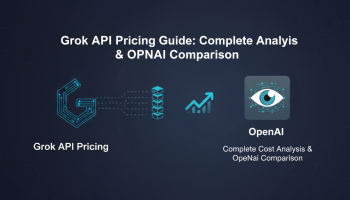
The landscape of artificial intelligence is shifting rapidly, with Elon Musk’s xAI entering the fray as a formidable competitor to established giants like OpenAI and Anthropic. For developers, CTOs, and tech leaders, the release of the Grok API represents more than just another large language model (LLM) option—it represents a new paradigm in Grok API pricing, performance trade-offs, and “unhinged” steerability.
Understanding the cost implications of integrating xAI’s models into your infrastructure is critical. As businesses seek to diversify their AI dependencies to avoid vendor lock-in, comparing the Grok API cost structure against market leaders like GPT-4o and Claude 3.5 Sonnet becomes a mandatory exercise in financial diligence. Whether you are building real-time chatbots, complex data analysis tools, or creative writing assistants, the price-per-token metrics can make or break your project’s profitability.
In this comprehensive cornerstone guide, we will dissect the pricing tiers of the Grok API, perform a granular cost analysis compared to OpenAI, and explore the technical nuances—such as context windows and rate limits—that influence your final monthly bill. We aim to provide you with the data needed to decide if xAI is the right investment for your technology stack.
The Philosophy Behind xAI’s Pricing Strategy
To understand the numbers, one must first understand the strategy. xAI has positioned Grok not just as a tool for logic and reasoning, but as a model with a distinct personality and access to real-time data via the X (formerly Twitter) platform. This unique value proposition impacts how they structure their Grok API pricing.
Unlike some competitors who race to the bottom with near-zero margins on “mini” models, xAI appears to be focusing on a premium, high-compute segment while offering competitive rates to attract developers away from the OpenAI ecosystem. The pricing reflects the massive computational resources required to run models like Grok-2, which boasts capabilities rivaling GPT-4 class models, particularly in reasoning and coding benchmarks.
Key Factors Influencing Cost
- Model Architecture: Grok utilizes a Mixture-of-Experts (MoE) architecture, which generally optimizes inference costs but requires significant VRAM overhead, influencing the base API price.
- Real-Time Capability: The integration of real-time knowledge retrieval is a premium feature that justifies specific pricing tiers compared to models with static knowledge cutoffs.
- Tokenization Efficiency: xAI’s tokenizer may process text differently than OpenAI’s tiktoken, meaning the same paragraph could cost different amounts across platforms purely based on token count.
Detailed Grok API Pricing Tiers
As of the latest beta releases, xAI has introduced specific pricing for its flagship models. Developers must note that these prices are for the API usage (pay-as-you-go) and are distinct from the monthly subscription costs of X Premium+.
Grok-2 (grok-beta) Pricing
Grok-2 is the heavy hitter in the xAI lineup, designed for complex reasoning, coding tasks, and nuanced content generation. It is the direct competitor to GPT-4o and Claude 3 Opus.
- Input Cost: Approximately $5.00 per 1 million tokens.
- Output Cost: Approximately $15.00 per 1 million tokens.
- Context Window: Up to 128k tokens (subject to change during beta).
This pricing places Grok-2 in the upper-mid tier of the market. It is priced aggressively to undercut legacy pricing of GPT-4 Turbo while offering performance that xAI claims is superior in specific benchmarks.
Grok-2 Mini (grok-beta-mini) Pricing
For high-volume tasks requiring speed and lower latency—such as customer support bots or simple classification—the mini model is the economical choice.
- Input Cost: Approximately $2.00 per 1 million tokens.
- Output Cost: Approximately $10.00 per 1 million tokens.
While “mini” implies reduced capability, initial benchmarks suggest it retains a surprising amount of the reasoning prowess of its larger sibling, making the Grok API pricing for this tier highly attractive for startups scaling their operations.
Comparative Analysis: Grok vs. The Titans
The numbers alone tell only half the story. To truly evaluate the Grok API pricing, we must juxtapose it with the industry standards: OpenAI and Anthropic.
1. Grok API vs. OpenAI GPT-4o
OpenAI’s GPT-4o (Omni) is the current gold standard for speed and intelligence. Let’s look at the cost differential.
| Feature | xAI Grok-2 (Beta) | OpenAI GPT-4o |
|---|---|---|
| Input Price / 1M Tokens | $5.00 | $2.50 |
| Output Price / 1M Tokens | $15.00 | $10.00 |
| Pricing Verdict | Premium Pricing | More Economical |
Analysis: Currently, OpenAI’s GPT-4o is priced more aggressively than Grok-2. However, developers must weigh this against the “wokeness” filters and refusal rates. For applications requiring less filtered output or specific “fun mode” interactions, the premium on Grok API pricing may be justified by the reduction in refusal-related engineering overhead.
2. Grok API vs. Claude 3.5 Sonnet
Anthropic’s Claude 3.5 Sonnet is widely regarded for its coding and writing nuances. Priced at roughly $3.00 (Input) and $15.00 (Output), it sits directly in competition with Grok.
- Comparison: Grok-2 matches the output cost of Claude 3.5 Sonnet but has a higher input cost.
- Use Case: If your application involves heavy prompt engineering (large input contexts) but short answers, Claude might be cheaper. If your application involves balanced conversations, the difference narrows.
Technical Factors Influencing Your Bill
When calculating your projected monthly spend, simply multiplying tokens by price is insufficient. Several technical factors inherent to the Grok API infrastructure will impact your bottom line.
Tokenization Differences
Not all tokens are created equal. A “token” is roughly 0.75 words, but this ratio varies between tokenizers. If xAI’s tokenizer is more verbose (using more tokens to represent the same sentence than OpenAI), your effective cost increases even if the price per million is identical. Early tests suggest Grok’s tokenizer is comparable to standard BPE (Byte Pair Encoding) models, but developers should run a sample set of their data through the tokenizer to calculate the “Effective Price Per Word.”
Context Window Management
Grok offers a generous context window (up to 128k). While this allows for processing massive documents, filling the context window is the fastest way to balloon costs. A single call with a full 128k context at $5/1M tokens costs approximately $0.64. If you run this continuously, the Grok API pricing scales linearly. Efficient context management—using RAG (Retrieval-Augmented Generation) to only feed relevant chunks—is essential for keeping xAI costs down.
Developer Implementation & Cost Optimization
Transitioning to Grok is streamlined by xAI’s decision to make their API compatible with OpenAI/Anthropic SDKs. This lowers switching costs, but operational costs require vigilance.
Strategies to Reduce Grok API Spend
- Hybrid Routing: Use Grok-2 for complex queries requiring “edgy” or creative responses, and route simple logic or formatting tasks to Grok-2 Mini or cheaper open-source models.
- Caching Responses: Implement semantic caching. If a user asks a question that has been answered before, serve the cached response rather than hitting the API and incurring new token costs.
- Output Token Limits: Strictly define `max_tokens` in your API requests. Grok can be verbose; preventing it from rambling saves money on the more expensive output tokens.
- Batch Processing: If xAI introduces a Batch API (similar to OpenAI’s 50% discount for non-urgent queries), utilize it for background tasks like data analysis or summarization.
Is Grok Worth the Premium?
The central question in any Grok API pricing analysis is ROI (Return on Investment). Grok offers distinct advantages that generic models do not:
- Real-Time Access: The ability to access current events via the X platform (depending on the specific endpoint configuration) can save developers the cost of building separate search scrapers.
- Less Restrictive Safety Guardrails: For creative writing apps, roleplay bots, or applications serving diverse user bases that dislike heavy censorship, Grok provides a user experience that retains users better than overly sanitized models. Higher retention justifies higher token costs.
Frequently Asked Questions (FAQ)
1. Is there a free tier for the Grok API?
Currently, xAI focuses on a credit-based system for beta users. While they may offer initial free credits to approved developers ($25 monthly credits were seen in early beta phases), there is no permanent “free tier” like OpenAI’s limited free trial. Access is generally pay-as-you-go.
2. How does Grok API pricing compare to running open-source models?
Running a model of Grok-2’s size (likely 70B+ parameters) locally requires expensive GPU clusters (e.g., A100s or H100s). For most businesses, the Grok API is significantly cheaper than the hardware and electricity costs of self-hosting a comparable model.
3. Are the prices for Grok-1 and Grok-2 different?
Yes. Legacy models (Grok-1) may have different pricing or be deprecated in favor of the more efficient Grok-2 and Grok-2 mini. Always check the official console for the active model list and associated costs.
4. Can I use my X Premium+ subscription to access the API?
No. The X Premium+ subscription grants access to Grok within the X app interface. The Grok API is a separate developer product billed based on token usage, not a flat monthly subscription.
5. Does xAI charge for Fine-Tuning?
As of now, fine-tuning pricing has not been fully standardized for the public. Typically, fine-tuning APIs charge higher rates for training and slightly higher rates for inference on custom models. Keep an eye on xAI developer changelogs for updates.
6. What are the rate limits for the Grok API?
Rate limits vary by tier usage. During the beta, limits were relatively strict (e.g., usually capped at a certain dollar amount per month or requests per minute) to ensure stability. As the platform matures, enterprise tiers with higher limits are expected.
Conclusion: The Strategic Verdict on Grok API
The entry of xAI into the API market forces a re-evaluation of AI budgets. While the Grok API pricing for its flagship model sits slightly higher than OpenAI’s GPT-4o input costs, it offers a unique flavor of intelligence that is less inhibited and culturally distinct. For developers building generic internal tools, the cost difference might steer them toward GPT-4o-mini. However, for consumer-facing applications where personality, reduced refusal rates, and real-time knowledge are competitive differentiators, Grok justifies its price tag.
Ultimately, the best approach is a diversified one. By adopting an API-agnostic architecture, you can dynamically route traffic to Grok when its unique strengths are required, ensuring you pay for value, not just tokens. As xAI continues to optimize its infrastructure, we expect these costs to become even more competitive, heating up the AI price wars for the benefit of builders everywhere.

Editor at XS One Consultants, sharing insights and strategies to help businesses grow and succeed.