

Blog

Hiring Freelance
Developer vs Web Development Agency: The Ultimate Comparison for Decision-Makers
Introduction Contents hide 1 Introduction 2 Understanding the Core
Players in Web Development 2.1 The Freelance Developer
Introduction
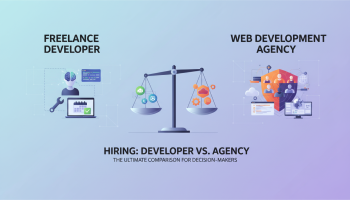
In the modern digital economy, the quality of your software architecture often dictates the trajectory of your business growth. For CTOs, product managers, and founders, the decision of how to staff a technical project is one of the most consequential choices they will make. The debate surrounding hiring freelance developer vs web development agency models is not merely about budget allocation; it is a strategic decision involving risk management, scalability, and long-term technical debt.
As businesses rush to undergo digital transformation, the demand for coding talent has outpaced supply, creating a complex market of solo practitioners and organized firms. Decision-makers often find themselves at a crossroads: do you opt for the agility and perceived cost-savings of a freelancer, or do you invest in the comprehensive structure and reliability of a web development agency?
This guide provides an authoritative analysis of both pathways. We will dissect the nuances of project management, total cost of ownership (TCO), code quality, and post-launch support to help you navigate the landscape of web development procurement with confidence.
Understanding the Core Players in Web Development
Before analyzing the comparative advantages, it is essential to define the operational realities of the two entities. The structural differences between a solo contractor and a full-service firm fundamentally shape the outcome of a software project.
The Freelance Developer Model
A freelance developer is an independent contractor who sells their services by the hour or by the project. They are essentially a one-person business. While many are highly skilled specialists, they operate in a silo. When you hire a freelancer, you are generally hiring a specific set of hands to execute code based on your instructions.
The Web Development Agency Model
A web development agency is a structured organization comprised of cross-functional teams. This entity typically includes backend and frontend developers, UI/UX designers, Project Managers (PMs), Quality Assurance (QA) engineers, and DevOps specialists. When engaging an agency, you are purchasing a product delivery system rather than just labor hours. They bring institutional knowledge, established processes, and collective accountability to the table.
The Case for Hiring a Freelance Developer
The gig economy has democratized access to top-tier talent. Platforms like Toptal, Upwork, and specialized GitHub communities have made it easier than ever to find niche experts. However, this route requires a specific type of client engagement to succeed.
Primary Advantages of Freelancers
- Cost Efficiency: Freelancers have significantly lower overhead than agencies. They do not pay for office space (usually), employee benefits, or administrative staff. Consequently, their hourly rates are typically lower, making them attractive for bootstrapped startups or small-scale projects.
- Direct Communication: Working with a freelancer eliminates layers of management. You speak directly to the person writing the code, which can speed up feedback loops for simple tasks.
- Niche Expertise: If you require a specific, isolated task—such as writing a script in Python or fixing a bug in a React component—a freelancer with that exact skill set is often the fastest solution.
Risks and Limitations
The “bus factor” is the most significant risk in freelance engagement. If your sole developer gets sick, takes a vacation, or abandons the project for a full-time job, your development halts immediately. Furthermore, freelancers rarely offer strategic input regarding product design or business logic; they build what you tell them to build, which can be dangerous if the client lacks technical prowess.
The Case for Partnering with a Web Development Agency
Agencies operate as strategic partners. They are built to handle complexity and mitigate the risks associated with software development life cycles (SDLC).
Primary Advantages of Agencies
- End-to-End Expertise: Successful digital products require more than just code. They need user experience design, security audits, database architecture, and project management. Agencies provide a full stack of talent under one roof.
- Continuity and Reliability: Agencies have redundancy. If one developer leaves, the agency replaces them without pausing your project. The institutional knowledge remains within the firm, not the individual.
- Quality Assurance (QA) and Standards: Reputable agencies employ rigorous testing protocols. Code is peer-reviewed, and CI/CD pipelines are established to ensure that deployment is smooth and bug-free. This level of process rigor is rarely found in freelance engagements.
Risks and Limitations
The primary barrier to entry with agencies is cost. The rates reflect the overhead of the entire team and the infrastructure provided. Additionally, agencies may have more rigid processes and contracts, which can feel less flexible than a casual freelance arrangement for very small tweaks.
Critical Comparison Factors: A Deep Dive
To truly resolve the hiring freelance developer vs web development agency debate, we must analyze specific operational metrics.
1. Total Cost of Ownership (TCO) vs. Hourly Rate
A common pitfall is confusing hourly rate with total cost. A freelancer might charge $60/hour, while an agency charges $150/hour. However, if the freelancer produces unscalable code that requires a complete rewrite in six months, the TCO skyrockets.
Agencies often reduce TCO by getting it right the first time. Their experience with similar projects allows them to avoid costly architectural mistakes. Furthermore, the speed of delivery from a coordinated team often brings the product to market faster, generating revenue sooner.
2. Project Management and Communication
Who manages the backlog? Who prioritizes the sprint? When you hire a freelancer, you are the Project Manager. If you are a non-technical founder, this is a recipe for disaster. You must define the scope, manage timelines, and ensure deliverables meet technical standards.
Agencies include Project Management as part of the service. They utilize tools like Jira or Asana, manage agile sprints, and shield the client from the daily noise of development, presenting only the critical decisions and progress reports.
3. Scalability and Technology Stack
Freelancers usually specialize in one or two technologies (e.g., a WordPress PHP developer or a React Native developer). If your project evolves to require a complex microservices backend or AI integration, the freelancer will hit a wall. You will then have to hire a second freelancer, then a third, and attempt to coordinate them yourself.
Agencies are inherently scalable. As your user base grows, they can allocate more resources to your team. They possess a diverse tech stack capability, allowing them to pivot from MVP to enterprise-grade architecture without changing vendors.
4. Security and Intellectual Property
Data breaches are a career-ending event for executives. Agencies carry professional liability insurance and adhere to strict security protocols (GDPR, HIPAA, SOC2) as part of their standard contracts. Vetting a freelancer’s security hygiene is difficult. Furthermore, enforcing NDAs and IP transfer agreements across international borders with individual contractors can be legally precarious compared to contracting with a registered domestic LLC or Corporation.
The Decision Matrix: Which Path is Right for You?
Choose a Freelancer When:
- Scope is Small: Minor bug fixes, landing pages, or maintenance of a simple CMS.
- Budget is Heavily Constrained: Pre-seed startups or personal hobby projects.
- You Are Technical: If you are a CTO who can code-review and manage the freelancer directly.
- Speed of Hiring is Critical: You need someone to start within 24 hours for a short task.
Choose an Agency When:
- Project is Complex: Custom SaaS platforms, mobile apps, e-commerce with custom integrations, or legacy system modernization.
- Reliability is Non-Negotiable: You have investors or stakeholders demanding a strict timeline and quality standard.
- Long-Term Partnership Needed: You view technology as a core business asset requiring ongoing evolution.
- You Lack Technical Leadership: You need a partner to guide the technical strategy, not just execute orders.
Strategic Conclusion
The choice between hiring freelance developer vs web development agency ultimately depends on your risk tolerance and the strategic value of the software being built. Freelancers offer a tactical solution for specific problems, providing speed and cost savings for limited scopes. However, for businesses aiming to build robust, scalable, and secure digital assets, the agency model provides the necessary infrastructure for success.
In the high-stakes world of software development, “cheap” is often expensive in the long run. An agency functions not just as a vendor, but as a growth partner, safeguarding your code quality and ensuring your technology scales with your vision. Assess your internal capabilities honestly—if you cannot effectively manage a development team, investing in an agency is the safest path to ROI.
Frequently Asked Questions
1. What is the cost difference between hiring freelance developer vs web development agency?
Freelancers typically charge 30-50% less per hour than agencies due to lower overhead. However, agencies often provide a fixed-cost project quote or a retainer model which includes Project Management, QA, and UI/UX design, potentially offering better value for complex projects despite the higher headline rate.
2. Is it safer to hire an agency for Intellectual Property (IP) protection?
Generally, yes. Agencies operate under strict corporate contracts with established legal jurisdictions. They have standard procedures for IP transfer upon payment. Enforcing IP rights against an anonymous freelancer in a different country can be significantly more challenging and costly.
3. Can a freelancer handle a full-stack enterprise project alone?
It is highly unlikely. Enterprise projects require diverse skills: database architecture, frontend design, security compliance, and DevOps. A “full-stack” freelancer may know the code, but rarely has deep expertise in all these areas simultaneously. An agency provides a team of specialists for each domain.
4. How do I transition from a freelancer to an agency?
This is a common scaling phase. The agency will typically start with a “Code Audit” to assess the quality of the freelancer’s work. They will then document the existing architecture, refactor unstable code, and migrate the project into their professional project management workflow.
5. Do agencies provide post-launch support?
Yes, most agencies offer Service Level Agreements (SLAs) for maintenance, updates, and server monitoring. Freelancers may move on to other projects, leaving you without support if something breaks months after launch.
6. Which option is faster for building an MVP (Minimum Viable Product)?
If the MVP is very simple, a freelancer might be faster due to the lack of formal process. However, for a high-quality MVP intended to secure funding, an agency can often work faster by paralleling tasks (e.g., designers and developers working simultaneously) rather than a freelancer doing tasks sequentially.

Editor at XS One Consultants, sharing insights and strategies to help businesses grow and succeed.