
Blog

How to
Build an AI Chatbot with a Custom Knowledge Base
Building an AI chatbot with a custom knowledge base
allows your chatbot to provide precise, context-aware answers
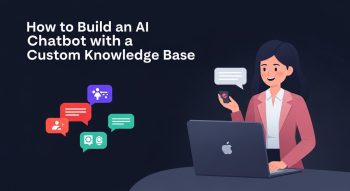
Building an AI chatbot with a custom knowledge base allows your chatbot to provide precise, context-aware answers based on your organisation’s data, documents, or FAQs. Unlike general-purpose AI chatbots, this approach ensures that responses are accurate, relevant, and aligned with your specific content. You can use AI models, vector databases, and retrieval-augmented generation (RAG) techniques to create an intelligent chatbot that draws knowledge from your curated sources.
Understanding AI Chatbots with Custom Knowledge Bases
A custom knowledge base An AI chatbot works by storing your data in a structured way, retrieving the most relevant content when a user asks a question, and using an AI model to generate natural, human-like responses. This architecture ensures that the chatbot provides answers grounded in your documents rather than relying solely on general AI knowledge.
Benefits of Using a Custom Knowledge Base
-
Accuracy: Answers are derived from verified internal data or documentation
-
Consistency: Responses align with company policies and guidelines
-
Efficiency: Reduces manual support efforts by handling repetitive queries
-
Scalability: Can handle multiple queries simultaneously without human intervention
-
Personalization: Responses can be tailored to your specific audience or context
Preparing Your Knowledge Base
Before building the chatbot, collect and organise the data that it will use to answer questions.
Steps to Prepare Your Knowledge Base
-
Collect Content: Gather FAQs, manuals, guides, product information, website content, or internal documents.
-
Format Documents: Convert documents to readable text if necessary (PDFs, Word, HTML).
-
Chunk Data: Break large documents into smaller sections or paragraphs for easier retrieval.
-
Add Metadata: Include tags, categories, or keywords to improve search accuracy.
-
Clean Content: Remove duplicate, irrelevant, or outdated information to ensure quality.
Choosing the Technology Stack
You can build a custom knowledge base chatbot using:
-
AI Models: OpenAI GPT models, Hugging Face transformers, or other LLMs
-
Vector Databases: Pinecone, Weaviate, Milvus, or Oracle 23ai for storing embeddings
-
Programming Languages: Python, JavaScript, or frameworks like LangChain for chaining retrieval and generation
-
Web or App Interface: HTML/CSS/JS for websites, or integration with messaging platforms like Discord, Slack, or WhatsApp
Building the Chatbot Architecture
The architecture of a knowledge base An AI chatbot typically follows the RAG model:
Document Ingestion and Embedding
-
Convert your content into text chunks
-
Generate embeddings (vector representations) for each chunk using an embedding model
-
Store embeddings in a vector database for fast similarity search
Query Handling
-
When a user asks a question, generate an embedding for the query
-
Retrieve the top relevant document chunks from the vector database using similarity search
Generative Response
-
Pass the retrieved content along with the user query to a generative AI model
-
Use prompt engineering to instruct the model to answer using the retrieved context
-
Return the generated response to the user via the chatbot interface
Implementation Steps
Step 1: Ingest Your Knowledge Base
-
Convert all your content to text
-
Break it into manageable chunks
-
Generate embeddings for each chunk using an AI embedding model
-
Store the embeddings and text chunks in a vector database
Step 2: Set Up a Retrieval System
-
Implement a semantic search function to query the vector database
-
Use cosine similarity or other metrics to find the most relevant chunks
-
Retrieve the top-k results for the user query
Step 3: Integrate the Generative AI Model
-
Construct a prompt that includes the retrieved context and the user question
-
Send the prompt to an AI model like GPT to generate the response
-
Ensure the AI model answers using only the retrieved knowledge to maintain accuracy
Step 4: Build the Chatbot Interface
-
Create a frontend interface for users to interact with the chatbot (web, mobile app, or messaging platform)
-
Display user queries and AI responses in a chat format
-
Add features like typing indicators, scrollable chat history, and message formatting
Step 5: Test and Optimize
-
Test the chatbot with various questions to verify accuracy
-
Refine prompts to improve response quality
-
Update and expand the knowledge base regularly
-
Monitor analytics to track user interactions and improve performance
Advanced Features for a Knowledge Base Chatbot
-
Contextual Memory: Maintain conversation history to answer multi-turn queries coherently
-
Custom Personalities: Tailor the AI model’s tone and style to match your brand
-
Multi-language Support: Provide responses in multiple languages for global users
-
Feedback Mechanism: Allow users to rate responses to improve chatbot accuracy
-
Document Updates: Automatically update embeddings when new content is added
Conclusion
Building an AI chatbot with a custom knowledge base enables accurate, reliable, and context-aware interactions. By collecting and structuring your content, generating embeddings, implementing a retrieval system, and integrating a generative AI model, you can create a chatbot that provides instant answers tailored to your organisation’s data. Continuous testing, prompt optimisation, and regular knowledge base updates ensure the chatbot remains effective and valuable for users.

He is a SaaS-focused writer and the author of Xsone Consultants, sharing insights on digital transformation, cloud solutions, and the evolving SaaS landscape.