
Blog

How to
Build Your AI Chatbot with NLP in Python
Building an AI chatbot with NLP (Natural Language Processing)
in Python allows you to create a conversational
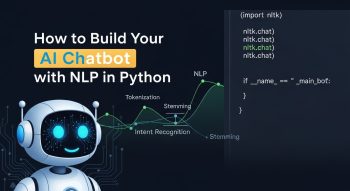
Building an AI chatbot with NLP (Natural Language Processing) in Python allows you to create a conversational agent that can understand user input, interpret the meaning, and generate meaningful responses. Python offers a rich ecosystem of NLP libraries, AI frameworks, and machine learning tools, making it ideal for developing intelligent chatbots.
Understanding NLP Chatbots
An NLP chatbot uses algorithms to process natural language input from users. Unlike rule-based chatbots, NLP chatbots can understand synonyms, sentence structures, and context, providing more human-like interactions. NLP techniques like tokenization, stemming, lemmatization, and intent recognition enable the chatbot to comprehend and respond accurately.
Benefits of an NLP Chatbot
-
Understanding natural language: Handles variations in user input
-
Context awareness: Maintains conversation flow for multi-turn interactions
-
Scalability: Can manage numerous simultaneous conversations
-
Automation: Reduces the need for human customer support
-
Customizable: Can be trained on domain-specific data for precise responses
Setting Up the Python Environment
Before building the chatbot, ensure you have Python installed and the required libraries.
Required Libraries
-
NLTK: For text preprocessing and tokenization
-
spaCy: For advanced NLP tasks like entity recognition
-
scikit-learn: For machine learning models
-
transformers: For pre-trained language models
-
Flask or FastAPI: For deploying the chatbot as a web service
Install the necessary libraries using pip:
Preprocessing User Input
NLP chatbots require text preprocessing to improve understanding. Preprocessing steps include:
Step 1: Tokenization
Break sentences into words or tokens for analysis.
Step 2: Lowercasing and Cleaning
Convert all text to lowercase and remove punctuation or special characters.
Step 3: Lemmatization or Stemming
Reduce words to their root forms to improve matching and intent recognition.
Example Python Code
Intent Recognition
Intent recognition is the process of determining what the user wants to achieve with their input.
Step 1: Define Intents
Create a JSON file or dataset containing common user intents and example phrases, e.g., greetings, FAQs, support requests.
Step 2: Train a Model
Use a machine learning classifier (like Logistic Regression, SVM, or a neural network) to classify user inputs into intents based on training examples.
Example Using scikit-learn
Response Generation
Once the chatbot recognizes the intent, it can generate an appropriate response.
Step 1: Predefined Responses
Map intents to predefined responses stored in a dictionary or database.
Step 2: AI-Generated Responses
For more advanced chatbots, use pre-trained language models like GPT to generate dynamic answers based on user queries.
Example of Predefined Responses
Adding NLP with Transformers for Advanced Chatbots
For more intelligent chatbots, use transformer models from Hugging Face:
Deploying the Chatbot
To make your chatbot accessible, you can deploy it as a web service using Flask or FastAPI.
Example Using Flask
This allows you to send POST requests to your chatbot and receive responses in JSON format, which can be integrated into a web interface, mobile app, or messaging platform.
Testing and Optimizing the Chatbot
-
Test with various phrasings to ensure accurate intent recognition
-
Expand your training dataset for better performance
-
Monitor user interactions to improve responses and handle edge cases
-
Fine-tune transformer models for domain-specific knowledge if needed
Conclusion
Building an AI chatbot with NLP in Python involves preprocessing user input, recognizing intents, generating responses, and deploying the system for real-time interaction. By using Python libraries like NLTK, scikit-learn, and transformers, you can create chatbots ranging from simple rule-based systems to intelligent, AI-driven conversational agents. Continuous testing, dataset expansion, and model optimization ensure your chatbot delivers accurate, human-like interactions and improves user engagement.

He is a SaaS-focused writer and the author of Xsone Consultants, sharing insights on digital transformation, cloud solutions, and the evolving SaaS landscape.