
Blog

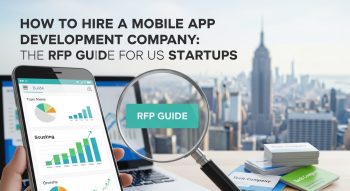
How to
Hire a Mobile App Development Company: The RFP Guide for US Startups
Learn how to hire a mobile app development company
with this comprehensive guide for US startups. Includes
Introduction
In the high-stakes ecosystem of the United States startup landscape, the difference between a unicorn and a failed venture often boils down to technical execution. For non-technical founders, the prospect of building a digital product is daunting. The question of how to hire a mobile app development company is not merely a logistical inquiry; it is a strategic decision that will define the trajectory of your business.
The market is flooded with agencies promising rapid delivery and rock-bottom prices. However, a partner who understands your business logic, adheres to US compliance standards, and writes scalable code is a rarity. A misstep here results in technical debt, delayed launches, and intellectual property disputes that can cripple a startup before it gains traction.
This comprehensive guide acts as your blueprint. We will dissect the process of vetting potential partners, structuring a Request for Proposal (RFP) that attracts top-tier talent, and navigating the complexities of contracts and IP ownership. Whether you are looking for localized expertise on the coasts or cost-effective cross-platform solutions, this article provides the architectural framework for making an informed hiring decision.
Defining Your Vision Before the Search
Before you even begin typing “mobile app developers” into a search engine, you must have a crystallized vision of your product. Development agencies are builders, not mind readers. The clarity of your initial requirements correlates directly with the accuracy of the quotes and timelines you will receive.
Scope, Objectives, and the MVP
Startups often fall into the trap of feature creep—trying to build a “Swiss Army Knife” application in version one. The most successful approach is to define a Minimum Viable Product (MVP). Identify the core problem your app solves and list the absolute minimum features required to solve it. This not only conserves budget but also allows you to test market fit faster.
When preparing to hire, document your user personas, user journeys, and the primary monetization model. A developer needs to know if this is a subscription-based productivity tool, a transactional e-commerce platform, or an ad-supported social network. These details fundamentally shift the architectural requirements.
Platform Strategy: iOS, Android, or Cross-Platform?
Your choice of platform dictates the skills you need to hire for. Native development (Swift for iOS, Kotlin for Android) offers superior performance for complex, hardware-intensive apps. However, it requires two separate codebases and, consequently, two separate development streams.
For many startups, cross-platform development is the most strategic entry point. Frameworks like Flutter allow for a single codebase to deploy on both iOS and Android without significant performance compromises. This approach reduces time-to-market and development costs. If budget efficiency is a priority, you might consider looking into affordable Flutter app developers in the USA who can deliver high-value cross-platform solutions that maintain a native feel.
In-House vs. Outsourcing vs. Hybrid Models
The dilemma of building an internal team versus hiring an external agency is common. Building an in-house team offers total control but comes with high overheads—salaries, benefits, and equipment costs—and a slow ramp-up time. Outsourcing to an agency provides immediate access to a complete team (developers, QA, PMs, designers) at a fixed or hourly rate, offering scalability.
A hybrid model often works best for scaling startups: hire a core CTO or Product Manager in-house to oversee the vision, while contracting a specialized agency to handle the heavy lifting of execution.
The Request for Proposal (RFP): Your Filtering Mechanism
Serious development companies respond to serious inquiries. An RFP is a document that announces your project, describes it, and solicits bids from qualified contractors. It is your first line of defense against low-quality agencies.
Why an RFP Matters
An RFP standardizes the vetting process. When every agency responds to the same set of questions and requirements, you can compare “apples to apples.” It also signals to vendors that you are a professional organization with a budget and a plan, which attracts higher-quality partners.
Key Components of a Winning App Development RFP
To attract the best proposals, your RFP should include:
- Executive Summary: A brief overview of your company and the project vision.
- Project Scope & Deliverables: Detailed feature lists, wireframes (if available), and platform requirements.
- Technical Constraints: Any specific APIs, legacy systems, or third-party integrations required.
- Timeline & Budget Range: Be realistic. Giving a range helps filter out agencies that are too expensive or suspiciously cheap.
- Submission Requirements: Ask for case studies, references, and a breakdown of their development methodology.
By investing time in a detailed RFP, you ensure that the proposals you receive are tailored to your specific needs, saving weeks of back-and-forth communication.
Sourcing Potential Partners: Where to Look
The United States is home to several major technology hubs, each with its own strengths. Depending on your industry and time zone preference, you may want to target specific regions.
The West Coast: Innovation and Tech Giants
Silicon Valley and the broader West Coast remain the epicenter of global tech innovation. Agencies here are often at the bleeding edge of trends like AI, AR/VR, and blockchain. If you are building a deep-tech startup and require proximity to the venture capital ecosystem, you should research the top mobile app development companies in California. These partners are accustomed to the high-velocity, high-stakes environment of unicorn startups.
The East Coast: Finance, Media, and Enterprise
For startups in FinTech, Media, or AdTech, the East Coast offers agencies with deep domain expertise in these verticals. New York, in particular, hosts developers who understand the rigorous compliance requirements of the financial sector. If your venture falls into these categories, exploring the leading mobile app development companies in New York can provide you with partners who speak your industry language.
B2B Directories and Review Platforms
Platforms like Clutch, GoodFirms, and Manifest are valuable resources. They verify client reviews and categorize agencies by service line and budget. However, treat these as a starting point. A high ranking on a directory does not guarantee a culture fit for your specific startup.
Vetting App Developers: A Step-by-Step Framework
Once you have a shortlist of proposals, the real work begins. Vetting is not just about checking if they can code; it is about ensuring they can deliver your product successfully.
1. Portfolio Analysis: Look Beyond the UI
Do not just look at the screenshots in their portfolio. Download the apps they have built. Test them. fast. Is the user experience smooth? Does the app crash? How frequently is it updated? A pretty interface means nothing if the backend is unstable. Look for apps in your specific industry vertical to gauge their domain expertise.
2. Technical Proficiency and Code Ownership
Ask about their tech stack and development standards. Do they use version control (Git)? do they have a CI/CD (Continuous Integration/Continuous Deployment) pipeline established? Crucially, you must clarify code ownership. As a US startup, you need to own the Intellectual Property (IP) of the code from day one. Avoid agencies that retain rights to the source code or use proprietary platforms that lock you in.
3. Client References and Testimonials
Ask for references from past clients, specifically those who had projects similar in size and complexity to yours. When you speak to them, ask hard questions:
- “Did they stay within budget?”
- “How did they handle scope changes?”
- “Was the communication transparent when things went wrong?”
- “How was the post-launch support?”
4. Assessing Culture and Communication
For US startups, communication is paramount. If you are outsourcing offshore or nearshore, ensure there is significant time zone overlap. You need to be able to have real-time Slack conversations and Zoom calls without waiting 24 hours for a reply. Assess their level of proactivity—do they challenge your ideas and suggest improvements, or do they just say “yes” to everything? You want a partner, not just a pair of hands.
Negotiating Contracts and Pricing Models
Understanding how you pay is as important as how much you pay. Development contracts generally fall into two categories.
Fixed Price Model
In this model, the scope, timeline, and budget are frozen. This is great for small, well-defined projects (MVPs) where budget certainty is critical. However, it is rigid. If you want to change a feature halfway through, it requires a “Change Order,” which can delay the project and increase costs.
Time and Materials (T&M)
You pay for the hours worked by the developers. This model offers maximum flexibility and is preferred for Agile development where requirements evolve based on user feedback. It requires a higher level of trust, as costs can spiral if not managed correctly. For most long-term startup projects, T&M is the standard, provided there is a capped budget or strict reporting.
The Service Level Agreement (SLA)
Ensure your contract includes an SLA that covers post-launch support. Who fixes bugs found after launch? What is the response time for a server outage? A 30 to 90-day warranty period for bug fixing is industry standard.
Red Flags to Watch Out For
During the hiring process, be vigilant for these warning signs:
- The “Yes” Men: If an agency agrees to every feature request without discussing feasibility or budget impact, they are likely setting you up for failure.
- Unrealistically Low Estimates: If one quote is 50% lower than the others, there is a reason. They may be cutting corners on QA, using junior developers, or planning to hit you with hidden costs later.
- Lack of Transparency: If they refuse to let you speak directly to the developers or hide their development process, walk away.
- Generic Proposals: If the proposal looks like a copy-paste job that doesn’t address your specific business goals, they are not invested in your success.
The Post-Hiring Phase: ensuring Success
Hiring the company is just the start. To ensure the project succeeds, you must remain involved.
Onboarding and Kickoff
Hold a formal kickoff meeting to introduce the teams, set up communication channels (Slack, Jira, Trello), and agree on the sprint schedule. Ensure the agency has access to all necessary assets (brand guidelines, server access).
Agile Project Management
Adopt an Agile workflow with bi-weekly sprints. This allows you to review progress every two weeks and pivot if necessary. Never go dark for months hoping the final product will be perfect. Constant iteration is the key to software development.
Frequently Asked Questions
How much does it cost to hire a mobile app development company in the US?
Costs vary wildly based on complexity and location. A simple MVP might cost between $25,000 and $50,000. A complex, feature-rich app developed by a top-tier US agency can range from $150,000 to over $500,000. Offshore options can be cheaper, but management overheads may increase.
How long does it take to build a mobile app?
A standard timeline for an MVP is typically 3 to 4 months. More complex applications with custom backends and third-party integrations can take 6 to 9 months or more. Timelines depend heavily on the clarity of requirements and the speed of client feedback.
Should I hire a freelancer or an agency?
Freelancers are cost-effective for small updates or very simple apps but lack the breadth of skills (design, QA, project management) required for a full-scale startup product. Agencies provide a cohesive team that ensures continuity if one member gets sick or leaves.
What is the difference between Native and Hybrid apps?
Native apps are built specifically for one platform (iOS or Android) using platform-specific languages, offering the best performance. Hybrid or Cross-platform apps (using Flutter or React Native) use one codebase for both platforms, saving time and money, often with negligible performance differences for standard apps.
Who owns the code after the app is developed?
You, the client, should always own the code, design assets, and intellectual property upon payment. Ensure this is explicitly stated in the contract (

Editor at XS One Consultants, sharing insights and strategies to help businesses grow and succeed.