

Blog

iPhone 17
Air Battery Life Controversy: Analyzing Performance in the Ultra-Thin Model
Introduction: The Paradox of the Ultra-Thin iPhone 17 Air
Contents hide 1 Introduction: The Paradox of the
Introduction: The Paradox of the Ultra-Thin iPhone 17 Air
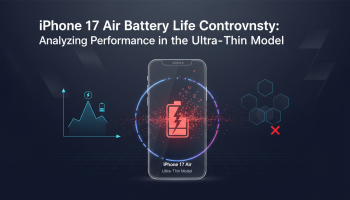
The smartphone industry is currently abuzz with the most polarizing rumor in recent Apple history: the introduction of the iPhone 17 Air. Slated to replace the "Plus" model in the 2025 lineup, this device promises a revolutionary form factor, reportedly measuring a mere 6mm in thickness. However, this aesthetic triumph brings with it a significant technical challenge that has sparked intense debate among analysts and power users alike: iPhone 17 Air battery life.
For years, the "Plus" and "Pro Max" models have reigned supreme in endurance, utilizing their larger chassis to house massive battery cells. By pivoting to an ultra-slim design, Apple is effectively fighting the laws of physics. How can a device significantly thinner than the iPhone 6 offer the all-day performance modern users demand? This cornerstone analysis delves deep into the controversy, examining the intersection of next-generation hardware efficiency, battery chemistry innovation, and the potential trade-offs early adopters might face.
The Core Controversy: Replacing the Battery King
To understand the gravity of the iPhone 17 Air battery life concerns, one must look at the model it is destined to replace: the iPhone Plus series. Historically, the iPhone 15 Plus and 16 Plus have offered some of the best battery performance in the entire smartphone market, often outlasting even the Pro models in pure video playback due to the lack of power-hungry Pro features like 120Hz always-on displays.
The iPhone 17 Air represents a paradigm shift. Reports from supply chain analysts like Ming-Chi Kuo and Ross Young suggest the "Air" (or "Slim") model will prioritize form over function. This creates a distinct conflict:
- The Plus Legacy: Known for multi-day usage and massive mAh capacities.
- The Air Reality: Physically constrained internal volume, necessitating a physically smaller battery cell.
The controversy lies in the math. If the chassis volume is reduced by 30-40% compared to a standard iPhone, the battery capacity (measured in milliampere-hours, or mAh) must theoretically shrink. Unless Apple introduces a quantum leap in power efficiency, the iPhone 17 Air battery performance risks falling short of the high bar set by its predecessors.
Engineering the Impossible: How Apple Plans to Mitigate Power Loss
Despite the physical constraints, Apple is not known for releasing devices that die by noon. To make the iPhone 17 Air viable, Cupertino is relying on a trifecta of engineering innovations designed to squeeze every ounce of efficiency out of the device.
1. The A19 Chip and 2nm Process Technology
The savior of the iPhone 17 Air battery life will likely be the A19 chipset. While the iPhone 17 Pro models may receive the A19 Pro, the Air is expected to utilize a highly optimized version of Apple’s next-generation silicon.
Fabricated on TSMC’s advanced N3P or potentially early 2nm process nodes, the A19 focuses on performance-per-watt. By shrinking the transistors, Apple can achieve the same processing power as the A18 while consuming significantly less energy. This architectural efficiency is crucial; if the chip consumes 20% less power, Apple can afford a 20% smaller battery without changing the user’s perceived battery life.
2. TDDI Display Technology
The screen is traditionally the biggest drain on a smartphone battery. For the iPhone 17 Air, Apple is rumored to be adopting Touch and Display Driver Integration (TDDI) for its OLED panels. This technology combines the touch sensor and display driver layers into a single unit.
Benefits of TDDI for the Air:
- Reduced Thickness: Helps achieve the 6mm profile.
- Energy Efficiency: Integrated drivers tend to manage power states more effectively than separate components.
- Variable Refresh Rates: If Apple includes ProMotion (1Hz-120Hz) on the Air, the ability to drop the refresh rate to static images will be vital for preserving battery during standby.
3. High-Density Battery Chemistry
To combat the volume reduction, Apple is reportedly exploring new battery chemistry with higher energy density. By increasing the amount of energy stored per unit of volume, Apple can use a physically smaller battery that holds a charge comparable to a larger, older-generation cell.
Supply chain leaks indicate a move toward cells with higher silicon content in the anode, allowing for greater capacity without increasing the physical footprint. This is the only way the iPhone 17 Air can approach the 3,500–4,000 mAh range required for modern usability.
Thermal Management: The Silent Battery Killer
A critical, often overlooked aspect of the iPhone 17 Air battery life controversy is thermal dynamics. Batteries perform poorly when overheated, and ultra-thin phones are notoriously difficult to cool.
With less internal space for air circulation and heat dissipation, the iPhone 17 Air faces a risk of thermal throttling. If the processor heats up, the phone must work harder, draining the battery faster. To counter this, Apple is expected to utilize a novel graphite sheet cooling system or potentially a resin-coated copper (RCC) mainboard to reduce internal resistance and heat generation.
If the thermal management fails, users could experience:
- Rapid battery drain during gaming or 5G usage.
- Diminished battery health over long-term ownership (chemical aging accelerates with heat).
- Reduced charging speeds as the device throttles input to prevent overheating.
Projected Performance: The "Air" vs. The "Pro"
For potential buyers, the decision will come down to a direct comparison. Here is how the iPhone 17 Air battery life is projected to stack up against the rumored 17 Pro lineup.
iPhone 17 Air vs. iPhone 17 Pro Max
The Pro Max will remain the undisputed king of endurance. With a thicker chassis allowing for a nearly 5,000 mAh battery, the Pro Max targets power users. The Air, by contrast, is a lifestyle device. Users moving from a Pro Max to an Air will notice a dip in longevity—likely requiring a mid-day top-up if they are heavy users.
iPhone 17 Air vs. Standard iPhone 17
This is the more competitive battleground. The standard iPhone 17 will likely share the A19 chip but will have a traditional form factor. If the standard model houses a significantly larger battery, the Air becomes a hard sell for utility-focused users. However, if Apple optimizes the Air effectively, the difference might be negligible—similar to the difference between an Apple Watch Series 10 and an Ultra (distinct use cases).
The Verdict: Who is the iPhone 17 Air For?
The iPhone 17 Air battery life controversy ultimately boils down to user priorities. This device is not designed for the gamer who plays Genshin Impact for three hours straight, nor is it for the videographer shooting 4K ProRes all day.
The iPhone 17 Air is designed for the social professional and the minimalist. It is for users who prioritize:
- Portability and Aesthetics: A device that disappears in a pocket.
- Standard Usage: Messaging, social media, light browsing, and photography.
- Fast Charging Reliance: Leveraging USB-C fast charging to mitigate lower capacity.
If you fall into the category of "heavy user," the anxiety surrounding the battery life is justified. However, for the average consumer, the efficiency gains of the A19 chip may render the controversy moot.
Frequently Asked Questions (FAQ)
1. Will the iPhone 17 Air battery life be worse than the iPhone 16 Plus?
Likely, yes. The iPhone 16 Plus is physically larger and houses a massive battery focused on pure endurance. The iPhone 17 Air sacrifices physical battery volume for extreme thinness. While the A19 chip will be more efficient, it is mathematically difficult to match the raw capacity of the Plus model.
2. What is the expected mAh capacity of the iPhone 17 Air?
While official specs are not released, analysts project the iPhone 17 Air battery capacity to sit somewhere between the standard iPhone SE and the base model iPhone 17, likely in the 3,000 to 3,500 mAh range, heavily relying on processor efficiency to stretch usage.
3. Will the iPhone 17 Air support MagSafe charging?
Yes, the iPhone 17 Air will support MagSafe. However, due to the thin chassis, there are rumors that Apple may use a thinner magnetic array or slightly different coil winding to prevent the phone from heating up excessively during wireless charging.
4. Does the ultra-thin design cause overheating issues that affect battery life?
Thermal management is the biggest challenge for the Air. If the device cannot dissipate heat effectively, the battery will drain faster. Apple is expected to use advanced materials like resin-coated copper motherboards to manage thermals without bulk.
5. Will the iPhone 17 Air have a 120Hz ProMotion display?
Current leaks are conflicted. If the Air receives a ProMotion (LTPO) display, it would significantly help battery life by ramping down to 1Hz when the screen is static. If it is stuck at 60Hz, it will be less power-efficient than the Pro models.
6. Should I wait for the iPhone 17 Air or buy the iPhone 16 Pro?
If battery life is your number one priority, the iPhone 16 Pro or Pro Max is the safer bet. You should only wait for the iPhone 17 Air if you value the thinnest, lightest form factor above multi-day battery endurance.
Conclusion: The Price of Innovation
The iPhone 17 Air battery life controversy highlights the eternal struggle in consumer electronics: the balance between aesthetics and utility. Apple is poised to release a device that looks like the future, but it may require users to adapt their charging habits to accommodate the laws of physics.
The success of the iPhone 17 Air will not depend on its raw mAh count, but on the real-world efficiency of the A19 chip and iOS optimization. For those willing to trade a few hours of screen-on time for a device that feels impossibly light, the Air will be a revelation. For the power user, however, the Pro Max remains the undisputed champion of endurance. As we approach the release, the industry watches with bated breath to see if Apple can truly pull off the ultimate disappearing act: making the battery bulk vanish without making the power disappear with it.

Editor at XS One Consultants, sharing insights and strategies to help businesses grow and succeed.