

Blog

Mobile App
Discovery Methods That Actually Work in 2025
In the hyper-competitive mobile app ecosystem of 2025, where
over 5.2 million apps vie for user attention
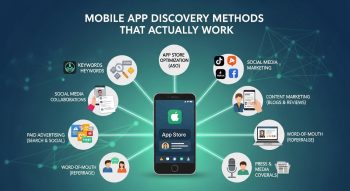
In the hyper-competitive mobile app ecosystem of 2025, where over 5.2 million apps vie for user attention across the Apple App Store and Google Play, mobile app discovery methods that actually work are the difference between viral success and digital obscurity. Proven strategies like app store optimization (ASO), word-of-mouth referrals, social media promotion, influencer marketing, paid advertising campaigns, cross-promotion strategies, user reviews and ratings, and referral incentives dominate effective user acquisition. When executed with precision—leveraging targeted keyword research, compelling app visuals, authentic endorsements, data-driven advertising, organic growth tactics, and community building—these methods enhance app discoverability, skyrocket organic downloads, improve app store rankings, and drive long-term user retention. This comprehensive guide explores mobile app discovery strategies that deliver measurable results, backed by real-world examples, data, and actionable frameworks.
Why Mobile App Discovery Is Harder Than Ever in 2025
With global smartphone users surpassing 6.8 billion and the average person engaging with just 25–35 apps monthly, mobile app discovery has become a high-stakes challenge. App store searches still account for 63% of all app installs, making search visibility a core pillar of growth. However, algorithm updates on iOS and Android now prioritize user engagement signals—session length, retention rates, in-app actions, and review velocity—over mere download volume.
Organic channels like ASO and word-of-mouth marketing outperform paid acquisition in cost-per-loyal-user (CPLU), with peer recommendations influencing 58% of download decisions. Yet, paid app install campaigns remain essential for scaling reach, especially in saturated categories like gaming, fitness, and productivity. The most successful apps in 2025 adopt a hybrid discovery model: blending organic app growth with targeted paid promotion to achieve sustainable user acquisition and positive ROI.
Ignoring mobile app discovery guarantees failure—even groundbreaking apps vanish without visibility. The objective? Acquire high-value users who engage, convert, and advocate, maximizing lifetime value (LTV) while minimizing churn.
App Store Optimization (ASO): The Undisputed King of Organic Discovery
App store optimization (ASO) is the foundation of mobile app discoverability, functioning as the mobile equivalent of SEO. In 2025, ASO is more sophisticated than ever, driven by AI-powered algorithms that analyze keyword relevance, visual appeal, user behavior, and localized performance.
1. Mastering Keyword Research and Metadata Optimization
Effective ASO begins with keyword research. Tools like App Radar, Mobile Action, and Sensor Tower help identify high-traffic, low-competition keywords. Focus on long-tail keywords—specific phrases users actually search, such as “habit tracker with reminders” or “budget planner for freelancers”.
- Title (30 characters on iOS, 50 on Google Play): Include your primary keyword and brand. Example: “Calm: Sleep & Meditation App” ranks for “meditation” while reinforcing brand.
- Subtitle (iOS) / Short Description (Android): Use secondary keywords. Keep it benefit-driven.
- Description: Front-load UVPs. Use bullet points. Repeat keywords 3–5 times naturally within 4,000 characters (Android).
- Keyword Field (iOS): 100-character hidden field—fill completely with comma-separated terms (no spaces after commas).
Pro Tip: Avoid keyword stuffing. Apple and Google penalize spammy metadata.
2. Visual Assets: The Silent Conversion Engine
Visuals influence 80% of download decisions. Optimized app icons, screenshots, and preview videos can boost conversion rates by 25–35%.
- App Icon: High contrast, simple, recognizable at 512px. Test bold colors and minimal text.
- Screenshots: 5–8 per orientation. First 3 are critical. Use captions like “Track habits in 10 seconds” or “Sync across all devices”.
- App Preview Video: 15–30 seconds. Show real usage. Vertical format dominates Google Play.
- A/B Testing: Use Apple Search Ads or Google Play Console experiments to test variants.
Case Study: Notion increased conversions by 28% after adding annotated screenshots highlighting collaboration features.
3. Localization: Unlocking Global Markets
Localized ASO boosts visibility in non-English markets. Translate title, subtitle, description, and screenshots for top regions (Japan, Germany, Brazil, India). Use region-specific keywords—e.g., “fussball” instead of “soccer” in Germany.
4. Ratings, Reviews, and Algorithm Signals
Apps with 4.5+ star ratings appear in “Top Charts” and “Similar Apps” sections. Respond to every review within 24 hours. Use in-app prompts after positive experiences to request ratings. Monitor review velocity—consistent new reviews signal active, healthy apps.
ASO Checklist:
- Update metadata every 4–6 weeks
- Monitor competitor keywords
- Refresh screenshots seasonally
- Maintain 4.5+ rating
- Localize top 5 markets
Word-of-Mouth & Referral Programs: The Viral Growth Engine
Word-of-mouth (WOM) remains the most trusted app discovery method, with 92% of consumers trusting peer recommendations over advertising. Apps that engineer shareability achieve exponential organic growth.
Building a Referral Flywheel
- Incentivize Both Parties: Offer value to referrer and referee. Dropbox grew 3,900% in 15 months by giving 500MB free storage to both.
- Frictionless Sharing: One-tap share buttons. Pre-filled messages. Deep links to app store.
- Trigger at Peak Delight: Prompt sharing after a win—e.g., completing a 7-day streak in a fitness app.
- Track with Unique Codes: Use dynamic links (Branch.io, AppsFlyer) to attribute installs and reward accurately.
Community-Powered Advocacy
Build in-app communities, Discord servers, or Reddit subgroups. Encourage user-generated content (UGC). Feature top users. Apps like Strava grew through athlete challenges and leaderboards that users naturally share.
WOM Success Metrics:
- Viral coefficient (K-factor) > 1.0
- 30%+ of new users from referrals
- 2x higher LTV for referred users
Social Media Promotion & Influencer Marketing: Reach + Credibility
Social media drives 25% of app installs, with TikTok, Instagram Reels, and YouTube Shorts leading for Gen Z. Combine organic social content with influencer partnerships for maximum impact.
Organic Social Media Strategies
- Short-Form Video: 15–60 second demos. Use trending audio. Show transformation (before/after).
- User-Generated Content: Repost customer stories. Run hashtag challenges (#MyCalmJourney).
- Stories & Reels: Add “Install Now” CTAs with link in bio (Linktree, Beacons).
- Cross-Platform Teasers: Announce updates on X, drive to TikTok for demos.
Influencer Marketing That Converts
- Micro-influencers (10K–100K followers): Higher engagement (6–8%), lower cost ($100–$500/post).
- Macro-influencers: For brand awareness in gaming/finance.
- Provide Creative Freedom: Give guidelines, not scripts. Authenticity > polish.
- Track with Promo Codes: “SARAH10” for 10% off premium—easy attribution.
Example: Duolingo partnered with TikTok creators for language challenge videos, driving 500K+ installs in one campaign.
Paid Advertising: Precision Scaling for App Growth
Paid app install campaigns are essential for category leaders and new entrants. Top channels:
| Platform | Best For | Avg. CPI (2025) |
|---|---|---|
| Google App Campaigns | Broad reach, intent-based | $1.50–$4.00 |
| Apple Search Ads | High-intent iOS users | $2.00–$5.50 |
| Meta Ads (FB/IG) | Lookalike audiences | $1.80–$3.50 |
| TikTok for Business | Viral potential | $1.20–$3.00 |
Winning Paid Strategies
- Playable Ads (Games): Let users try before install. Boost CVR by 40%.
- Retargeting: Re-engage app openers who didn’t convert. 70% lift in CVR.
- Lookalike Audiences: Seed with high-LTV users.
- Creative Testing: Rotate 5+ ad variants weekly.
- Post-ATT Optimization: Use SKAdNetwork, incrementality testing, and probabilistic modeling.
ROAS Benchmark: Aim for 3:1 in month 1, 5:1 by month 3 for subscription apps.
Cross-Promotion & Strategic Partnerships
Cross-promotion leverages existing user bases at near-zero cost.
- Portfolio Apps: Promote new app within established ones via banners, push, or in-app messages.
- Complementary Partnerships: Fitness app + smart scale brand. Language app + travel blog.
- Ad Networks: ironSource, AppLovin, Unity Ads offer cross-promo inventory.
Example: Headspace cross-promoted with Calm in wellness bundles, driving 120K installs mutually.
User Reviews & Ratings: The Trust Multiplier
79% of users read reviews before downloading. Ratings impact:
- App store ranking
- Featured section eligibility
- Conversion rate (4.5+ stars = 320% higher CVR)
Review Optimization Tactics
- Prompt at Right Moment: After 3rd use or positive action.
- Make It Easy: One-tap rating → app store.
- Respond to All Reviews: Especially negative. 60% of upset users update to 5 stars after resolution.
- Monitor Sentiment: Use AppFollow or Apptentive to track trends.
Content Marketing, Email, and Web-to-App Funnels
Drive discovery beyond app stores:
- SEO-Optimized Landing Pages: Rank for “best habit tracker 2025” → CTA to download.
- Blog & YouTube: “How to Meditate in 5 Minutes” → embed app demo.
- Email Sequences: Nurture blog subscribers with free trials.
- Web-to-App Deep Linking: Click email → open specific feature in-app.
Measuring Success: KPIs That Matter
| Metric | Target | Tool |
|---|---|---|
| Organic Install % | 40%+ | App Store Connect |
| Day 7 Retention | 35%+ | Firebase |
| LTV (Day 90) | 3x CPI | AppsFlyer |
| Referral Rate | 15%+ | Branch.io |
| ROAS | 3:1+ | Platform Dashboards |
A/B test everything. Use incrementality testing to measure true paid impact.
Conclusion: Your Mobile App Discovery Playbook for 2025
The mobile app discovery methods that actually work in 2025 are not one-size-fits-all. The winning formula combines:
- ASO mastery for organic visibility
- Referral programs for viral growth
- Social + influencer for reach and trust
- Paid ads for scalable acquisition
- Cross-promotion for low-cost leverage
- Reviews for social proof
- Content + email for owned channels
Success demands relentless testing, data-driven decisions, and user obsession. The apps that dominate tomorrow are discovering users today—through smart, integrated, measurable strategies.
Start with ASO. Layer in referrals. Scale with paid. Optimize continuously.
Your next million users are waiting. Go find them.

He is a SaaS-focused writer and the author of Xsone Consultants, sharing insights on digital transformation, cloud solutions, and the evolving SaaS landscape.