

Blog

Neuralink Mass
Production: Elon Musk Sets 2026 Goal for Brain-Chips
Introduction: The Dawn of the Brain-Computer Interface Era Contents
hide 1 Introduction: The Dawn of the Brain-Computer
Introduction: The Dawn of the Brain-Computer Interface Era
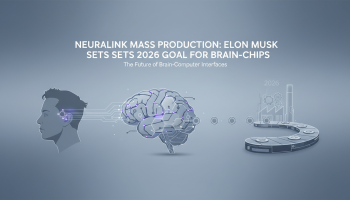
In the landscape of emerging technologies, few announcements have reverberated with as much potential impact as Elon Musk’s recent declaration regarding Neuralink. The ambitious billionaire and tech mogul has set a definitive target: the Neuralink mass production 2026 goal. This timeline signifies a shift from experimental prototypes and limited clinical trials to a scalable industrial reality where Brain-Computer Interfaces (BCIs) could become accessible medical devices.
For decades, the concept of merging human consciousness with digital intelligence was confined to the realms of science fiction. However, with the successful implantation of the "Telepathy" device in human patients, the conversation has pivoted from "if" to "when." Musk’s projection suggests that within a few short years, the manufacturing capabilities will be in place to produce these intricate devices at scale, potentially revolutionizing how we treat neurological conditions and interact with technology.
This cornerstone article dissects the feasibility, technology, and implications of this 2026 goal. We will explore the engineering hurdles of mass-producing nanoscale electrodes, the role of artificial intelligence in decoding neural signals, and the necessary ecosystem of expert technology consultancy required to navigate this uncharted territory.
The 2026 Roadmap: From Prototype to Mass Production
The leap from a controlled laboratory setting to a mass-production assembly line is one of the most difficult transitions in hardware engineering. Neuralink’s objective to achieve mass production by 2026 is aggressive, given the medical and regulatory strictures involved. However, the roadmap is predicated on the success of the specialized surgical robot, the R1, which is effectively the "factory" for installation.
To understand the magnitude of this goal, one must look at the trajectory of the "PRIME" study (Precise Robotically Implanted Brain-Computer Interface). The initial human trials have provided critical data on the durability of the threads and the fidelity of the signal. By 2026, the aim is not just to have a working device, but a streamlined supply chain capable of producing thousands of units with zero defects. This requires a level of precision manufacturing usually reserved for the most advanced aerospace or semiconductor components.
The Supply Chain Challenge
Mass production implies a supply chain capable of sourcing biocompatible materials, advanced battery systems, and hermetically sealed casings at volume. The N1 implant requires specific polymers and gold or platinum-iridium wiring that must adhere to strict FDA standards. Scaling this involves complex logistics and likely partnerships with firms specializing in medical device fabrication.
Deciphering the Technology: The N1 Implant and R1 Robot
At the core of the "Neuralink mass production 2026" narrative are two distinct pieces of technology: the implant and the surgeon.
The N1 Implant
The N1 is a coin-sized device designed to replace a small chunk of the skull. It sits flush with the bone and is invisible from the outside. The critical innovation lies in the 64 "threads" attached to the device. These threads are thinner than a human hair and contain over 1,000 electrodes capable of recording neural activity and stimulating neurons.
Developing the software to interpret these signals requires sophisticated custom software development. The device must capture analog brain spikes, convert them into digital signals, and transmit them wirelessly via Bluetooth to an external app. The latency must be imperceptible for the user to feel a sense of agency over the cursor or limb they are controlling.
The R1 Robot
Because the threads are so fine and the brain is so delicate (and moves with respiration and heartbeat), human hands cannot install the N1. The R1 Robot is designed to insert these threads avoiding blood vessels with micron-level precision. For mass adoption by 2026, Neuralink must mass-produce not just the chips, but the R1 robots themselves to distribute to hospitals and clinics worldwide.
The Critical Role of AI in BCI Decoding
Hardware is only half the battle. The utility of a Neuralink device is entirely dependent on the algorithms that interpret the noise of firing neurons. This is where high-level AI-powered applications come into play. The brain does not speak binary; it speaks in complex, noisy patterns of electrochemical spikes.
Machine learning models must be trained to recognize that a specific firing pattern in the motor cortex corresponds to the intention to "move cursor up" or "click left mouse button." As Neuralink aims for 2026 mass production, the accompanying AI models must become generalized enough to work for different users with minimal calibration time. Currently, calibration can be tedious. Future iterations must utilize adaptive AI that learns the user’s neural syntax in real-time.
Applications: Medical Restoration and Beyond
Elon Musk has bifurcated the goals of Neuralink into near-term and long-term applications. The 2026 production goal is primarily focused on the medical sector, but the seeds for consumer application are being sown.
Restoring Autonomy
The immediate market for the mass-produced N1 includes individuals with quadriplegia or Amyotrophic Lateral Sclerosis (ALS). The ability to control a computer allows these individuals to communicate, browse the web, and manage their environment. This involves complex UI/UX design challenges—creating interfaces that are optimized for neural input rather than mouse-and-keyboard input.
The Gaming Frontier
One of the most widely publicized demonstrations of Neuralink involved a macaque playing the game Pong using only its mind. While this seems trivial, it proves the speed and accuracy of the connection. As the technology matures, we can expect significant crossovers into game development. The ultimate immersive experience involves removing the controller entirely and mapping intention directly to in-game action. While mass consumer gaming via BCI is likely post-2030, the 2026 production ramp-up will provide the developer kits necessary for studios to begin experimenting.
Regulatory Hurdles: FDA Approval and Safety
Setting a goal for 2026 is one thing; getting the Food and Drug Administration (FDA) to agree is another. Mass production cannot legally commence until the device passes rigorous safety phases. The FDA looks for:
- Biocompatibility: The device must not trigger an immune response or break down over time.
- Thermal Regulation: The battery charging and chip processing must not heat the brain tissue.
- Removal: There must be a safe protocol for explanting or upgrading the device.
Neuralink has received "Breakthrough Device Designation," which speeds up the review process, but mass market approval requires data from hundreds, if not thousands, of successful implantations. The timeline to recruit, implant, and monitor this many patients by 2026 is extremely tight.
Cybersecurity and Privacy in the Age of Brain-Chips
When the brain becomes a node on the network, cybersecurity moves from protecting data to protecting biological integrity. If a Neuralink device connects to a smartphone, it is theoretically vulnerable to the same vectors of attack as any other IoT device.
The integration of BCI with mobile app development ecosystems necessitates a new standard of encryption. A hacked pacemaker is dangerous; a hacked brain chip could theoretically alter sensory input or motor output. Trust in the security architecture will be the deciding factor for mass adoption. Manufacturers will need to implement hardware-level security that makes remote tampering impossible.
The Competitor Landscape
Neuralink is not alone in this race, though Musk’s mass production rhetoric is the loudest. Competitors like Synchron have already beaten Neuralink to certain clinical milestones using less invasive stent-trode technology (entering via blood vessels rather than craniotomy). However, Neuralink’s approach offers higher bandwidth (more data transfer) due to direct cortical contact.
The "winner" of the mass production race will not necessarily be the one with the best specs, but the one with the most scalable manufacturing process and the smoothest software integration.
Future Integration: The Digital Human
Looking past the 2026 goal, mass production of BCIs signals a fundamental shift in human evolution. It represents the potential to increase the bandwidth of human-to-human and human-to-AI communication. Musk has often cited the need for humans to merge with AI to avoid becoming obsolete.
This future requires a convergence of disciplines. It needs advanced materials science, robotic surgery, neuro-ethics, and robust technology consultancy to guide corporations and governments through the transition. The companies that build the software bridges between these chips and everyday devices will define the user experience of the next century.
Frequently Asked Questions (FAQs)
1. Is the 2026 goal for Neuralink mass production realistic?
It is an aggressive target known in the industry as a "stretch goal." While the technology is advancing rapidly, regulatory approval for mass market commercialization typically takes longer. 2026 may see limited commercial release or expanded trials rather than full-scale global availability.
2. How much will a Neuralink implant cost?
Elon Musk has suggested that eventually, the surgery could cost around $5,000 to $10,000, similar to LASIK surgery. However, initial mass-produced units in 2026 will likely be significantly more expensive, potentially subsidized by insurance for medical necessities.
3. Can healthy people get a Neuralink in 2026?
Unlikely. The FDA approval pathway Neuralink is currently on focuses on medical devices for restoring function to those with paralysis or neurological disorders. Elective surgery for healthy individuals "enhancement" is a different regulatory category that will face higher ethical and safety scrutiny.
4. What happens if the technology becomes obsolete after implantation?
Neuralink designs its implants to be upgradeable, but this requires subsequent surgeries. The mass production plan involves standardizing the R1 robot to perform explants (removal) and upgrades as safely as the initial installation.
5. Is the Neuralink device safe from hackers?
Security is a top priority. The device uses advanced encryption for data transmission. However, like any wireless device, zero risk does not exist. Neuralink employs top-tier cybersecurity experts to conduct penetration testing to minimize these risks.
Conclusion: Preparing for the Interface Revolution
The Neuralink mass production 2026 goal serves as a rallying cry for the neuro-tech industry. Whether or not the company hits the exact number of units by that specific year is secondary to the momentum it generates. We are witnessing the industrialization of neuroscience.
For businesses, developers, and medical professionals, this era presents unprecedented opportunities and challenges. From developing apps controlled by thought to designing privacy frameworks for neural data, the ecosystem surrounding BCIs will be vast. As we approach 2026, the line between biology and technology blurs, promising a future where the limitations of the human body are no longer absolute.

Editor at XS One Consultants, sharing insights and strategies to help businesses grow and succeed.