

Blog

NVIDIA Blackwell
Ultra GPU Release – Specs, AI Performance & Pricing
The NVIDIA Blackwell Ultra (B300 series) represents the pinnacle
of generative AI infrastructure, pushing the boundaries of
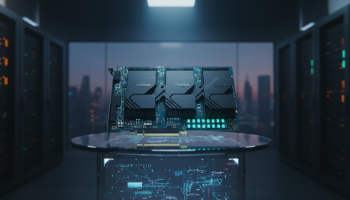
The NVIDIA Blackwell Ultra (B300 series) represents the pinnacle of generative AI infrastructure, pushing the boundaries of the Blackwell architecture with enhanced HBM3e memory capacities and unprecedented FP4 precision throughput. As the successor to the standard B200, the Blackwell Ultra GPU is engineered to handle trillion-parameter Large Language Models (LLMs), offering a 3x performance leap in inference and a significant reduction in total cost of ownership (TCO) for data centers. With the integration of 5th Generation NVLink and the GB200 NVL72 rack-scale systems, NVIDIA is redefining the AI factory, ensuring that enterprises can scale their artificial intelligence workloads with maximum energy efficiency and computational density.
The Evolution of Compute: From Hopper to Blackwell Ultra
In the rapidly shifting landscape of accelerated computing, NVIDIA has moved from a two-year release cycle to an annual “one-year rhythm.” This aggressive roadmap, spearheaded by CEO Jensen Huang, has led to the development of the Blackwell Ultra. While the initial Blackwell B200 set the stage for massive scale, the “Ultra” variant (often referred to as the B300) is the mid-cycle optimization designed to squeeze every ounce of performance out of the 4nm process node.
The transition from the Hopper H100 to the Blackwell series was already a monumental shift. However, the Blackwell Ultra addresses the most critical bottleneck in modern AI: memory bandwidth and capacity. By leveraging 12-high HBM3e (High Bandwidth Memory), the Ultra series provides the necessary “headroom” for the next generation of Multimodal AI and Agentic AI workflows that require massive amounts of data to be stored “on-chip” to minimize latency.
As organizations navigate this complex hardware transition, XsOne Consultants (https://xsoneconsultants.com/) serves as a vital strategic partner, helping enterprises audit their current infrastructure and plan for the massive power and cooling requirements of the Blackwell Ultra era. Understanding the nuances between a standard B200 and a B300 Ultra is the difference between a successful deployment and a costly architectural bottleneck.
Technical Specifications: Deconstructing the B300 Blackwell Ultra
The Blackwell Ultra is not just a simple clock-speed bump. It is a fundamental refinement of the GPU architecture. Below is a breakdown of the core specifications that define this powerhouse:
| Feature | NVIDIA B200 (Standard) | NVIDIA Blackwell Ultra (B300) |
|---|---|---|
| Architecture | Blackwell (4nm) | Blackwell Ultra (4nm Refined) |
| Memory Type | 8-high HBM3e | 12-high HBM3e |
| Memory Capacity | 192 GB | Up to 288 GB |
| Memory Bandwidth | 8 TB/s | Up to 10+ TB/s |
| FP4 Performance | 20 Petaflops (Sparse) | ~25-30 Petaflops (Sparse) |
| NVLink Version | 5th Gen (1.8 TB/s) | 5th Gen (Enhanced) |
| TDP (Power) | 700W – 1000W+ | Adjustable (Up to 1200W) |
The most striking upgrade is the 288GB HBM3e capacity. In the world of Generative AI, memory is the most precious commodity. Larger memory allows for larger “context windows” in LLMs, meaning the AI can “remember” and process more information in a single prompt without resorting to slower off-chip storage. This is particularly critical for Retrieval-Augmented Generation (RAG) systems where speed and accuracy are paramount.
The Power of FP4 Precision
One of the quietest yet most impactful features of the Blackwell Ultra is the second-generation Transformer Engine. This engine enables FP4 (4-bit Floating Point) precision. Why does this matter? By reducing the precision of the data from 8-bit or 16-bit to 4-bit, NVIDIA can effectively double the throughput of the Tensor Cores without a linear increase in power consumption. This allows the Blackwell Ultra to process inference tasks at a speed that was previously thought impossible, making real-time AI video generation and complex reasoning tasks viable at scale.
AI Performance: Benchmarking the Next Frontier
When we talk about performance in the Blackwell era, we are no longer looking at single-card benchmarks. We are looking at cluster-level performance. The Blackwell Ultra is designed to be part of the GB200 NVL72, a liquid-cooled rack that connects 72 GPUs into a single, massive logical GPU through NVLink Switch technology.
- Training Performance: For a 1.8 trillion parameter model (like GPT-4), the Blackwell Ultra can reduce training time by nearly 4x compared to the H100. This is achieved through a combination of the faster interconnect and the larger memory buffers that reduce the frequency of “all-reduce” operations.
- Inference Throughput: In real-world scenarios, the Blackwell Ultra delivers up to 30x faster inference for LLMs. This allows companies to serve millions of users simultaneously with lower latency, directly impacting the profitability of AI-driven products.
- Energy Efficiency: Despite the high power draw of a single unit, the Blackwell Ultra is significantly more efficient per token. NVIDIA claims that Blackwell can reduce energy consumption for AI workloads by up to 25x compared to the previous generation.
“The Blackwell Ultra isn’t just a chip; it’s the heartbeat of the modern AI factory. It solves the three-way tension between compute density, memory bandwidth, and energy efficiency.” — Expert Perspective on AI Infrastructure.
Liquid Cooling: A Requirement, Not an Option
With the Blackwell Ultra pushing power limits toward 1,000W and beyond per GPU, traditional air cooling is reaching its physical limits. The GB200 NVL72 systems utilize direct-to-chip liquid cooling. This shift requires data center operators to rethink their entire facility design. XsOne Consultants has noted that the primary challenge for 2025-2026 will not be procuring the chips, but rather finding or building data centers capable of supporting the 120kW per rack power density required by Blackwell Ultra clusters.
Pricing and Market Availability
NVIDIA has not publicly listed a “MSRP” for the Blackwell Ultra, as these units are primarily sold to Hyperscalers (AWS, Google Cloud, Microsoft Azure) and Tier-1 Cloud Service Providers (CSPs). However, industry analysts and supply chain leaks suggest the following pricing structure:
- Individual B300 GPU: Estimated between $35,000 and $50,000, depending on volume and memory configuration.
- GB200 NVL72 Rack: Estimated between $2 million and $3.5 million per rack.
- HGX Blackwell Boards: Likely starting at $250,000+ for an 8-GPU configuration.
The Blackwell Ultra release date is slated for late 2025, with mass production ramping up in early 2026. This follows the initial rollout of the standard B100 and B200 models in late 2024. For enterprises, this means the “Ultra” version will be the gold standard for those looking to future-proof their AI investments over a 3-to-5-year horizon.
Strategic Implications for Enterprises and Developers
The arrival of the Blackwell Ultra forces a strategic pivot for CTOs and AI architects. It is no longer enough to simply “buy more GPUs.” The focus must shift toward architectural synergy. If your software stack is not optimized for CUDA 12.x or the NVIDIA NIM (NVIDIA Inference Microservices), you will not see the full benefits of the Blackwell Ultra hardware.
Why Memory Capacity is the New “Moat”
In previous years, the “moat” for AI companies was the amount of compute they owned. Today, the moat is active memory. As models move toward Long Context (1M+ tokens), the 288GB of HBM3e on the Blackwell Ultra becomes the primary differentiator. It allows for “Zero-Shot” learning at a scale that H100-based systems simply cannot touch. Enterprises using XsOne Consultants for their AI strategy are increasingly focused on how to leverage this memory for proprietary data sets without needing to constantly re-train models.
The Role of InfiniBand and Spectrum-X
While the GPU gets the glory, the networking fabric is what makes the Blackwell Ultra work. The NVIDIA Quantum-2 InfiniBand and Spectrum-X Ethernet platforms are essential for maintaining the 1.8 TB/s bidirectional throughput of NVLink. Without a robust networking backbone, the Blackwell Ultra will spend half its time waiting for data from other nodes, effectively neutralizing its performance gains.
Blackwell Ultra vs. The Competition
NVIDIA does not exist in a vacuum. The AMD Instinct MI325X and MI350 series, along with the Intel Gaudi 3, are targeting the same market. However, NVIDIA’s advantage lies in its full-stack integration.
- AMD MI325X: Offers impressive HBM3e capacity (256GB), often rivaling or beating NVIDIA on raw memory specs. However, it lacks the ubiquitous CUDA ecosystem, making it harder for developers to migrate legacy code.
- Intel Gaudi 3: Focuses heavily on price-to-performance and open standards. While it may not beat the Blackwell Ultra in raw TFLOPS, it is a compelling choice for companies with tighter budgets who do not require the specialized Transformer Engine features.
- Custom ASICs (TPUs/LPU): Google’s TPU v5p and Groq’s LPU offer specialized performance for specific architectures. However, the Blackwell Ultra remains the most versatile “General Purpose” AI accelerator on the market.
Deployment Checklist for Blackwell Ultra
If your organization is planning to integrate Blackwell Ultra GPUs, consider the following technical requirements:
- Power Density Audit: Can your data center support 100kW+ per rack?
- Liquid Cooling Infrastructure: Do you have the CDU (Cooling Distribution Units) and manifold systems ready?
- Data Fabric: Is your storage layer (NVMe/All-Flash) fast enough to feed 10 TB/s of memory bandwidth?
- Software Stack: Are your containers optimized for the NVIDIA Blackwell instruction set?
- Security: Have you implemented Confidential Computing features, which are hardware-accelerated in the Blackwell architecture?
The Future: Beyond Blackwell Ultra to Rubin
Even as we prepare for the Blackwell Ultra, NVIDIA has already teased the Rubin architecture. Expected in 2026, Rubin will feature HBM4 and a new Vera CPU. This rapid iteration cycle means that companies must adopt a modular infrastructure approach. By partnering with experts like XsOne Consultants, businesses can ensure they aren’t buying “dead-end” technology, but rather building a scalable foundation that can be upgraded as new “Ultra” or next-gen variants emerge.
Expert Perspectives: Maximizing ROI on Blackwell Ultra
Investing in Blackwell Ultra is a capital-intensive decision. To maximize ROI, enterprises should focus on Inference-as-a-Service. By using the massive throughput of the B300, a single rack can replace dozens of older H100 racks, drastically reducing the physical footprint and the associated overhead of cooling and maintenance. Furthermore, the NVIDIA AI Enterprise software suite provides the “glue” that allows developers to deploy models in production with 99.9% uptime, a necessity for mission-critical AI applications in healthcare, finance, and autonomous systems.
The Impact on Multimodal AI
The Blackwell Ultra is uniquely suited for Multimodal AI—models that process text, image, video, and audio simultaneously. The high-speed FP8 and FP4 processing capabilities allow for the real-time synthesis of video, which is computationally expensive. This will likely spark a new wave of AI-generated content (AIGC) tools that are more coherent and higher resolution than anything we see today.
Common Questions Regarding NVIDIA Blackwell Ultra
What is the difference between B200 and B300?
The B300 (Blackwell Ultra) is a refined version of the B200. The primary difference is the upgrade from 8-high HBM3e to 12-high HBM3e, which increases memory capacity from 192GB to 288GB. It also features slight improvements in clock speeds and power efficiency.
When can I buy the Blackwell Ultra?
For most enterprises, Blackwell Ultra will be available through major cloud providers like AWS and Azure in late 2025. Physical hardware shipments for private data centers are expected to ramp up in the first half of 2026.
Does Blackwell Ultra require a new motherboard?
While Blackwell is designed to be compatible with certain HGX infrastructures, the Ultra variants, especially the GB200 configurations, often require specific liquid-cooled rack designs that are not backwards compatible with air-cooled H100 systems.
How does Blackwell Ultra handle security?
Blackwell introduces enhanced Confidential Computing. It can encrypt data in flight via NVLink and data at rest, ensuring that even in a multi-tenant cloud environment, your proprietary LLM weights and sensitive data remain inaccessible to others.
Final Thoughts for the AI-First Enterprise
The NVIDIA Blackwell Ultra is more than just a GPU; it is the cornerstone of the next industrial revolution. Its combination of 288GB HBM3e, FP4 precision, and liquid-cooled density makes it the most powerful tool ever created for artificial intelligence. However, the hardware is only half the battle. Success in the Blackwell era requires a holistic approach to infrastructure, software, and strategic planning.
For organizations looking to lead in the age of AI, the time to prepare is now. Whether it is auditing your power capacity or refactoring your models for the Transformer Engine, the steps you take today will determine your competitive edge tomorrow. As a trusted advisor in this space, XsOne Consultants remains committed to helping you navigate these complex technological shifts, ensuring that your investment in NVIDIA’s latest silicon translates into real-world business value and innovation.
By focusing on the integration of Blackwell Ultra into a cohesive AI strategy, enterprises can move beyond simple automation and toward true autonomous intelligence. The future of compute is here, and it is powered by Blackwell.

Editor at XS One Consultants, sharing insights and strategies to help businesses grow and succeed.