

Blog

What is
a Rapid Trigger Keyboard? Hall Effect Technology and Gaming Benefits Explained
Introduction: The Millisecond That Defines Victory Contents hide 1
Introduction: The Millisecond That Defines Victory 2 The
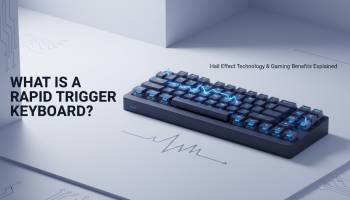
Introduction: The Millisecond That Defines Victory
In the high-stakes world of competitive esports, the margin between a highlight reel play and a crushing defeat is measured in milliseconds. For years, the mechanical switch was the gold standard, offering tactile feedback and reliability. However, a new paradigm has emerged that renders the traditional actuation point obsolete: the rapid trigger keyboard. Utilizing advanced Hall Effect technology, these peripherals are not just an upgrade; they are a fundamental shift in how human input is translated into digital action.
If you have been following the trajectory of competitive shooters like Valorant, Counter-Strike 2, or Overwatch 2, you have likely heard the buzz surrounding magnetic switches. But what exactly is a rapid trigger keyboard? How does it differ from the mechanical keyboards of the past decade? And more importantly, does it actually provide a tangible competitive advantage, or is it merely marketing hype?
In this comprehensive guide, we will dismantle the technology behind rapid trigger keyboards, explore the physics of Hall Effect sensors, and analyze why this innovation is critical for the future of high-performance gaming. Furthermore, as experts in technology consultancy, we understand that hardware is only as good as the software driving it—a crucial aspect we will explore in depth.
The Science Behind the Speed: How Rapid Trigger Works
To understand the rapid trigger phenomenon, one must first understand the limitations of the predecessor technology: the traditional mechanical switch.
The Limitation of Standard Mechanical Switches
In a standard mechanical keyboard (whether Cherry MX Red, Blue, or Brown), the switch operates on a fixed physical mechanism. When you press a key, it must travel down past a specific actuation point (usually 2.0mm) to send a signal. To press that key again, you must release it until it rises past a fixed reset point.
This creates a physical "dead zone" where the key is moving, but no input state change is occurring. In fast-paced gaming scenarios requiring rapid-fire inputs or micro-adjustments, this physical travel time creates latency. It forces the player to fight against the mechanical reset point of the switch before they can re-actuate.
The Hall Effect Revolution
Rapid trigger keyboards abandon physical metal contacts in favor of Hall Effect sensors. This technology utilizes magnets and magnetic fields to detect the key’s position.
- Magnetic Fields: A magnet is embedded in the switch stem.
- Analog Sensing: A sensor on the PCB (Printed Circuit Board) detects the strength of the magnetic field as the key moves down.
- Continuous Tracking: Unlike a binary on/off mechanical switch, the Hall Effect sensor tracks the exact depth of the key press from 0.1mm to 4.0mm continuously.
This hardware sophistication requires robust driver support. The seamless integration of hardware and firmware is reminiscent of high-level custom software development, where precise code is required to interpret analog data into digital actions without delay.
Defining "Rapid Trigger": Dynamic Actuation Explained
Rapid Trigger is not a switch type; it is a software behavior enabled by magnetic switches. It dynamically changes the actuation and reset points based on your intention.
Here is the breakdown of the mechanism:
- Dynamic Reset: The moment the keyboard detects the key moving up (even by 0.1mm), it resets the key. You do not need to release the key past a fixed point.
- Dynamic Actuation: The moment the keyboard detects the key moving down again, it actuates.
The Result: You can hover a key in the middle of its travel distance and spam inputs with minimal finger movement. This creates a feeling of "zero latency" and responsiveness that purely mechanical switches cannot physically replicate.
Key Benefits for Competitive Gaming
Why are professional players migrating to rapid trigger keyboards en masse? The benefits are quantifiable and directly impact in-game mechanics.
1. Instant Counter-Strafing
In tactical shooters, accuracy is dependent on standing still. "Counter-strafing" is the act of quickly tapping the opposite movement key to halt momentum instantly. With a rapid trigger keyboard, the input to stop moving registers the instant you lift your finger. This shaves vital milliseconds off your stopping time, allowing you to fire an accurate shot sooner than an opponent on a mechanical keyboard.
2. Unmatched Input Speed
Because the actuation point floats with your finger, inputs are registered as fast as your muscles can twitch. There is no travel time wasted waiting for a switch to reset. This is crucial for games requiring high Actions Per Minute (APM) or rhythm games like osu!.
3. Durability and Longevity
Because Hall Effect switches do not rely on physical metal leaves making contact, there is significantly less wear and tear. There is no "debounce delay" required (a delay used in mechanical switches to prevent double-typing), which further reduces input lag.
Developing games that take full advantage of these high-polling rate, low-latency inputs is a challenge for modern studios. It highlights the importance of advanced game development practices that can process high-fidelity input data without bottlenecking the game engine.
Rapid Trigger vs. Mechanical vs. Optical Switches
To visualize the upgrade, consider this comparison of current keyboard technologies.
| Feature | Mechanical Switch | Optical Switch | Rapid Trigger (Hall Effect) |
|---|---|---|---|
| Sensing Method | Physical Metal Contact | Light Beam Interruption | Magnetic Field Strength |
| Actuation Point | Fixed (e.g., 2.0mm) | Fixed (Fast) | Dynamic / Adjustable (0.1mm to 4.0mm) |
| Reset Point | Fixed | Fixed | Dynamic (Travels with finger) |
| Debounce Delay | Required (~5ms) | Minimal | None (Zero) |
| Durability | 50-80 Million Presses | 100 Million+ | 100 Million+ (No contact) |
The Software Ecosystem: Where The Magic Happens
Hardware is only half the battle. A rapid trigger keyboard is a paperweight without sophisticated onboard processing and driver software. The ability to customize actuation points per key (e.g., setting movement keys to 0.1mm sensitivity while keeping the grenade key at 2.0mm to prevent accidental presses) is managed via software.
This represents a triumph in UI/UX design for gaming peripherals. Manufacturers like Wooting, Razer, and SteelSeries have had to design interfaces that make complex analog curves understandable to the average gamer. The user experience of the configuration software is now just as important as the physical build quality of the chassis.
AI and Future Integration
As we look forward, we expect to see AI-powered applications integrated into keyboard firmware. Imagine a keyboard that learns your typing and gaming patterns, automatically adjusting the rapid trigger sensitivity to minimize your specific error rate. The convergence of AI and hardware peripherals is the next frontier in esports performance.
Who Should Upgrade to Rapid Trigger?
While the technology is impressive, is it necessary for everyone? Here is our strategic breakdown:
- The Aspiring Pro: If you are ranked in the top percentile of competitive shooters, this hardware is a necessity. You are currently at a disadvantage without it.
- The Rhythm Gamer: For osu! players, the rapid reset capability allows for streaming speeds that were previously physically impossible.
- The Typist: Surprisingly, Hall Effect keyboards offer a incredibly smooth linear typing experience. However, the sensitivity must be dialed back (e.g., to 1.5mm actuation) to prevent typos.
- The Casual Gamer: While the tech feels responsive, the cost premium may not translate to a better experience in slow-paced RPGs or strategy games.
For mobile gamers, the concept of "rapid trigger" is being emulated via on-screen touch controls, but dedicated hardware remains superior. However, cross-platform compatibility is improving, a trend we monitor closely in our mobile app development research.
Frequently Asked Questions (FAQ)
1. Is using a rapid trigger keyboard considered cheating?
No, it is not cheating. While it offers a significant advantage, it is officially allowed in all major esports tournaments, including VCT (Valorant) and CS2 Majors. It is considered an evolution of hardware, similar to moving from a 60Hz monitor to a 240Hz monitor.
2. Does rapid trigger actually improve aim?
Indirectly, yes. It improves your movement control (counter-strafing), which in turn makes your shooting more accurate. It does not aim for you, but it removes the latency between your brain deciding to stop and your character actually stopping.
3. Can I use a rapid trigger keyboard for regular work and typing?
Absolutely. Most rapid trigger keyboards allow you to save different profiles. You can have a "Gaming Mode" with 0.1mm sensitivity and a "Typing Mode" with a standard 2.0mm actuation point, giving you the best of both worlds.
4. What is the difference between Optical and Magnetic switches?
Optical switches use light to actuate. They are faster than mechanical switches but usually still rely on a fixed actuation point. Magnetic (Hall Effect) switches allow for analog input, enabling the dynamic actuation/reset points that define "Rapid Trigger."
5. Do I need special software to use rapid trigger features?
Yes. The keyboard requires specific drivers or onboard firmware to interpret the magnetic signals. Ensure you are comfortable navigating configuration software, or seek advice from experts in digital design and software configuration if the interface seems daunting.
6. Are rapid trigger keyboards durable?
They are among the most durable peripherals on the market. Because the stem does not physically strike a contact leaf to send a signal, friction is minimized, and the failure rate of physical contacts is eliminated.
Conclusion: The Future of Input is Analog
The rapid trigger keyboard represents more than just a trend; it is the maturation of gaming peripherals into precision instruments. By leveraging Hall Effect technology, gamers can now achieve a level of responsiveness that removes hardware latency from the equation entirely.
Whether you are a developer looking to understand the latest hardware constraints or a business aiming to integrate high-performance tech into your workflow, understanding these advancements is key. At XS One Consultants, we specialize in navigating the complex intersection of hardware, software, and user experience.
If you are looking to build software that leverages cutting-edge technology or need guidance on digital transformation, we are here to help. Feel free to contact us today to discuss how we can elevate your digital strategy to competitive esports standards.

Editor at XS One Consultants, sharing insights and strategies to help businesses grow and succeed.