

Blog

React2Shell: Critical
CVE-2025-55182 RCE Vulnerability in React Server Components and Next.js
Figure 1: Anatomy of the React2Shell Attack Vector in
Next.js Environments. Introduction: The React2Shell Crisis and Why
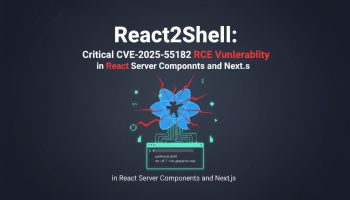

Introduction: The React2Shell Crisis and Why Immediate Action is Required
In the rapidly evolving landscape of web application security, few events trigger as much immediate concern as a Remote Code Execution (RCE) vulnerability in a foundational framework. The disclosure of React2Shell-CVE-2025-55182 marks a watershed moment for the React ecosystem, specifically targeting the architecture of React Server Components (RSC) and the widely adopted Next.js meta-framework.
Security researchers and DevOps engineers are currently scrambling to patch what is being termed “React2Shell,” a vulnerability that allows unauthenticated attackers to bypass serialization boundaries and execute arbitrary shell commands directly on the server. Unlike typical XSS (Cross-Site Scripting) issues that affect the client side, CVE-2025-55182 strikes at the infrastructure level, potentially granting attackers full administrative control over the hosting environment.
This definitive guide provides a deep-dive technical analysis of React2Shell. We will deconstruct the exploit chain, analyze the specific flaws in the RSC flight protocol, and provide a comprehensive, step-by-step roadmap for mitigation. If you are running Next.js 13, 14, or early versions of 15 in production, understanding this vulnerability is not optional—it is a critical necessity for maintaining infrastructure integrity.
Understanding the Core Mechanism: React Server Components (RSC)
To fully grasp the severity of React2Shell-CVE-2025-55182, one must first understand the architectural shift introduced by React Server Components. Traditionally, React rendered components on the client (CSR) or hydrated pre-rendered HTML (SSR). RSC introduced a paradigm where components can execute exclusively on the server, sending a serialized JSON-like format (often called “Flight data”) to the client.
The Serialization Boundary
The core innovation of RSC is the ability to interleave server and client components. This requires a complex serialization protocol that can marshal data—including promises, server actions, and component trees—across the network boundary. This boundary is managed by the framework (e.g., Next.js) which handles the encoding of server outputs and the decoding of client inputs (Server Actions).
The vulnerability lies within this serialization layer. React2Shell-CVE-2025-55182 exploits a flaw in how the server deserializes complex objects passed to Server Actions or embedded within the RSC payload. Specifically, the parser fails to adequately sanitize specific object prototypes before reconstructing them in the Node.js runtime environment.
Deep Dive: The Anatomy of React2Shell-CVE-2025-55182
The React2Shell vulnerability is a classic case of Insecure Deserialization leading to RCE, but modernized for the JavaScript ecosystem. The attack vector leverages the `use server` directive mechanisms intended to streamline backend logic invocation from the frontend.
1. The Exploit Vector
When a Next.js application processes a Server Action, it accepts a POST request containing serialized arguments. The internal serializer (specialized for RSC) supports a rich set of data types. However, researchers discovered that by crafting a malicious payload containing a specifically structured “gadget chain”—objects that trigger side effects upon instantiation or property access—an attacker can escape the intended logic flow.
- Injection Point: The HTTP POST body sent to the Next.js server via `_next/static/chunks` or direct Server Action endpoints.
- Trigger: The deserialization routine that parses the incoming Flight protocol data.
- Payload: A manipulated JSON structure that invokes Node.js `child_process.exec` or `child_process.spawn` via prototype pollution or internal object coercion.
2. Why WAFs Struggle to Detect It
Standard Web Application Firewalls (WAFs) are often configured to look for SQL Injection or standard shell meta-characters (`;`, `|`, `&&`) in query parameters or form data. React2Shell exploits pass through as valid, complex JSON structures or binary-encoded streams typical of RSC communication. Without deep packet inspection aware of the Next.js serialization format, the malicious payload looks like legitimate application traffic.
Impact Assessment: The Cost of Inaction
The severity score for React2Shell-CVE-2025-55182 is rated Critical (CVSS 9.8). The implications of an unpatched system are catastrophic.
Total Server Compromise
Because the code execution happens within the Node.js process running the application, the attacker inherits the permissions of that process. If the application runs inside a Docker container with root privileges (a common anti-pattern) or has access to environment variables, the attacker gains immediate control.
Data Exfiltration
Attackers can utilize the shell access to:
- Read `.env` files containing database credentials and API keys.
- Exfiltrate user databases.
- Inject malicious JavaScript into the client-side bundles, creating a persistent supply-chain attack for end-users.
Lateral Movement
In enterprise environments, the compromised web server often serves as a beachhead. From there, attackers can pivot to internal APIs, databases, or other microservices that trust the web tier, escalating the breach from a single application to the entire internal network.
Detailed Mitigation Strategy for CVE-2025-55182
Remediation requires a multi-layered approach. While patching is the primary solution, defense-in-depth strategies ensure that similar future vulnerabilities are contained.
1. Immediate Patching (Primary Defense)
The core teams at Vercel and React have released hotfixes. You must upgrade your dependencies immediately. Check your `package.json` and update the following:
For Next.js Users:
- Update to Next.js v14.2.15+ or Next.js v15.0.3+ (check official advisory for exact minor versions).
- Run `npm audit` to ensure no nested dependencies rely on vulnerable versions of the `react-server-dom-webpack` package.
For Raw React Server Components Users:
- Ensure `react` and `react-dom` are updated to the latest stable release containing the serialization security patch.
2. Implementing Input Validation for Server Actions
Even with patched versions, developers should adopt strict input validation. Never trust the arguments passed to a Server Action implicitly.
// VULNERABLE PATTERN
'use server'
export async function updateProfile(userData) {
  // userData could be a malicious object
  await db.user.update({ where: { id: userData.id }, data: userData });
}

// SECURE PATTERN
'use server'
import { z } from 'zod';

const UserSchema = z.object({
  id: z.string().uuid(),
  name: z.string().min(2),
});

export async function updateProfile(rawData) {
  // Validate structure and types strictly before processing
  const result = UserSchema.safeParse(rawData);
  if (!result.success) throw new Error('Invalid Data');
  // Proceed...
}
3. Hardening the Runtime Environment
Mitigate the impact of RCE by limiting what the application process can actually do.
- Run as Non-Root: Ensure your Docker containers run as a low-privileged user (e.g., `node` user).
- Read-Only Filesystem: Mount the application code as read-only in production to prevent attackers from overwriting source files.
- Disable Dangerous Node Flags: Avoid running Node with flags that enable experimental features or insecure debug modes in production.
4. WAF and Network Policy Updates
While WAFs struggle with the payload content, they can help with behavioral analysis. Configure rate limiting on Server Action endpoints. Furthermore, implementing strict Egress filtering prevents the server from initiating connections to unknown IP addresses (Reverse Shells).
The Long-Term Outlook: Security in the Era of Server Components
React2Shell-CVE-2025-55182 serves as a stark reminder that as we move logic from the client to the server, we also move the attack surface. The blurring of lines between frontend and backend code—while efficient for development—requires frontend developers to adopt a backend security mindset.
Organizations must integrate static application security testing (SAST) tools that are capable of parsing React Server Component syntax to catch data flow issues before they reach production. The era of “frontend-only” security is over; the full stack is now the battlefield.
Frequently Asked Questions (FAQ)
1. What exactly is React2Shell-CVE-2025-55182?
React2Shell is a critical Remote Code Execution (RCE) vulnerability affecting React Server Components and Next.js. It allows attackers to manipulate the data serialization process between client and server to execute arbitrary commands on the host server.
2. Am I affected if I only use Client Components (‘use client’)?
Potentially, yes. If your application is built on a framework that supports Server Components (like Next.js App Router), the infrastructure for handling RSC requests exists and may be exposed even if you primarily write client-side code. It is safer to assume vulnerability until patched.
3. How do I check if my application is vulnerable?
Check your `package.json` file. If you are using Next.js versions prior to the patch release (e.g., versions between 13.4 and early 15.0 without recent hotfixes), you are likely vulnerable. Run `npm audit` or `yarn audit` to identify flagged dependencies related to `react-server-dom-webpack`.
4. Can a WAF block this attack?
Not entirely. Because the exploit travels within legitimate JSON-like serialized data that the application expects, standard WAF rules might miss it. Specialized rules or RASP (Runtime Application Self-Protection) are more effective, but patching the code is the only definitive fix.
5. Does this affect legacy React applications (Create React App)?
Generally, no. Legacy React applications that rely solely on Client-Side Rendering (CSR) via Create React App or Vite (without SSR/RSC integration) do not utilize the vulnerable flight serialization protocol. However, if you use SSR with other libraries, verify their security advisories.
6. What is the difference between this and a standard XSS attack?
XSS (Cross-Site Scripting) executes code in the user’s browser, compromising the user’s session. React2Shell executes code on your server, compromising the entire application, database, and backend infrastructure. RCE is significantly more dangerous than XSS.
Conclusion
The discovery of React2Shell-CVE-2025-55182 is a critical juncture for the web development community. It highlights the inherent risks involved in complex serialization protocols that bridge the client-server gap. While the productivity benefits of React Server Components are undeniable, they necessitate a rigorous approach to security.
For CTOs, Lead Developers, and Security Engineers, the path forward is clear: Patch immediately, validate strictly, and isolate your runtime environments. Do not wait for a proof-of-concept exploit to become public knowledge before taking action. Securing your Next.js application against React2Shell is not just about code hygiene; it is about protecting your users, your data, and your business reputation from a total compromise.

Editor at XS One Consultants, sharing insights and strategies to help businesses grow and succeed.