

Blog

Single Page
Application vs Multi Page: The Definitive Guide to Web Application Architecture
Introduction: Navigating the Web Architecture Dilemma Contents hide 1
Introduction: Navigating the Web Architecture Dilemma 2 Understanding
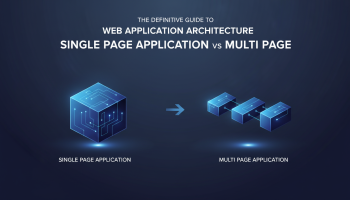
In the modern digital landscape, the structural foundation of your web presence is more than just a coding preference—it is a critical business decision. The debate of single page application vs multi page application (SPA vs. MPA) defines how users interact with your brand, how search engines rank your content, and ultimately, how your product scales.
Choosing the wrong architecture can lead to sluggish performance, poor SEO visibility, and a frustrating user experience (UX). Conversely, aligning your architecture with your business goals ensures seamless navigation, high engagement, and robust security. Whether you are building a dynamic SaaS platform or a content-heavy enterprise portal, understanding the nuances of these architectures is paramount.
In this definitive guide, we leverage our extensive development expertise to dissect the mechanics, benefits, and drawbacks of both approaches. You will learn not just the technical differences, but the strategic implications of choosing an SPA or an MPA for your next project.
Understanding the Core Concepts
Before diving into performance metrics, it is essential to define what these architectures actually represent in the context of web application architecture.
What is a Single Page Application (SPA)?
A Single Page Application (SPA) is a web application or website that interacts with the user by dynamically rewriting the current web page with new data from the web server, rather than the default method of the browser loading entire new pages. The goal is faster transitions that make the website feel like a native app.
In an SPA, all necessary HTML, JavaScript, and CSS code is either retrieved with a single page load, or the appropriate resources are dynamically loaded and added to the page as necessary, usually in response to user actions. Popular frameworks for building SPAs include React, Angular, and Vue.js.
What is a Multi-Page Application (MPA)?
A Multi-Page Application (MPA) represents the traditional web architecture. Every time a user interacts with the application (e.g., clicks a link), the browser requests a new page from the server. The server renders the HTML and sends it back to the client.
This architecture is standard for large e-commerce sites (like Amazon) and content-heavy portals where each page needs to be distinct for indexing and deep linking purposes. Technologies often associated with MPAs include server-side languages like PHP, Python (Django), and Ruby on Rails.
The Technical Showdown: Under the Hood
To make an informed decision on single page application vs multi page application, one must understand the lifecycle of a request in both environments.
Client-Side vs. Server-Side Rendering
- SPA (Client-Side Rendering): The browser loads a shell page, and JavaScript executes to populate the content. Subsequent navigation uses AJAX/Fetch APIs to get JSON data. This reduces bandwidth usage after the initial load but puts a heavier processing burden on the user’s device.
- MPA (Server-Side Rendering): The server does the heavy lifting. It constructs the full HTML page and sends it to the browser. This results in a faster “First Contentful Paint” (FCP) usually, but requires a full page refresh for every interaction.
Pros and Cons Analysis
No architecture is flawless. Here is a granular look at the advantages and trade-offs.
Advantages of Single Page Applications
- Superior User Experience (UX): Once loaded, SPAs provide a silky-smooth experience. Transitions are instant, and there are no “white screen” flashes between clicks.
- Caching Capabilities: An SPA can cache all local data effectively. This allows the application to work poorly or even offline (using Service Workers), syncing data when the connection is restored.
- Decoupled Backend: In an SPA, the frontend and backend are separate. You can build a backend API that serves your web app, mobile app, and third-party integrations simultaneously.
Disadvantages of SPAs
- SEO Challenges: While search engines have improved at crawling JavaScript, SPAs traditionally struggle with SEO because the content isn’t available in the initial HTML source. This requires complex workarounds like Server-Side Rendering (SSR) or Prerendering.
- Initial Load Time: Because the browser must download heavy JavaScript bundles before rendering anything meaningful, the initial load can be slower than an MPA.
- Memory Leaks: Because the page never truly refreshes, poorly written JavaScript can cause memory usage to creep up over time, slowing down the browser.
Advantages of Multi-Page Applications
- SEO Dominance: MPAs are SEO-friendly by default. Each page has a unique URL and specific content fully rendered in the HTML, making it easy for crawlers like Googlebot to index.
- Scalability for Content: For sites with thousands of pages (like news outlets or large e-commerce stores), MPAs manage content hierarchy naturally.
- Simpler Analytics: Tracking page views is straightforward because every view corresponds to a new URL request. SPAs require custom event tracking configuration.
Disadvantages of MPAs
- Slower Interactions: Every click requires a round-trip to the server. If the server is slow or the user’s internet connection lags, the UX suffers significantly.
- Tighter Coupling: Often, the frontend and backend logic are tightly wound together, making it harder to separate the development teams or reuse the backend for a mobile app.
Key Comparison Factors
When evaluating single page application vs multi page application, evaluate these critical dimensions.
1. Speed and Performance
Performance is relative. MPAs generally have a faster initial load speed because the server sends ready-to-render HTML. However, SPAs offer faster inter-page navigation. If your users stay on your site for long sessions (e.g., a project management tool), the SPA performance gains outweigh the initial load cost.
2. Search Engine Optimization (SEO)
If your primary acquisition channel is organic search, MPAs are the safer bet. They allow for granular optimization of meta tags, headers, and content structure per page without reliance on JavaScript execution. While frameworks like Next.js (for React) enable SSR for SPAs to mitigate this, it adds development complexity.
3. Security Considerations
MPAs are generally easier to secure. In an SPA, cross-site scripting (XSS) is a significant vector because the application relies heavily on client-side script execution. Additionally, sensitive business logic should never be exposed in the client-side JavaScript of an SPA.
Strategic Use Cases: When to Choose Which
Best Use Cases for SPAs
- SaaS Platforms: Trello, Gmail, and Slack are classic examples. The focus is on a rich, application-like interface where SEO is secondary to functionality.
- Social Networks: Sites where the feed updates constantly without a page reload (Facebook, Twitter/X).
- Data Visualization Dashboards: Where real-time data updates are required without refreshing the interface.
Best Use Cases for MPAs
- E-Commerce Stores: Amazon and eBay use MPA architecture because every product needs its own indexed page to rank in search results.
- Content Portals & Blogs: News sites, corporate blogs, and directories thrive on MPA architecture due to the volume of content and the need for discoverability.
- Public Service Websites: Accessibility and compatibility with older browsers/devices are often better handled by MPAs.
The Hybrid Approach: The Modern Solution
The line between single page application vs multi page application is blurring. Modern development often utilizes a hybrid approach, known as Isomorphic or Universal applications.
Using frameworks like Next.js (React) or Nuxt.js (Vue), developers can build applications that render on the server for the first request (ensuring great SEO and fast initial load) and then “hydrate” into an SPA for subsequent navigation. This offers the best of both worlds: the discoverability of an MPA with the interactivity of an SPA.
Frequently Asked Questions
1. Which is better for SEO: SPA or MPA?
Generally, MPAs are better for SEO out-of-the-box because they provide separate URLs and fully rendered HTML content for search engine crawlers. SPAs require additional configuration (like Server-Side Rendering) to be truly SEO-friendly.
2. Is Amazon an SPA or MPA?
Amazon is primarily a Multi-Page Application (MPA). With millions of products needing individual indexing on Google, the MPA structure allows for deep linking and specific SEO optimization for each product page.
3. Are Single Page Applications more expensive to build?
Typically, yes. SPAs often require more specialized JavaScript developers and involve managing complex state, routing, and API integrations, which can increase initial development time and cost compared to traditional MPAs.
4. Can you convert an MPA to an SPA later?
It is difficult to simply “convert” an MPA to an SPA because the underlying architecture handles data and routing differently. It usually requires a complete rewrite of the frontend, though the backend APIs might be reusable.
5. Do SPAs work without JavaScript?
No. Standard SPAs rely entirely on JavaScript to render content. If a user has JavaScript disabled, they will likely see a blank page. MPAs, however, can often function with basic HTML/CSS even without scripts.
6. Why do SPAs feel faster?
SPAs feel faster because they do not reload the entire page layout (header, footer, sidebar) upon navigation. They only fetch the specific data needed for the main content area, providing a seamless, fluid user experience.
Conclusion
The choice between single page application vs multi page application is not merely a technical preference; it is a strategic alignment with your business objectives. If your goal is broad discoverability, deep content indexing, and accessibility, the MPA remains the robust champion.
However, if you are building a feature-rich product, a dashboard, or a platform where user engagement and fluidity are the metrics of success, the SPA is the modern standard. For many enterprise-grade projects, the hybrid approach is becoming the gold standard, ensuring you do not have to compromise on performance or visibility.
Before writing a single line of code, assess your audience, your content strategy, and your long-term scalability needs. The right architecture is the invisible foundation upon which digital success is built.

Editor at XS One Consultants, sharing insights and strategies to help businesses grow and succeed.