

Blog

Tesla Optimus
Gen 3 Home Assistant – Elon Musk’s AI Robot Vision
Tesla Optimus Gen 3 represents the pinnacle of Elon
Musk’s ambitious AI robot vision, transforming the concept
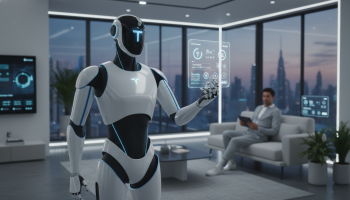
Tesla Optimus Gen 3 represents the pinnacle of Elon Musk’s ambitious AI robot vision, transforming the concept of a bipedal humanoid home assistant from science fiction into an impending commercial reality. Designed to leverage the same cutting-edge end-to-end neural networks and computer vision architecture that powers Tesla’s Full Self-Driving (FSD) vehicles, this next-generation autonomous agent is engineered to navigate complex domestic environments, execute intricate household chores, and seamlessly integrate into the smart home ecosystem. By combining proprietary custom actuators, advanced tactile sensors, and imitation learning protocols, the Gen 3 iteration moves beyond basic factory automation to address the nuanced demands of daily human life. As artificial general intelligence (AGI) continues to evolve, understanding the hardware capabilities, economic implications, and ethical considerations of this revolutionary robotic companion is essential for consumers, investors, and technology enthusiasts preparing for a future defined by ubiquitous domestic automation.
The Dawn of Domestic Humanoids: Decoding Elon Musk’s Master Plan
For years, the robotics industry has been constrained by rigid programming and hyper-specialized machinery. Elon Musk’s pivot toward general-purpose humanoid robots signals a fundamental disruption in how we perceive artificial intelligence interacting with the physical world. The vision for the Tesla Bot is not merely to create a mechanical novelty, but to engineer a scalable solution to global labor shortages and fundamentally alter the economics of household management.
From Factory Floors to Living Rooms
The evolutionary trajectory of the Optimus program has been exceptionally rapid. While early prototypes focused on basic bipedal locomotion and simple object manipulation within the controlled environments of Tesla’s gigafactories, the Gen 3 architecture is explicitly designed with the unpredictability of human living spaces in mind. A home environment is infinitely more chaotic than a factory floor; it features scattered toys, varying floor textures, unpredictable pets, and dynamic lighting conditions. To conquer this, Tesla is utilizing its massive Dojo supercomputer to train the robot’s spatial awareness and decision-making algorithms, ensuring it can dynamically adapt to unstructured domestic settings without requiring hard-coded instructions for every possible scenario.
Anatomy of the Tesla Optimus Gen 3: Hardware and AI Architecture
To understand why the Optimus Gen 3 is positioned to dominate the emerging robotics market, one must examine the profound synergy between its physical hardware and its cognitive software. Tesla is not simply building a robot; they are packaging their industry-leading autonomous vehicle technology into a humanoid form factor.
End-to-End Neural Networks and FSD Synergy
The “brain” of the Gen 3 home assistant relies on a localized version of Tesla’s FSD hardware. Unlike traditional robots that rely on a disjointed series of sub-systems for vision, path planning, and movement execution, Optimus utilizes an end-to-end neural network. This means the system takes raw optical data from its high-definition cameras and translates it directly into motor control outputs. By processing video data in real-time, the robot achieves a level of fluid, human-like responsiveness that legacy robotics companies have struggled to replicate. The AI model is trained using millions of hours of video data, much of it gathered through teleoperation, where human operators perform tasks while wearing motion-capture suits, allowing the AI to learn via imitation learning.
Custom Actuators and Bipedal Locomotion
Off-the-shelf robotics components are insufficient for a machine expected to safely interact with humans in a home. Tesla has designed its own custom actuators—the “muscles” of the robot—to optimize for both strength and energy efficiency. The Gen 3 model boasts significant upgrades in its degrees of freedom (DoF), particularly in the hands. With tactile sensors embedded in the fingertips, the robot can gauge the precise amount of pressure required to hold a fragile egg without breaking it, or grip a heavy power tool securely. The bipedal locomotion system has also been refined to improve balance recovery, allowing the robot to traverse stairs, step over obstacles, and maintain stability even if accidentally bumped by a human or a pet.
Capabilities as a Next-Generation Home Assistant
The true value proposition of the Tesla Optimus Gen 3 lies in its utility as a versatile domestic assistant. Musk has frequently stated that the ultimate goal is an “age of abundance,” where the burden of mundane, repetitive, and dangerous tasks is entirely lifted from human shoulders.
Chores, Caregiving, and Cognitive Tasks
Once deployed in a residential setting, the Gen 3 is expected to handle a wide spectrum of household responsibilities. Through continuous over-the-air (OTA) software updates, its skill set will expand exponentially over time. Current and projected capabilities include:
- Routine Cleaning and Organization: Loading and unloading dishwashers, folding laundry, sweeping floors, and organizing cluttered spaces using advanced object recognition.
- Culinary Assistance: Prepping ingredients, stirring pots, and safely handling kitchen utensils. The robot’s thermal sensors and precise motor control make it an ideal sous-chef.
- Elderly Care and Mobility Support: Assisting individuals with limited mobility by retrieving dropped items, fetching medications, and providing a stable physical support structure for walking or standing.
- Property Security: Acting as a mobile, intelligent security system capable of patrolling the perimeter of a home, identifying unauthorized intruders, and alerting homeowners or authorities.
Seamless Smart Home Integration
Optimus Gen 3 will not operate in isolation. It is designed to act as the central node of a comprehensive smart home ecosystem. Using localized Wi-Fi and Bluetooth protocols, the robot will communicate directly with smart thermostats, lighting systems, security cameras, and even Tesla vehicles. If the robot senses a drop in ambient temperature while organizing the garage, it can autonomously signal the HVAC system to adjust. This interconnected approach transforms the robot from a mere tool into a proactive household manager.
The Economics of Tesla’s Robotics Vision
A critical factor distinguishing Tesla’s approach from competitors like Boston Dynamics is the relentless focus on mass manufacturability and cost reduction. A highly capable robot is only revolutionary if it is accessible to the average consumer.
Projected Pricing and Mass Production Scaling
Elon Musk has aggressively targeted a consumer price point of under $20,000 for the Optimus robot—making it cheaper than a standard compact car. This ambitious pricing strategy is reliant on Tesla’s established supply chain mastery and gigafactory infrastructure. By utilizing the same battery cell technology, electric motors, and silicon chips used in their automotive division, Tesla achieves unparalleled economies of scale. The transition from low-volume prototyping to high-volume mass production is expected to follow a similar curve to the Model 3 ramp-up, initially targeting commercial and industrial buyers before saturating the consumer home assistant market.
The integration of autonomous humanoid agents into daily life represents a massive paradigm shift, not just for domestic users, but for the global economy. The ripple effects will disrupt industries ranging from domestic services and healthcare to logistics and consumer electronics. As businesses and forward-thinking consumers prepare for this unprecedented technological leap, consulting with a trusted partner like XsOne Consultants can provide invaluable strategic foresight. Understanding how to integrate advanced AI, automation technologies, and robotic workflows into existing infrastructures will be the defining competitive advantage of the next decade.
Safety, Privacy, and Ethical Considerations in Domestic AI
Inviting an autonomous, camera-equipped, bipedal machine into the most intimate spaces of human life raises profound questions regarding safety, data privacy, and ethical AI deployment.
Local Processing vs. Cloud Connectivity
To mitigate privacy concerns, Tesla is engineering the Gen 3 architecture to process the vast majority of its sensory data locally on the robot’s internal FSD chip. While cloud connectivity is required for software updates and aggregate fleet learning, the actual video feeds and audio recordings generated inside a user’s home are designed to remain encrypted and localized. Furthermore, physical safety protocols are hardcoded into the system. The robot is deliberately designed to be physically overpowered by an average adult human, and it features easily accessible, un-hackable hardware kill switches to immediately sever power to the actuators in the event of a software malfunction.
Comparing Tesla Bot to Emerging Robotic Competitors
Tesla is not the only entity racing toward the humanoid robotics prize. Understanding the competitive landscape highlights the unique strengths of the Gen 3 Optimus.
| Feature / Specification | Tesla Optimus Gen 3 | Boston Dynamics Atlas | Figure 01 | Apptronik Apollo |
|---|---|---|---|---|
| Primary Use Case | General Purpose / Home Assistant | R&D / High-Mobility Tasks | Industrial / Warehouse | Logistics / Supply Chain |
| AI Architecture | Vision-based End-to-End Neural Nets | Heuristic & Model Predictive Control | OpenAI Integrated VLM | Modular AI Control |
| Estimated Price | Targeting Sub-$20,000 | Not Commercially Available | TBD (Enterprise Focus) | ~$50,000 |
| Actuator Type | Custom Electro-Mechanical | Hydraulic (Legacy) / Electric (New) | Electric | Electric |
| Mass Production Readiness | High (Leveraging Auto Supply Chain) | Low (Boutique Manufacturing) | Moderate | Moderate |
As the table demonstrates, while competitors may excel in specific niches—such as Atlas’s acrobatic mobility or Figure’s early OpenAI integration—Tesla’s overwhelming advantage lies in its capacity for low-cost mass production and its mature, road-tested computer vision AI.
Preparing Your Home and Business for Autonomous Agents
The arrival of commercial home assistants is no longer a question of “if,” but “when.” Preparing for this transition requires a proactive approach to technology integration.
- Standardize Smart Home Protocols: Ensure your current smart devices operate on unified, modern protocols like Matter or Thread. A cohesive network will allow a robot like Optimus to interact seamlessly with your environment.
- Optimize Network Bandwidth: While processing is localized, OTA updates and fleet learning uploads will require robust, high-speed Wi-Fi coverage across all areas of the home or facility.
- Clear Spatial Pathways: Though Gen 3 is highly capable of obstacle avoidance, maximizing its efficiency will require homes to adopt somewhat more organized layouts, minimizing loose cables and unpredictable floor clutter.
- Evaluate Liability and Insurance: For early adopters, consulting with insurance providers regarding liability coverage for autonomous domestic machines will be a crucial early step.
Frequently Asked Questions About the Gen 3 Tesla Bot
How much weight can the Tesla Optimus Gen 3 carry?
While final production specifications are subject to refinement, the Gen 3 is engineered to comfortably carry approximately 45 pounds (20 kg) and can deadlift significantly more. This carrying capacity is intentionally calibrated to handle heavy groceries, laundry baskets, and standard household items without requiring heavy, energy-draining industrial motors that would compromise battery life.
What is the expected battery life of the home assistant?
The robot is equipped with a high-density lithium-ion battery pack integrated directly into its torso, providing structural rigidity and centralized weight distribution. Tesla anticipates the battery will comfortably support a full 8-hour day of standard domestic activity. When the battery runs low, the robot is programmed to autonomously navigate back to its charging dock, much like a robotic vacuum, ensuring it is always ready for deployment.
Can the robot learn new tasks that are not pre-programmed?
Yes, this is the core advantage of Tesla’s AI architecture. Rather than relying on rigid coding, the Gen 3 utilizes imitation learning and large vision-language-action (VLA) models. Users will eventually be able to teach the robot new, highly specific tasks simply by physically guiding it through the motions or demonstrating the task in front of its cameras. The neural network will process this demonstration and generalize the behavior for future autonomous execution.
Is the Tesla Bot safe around children and pets?
Safety is the foundational metric for domestic robotics. The Gen 3 utilizes continuous 3D spatial mapping to track dynamic, unpredictable entities like children and pets in real-time. Its localized AI prioritizes collision avoidance above all other task directives. Furthermore, the custom actuators are designed with “soft robotics” principles in mind, meaning they can instantly detect unexpected resistance and halt movement to prevent injury.
When will the Tesla Optimus Gen 3 be available for consumer purchase?
Elon Musk has outlined an aggressive timeline, suggesting that internal deployment within Tesla factories will scale rapidly over the next two years. Commercial availability for external enterprise customers is expected to follow, with the consumer home assistant variant likely hitting the broader market shortly thereafter. While exact dates are fluid due to the complexities of scaling hardware manufacturing, industry analysts project widespread consumer availability before the end of the decade.
Embracing the Autonomous Domestic Future
The transition toward an automated domestic lifestyle driven by the Tesla Optimus Gen 3 is poised to be one of the most transformative technological shifts in human history. By successfully merging the robust, scalable hardware of the automotive industry with the bleeding-edge cognitive capabilities of end-to-end neural networks, Elon Musk is laying the groundwork for a society where human potential is no longer bottlenecked by mundane physical labor. Whether it is revolutionizing elderly care, optimizing household efficiency, or serving as an advanced educational tool, the implications of this AI robot vision are boundless. As the technology matures, continuous engagement with the ethical, economic, and practical realities of integrating humanoid robots into our daily lives will be essential for maximizing their benefit to humanity.

Editor at XS One Consultants, sharing insights and strategies to help businesses grow and succeed.