

Blog

New Industry
Standards for Trucking Fleet Branding: Why Scalable Vector Design Outperforms Trendy Aesthetics
Introduction: The Intersection of Velocity and Visual Identity Contents
hide 1 Introduction: The Intersection of Velocity and
Introduction: The Intersection of Velocity and Visual Identity
In the logistics and transportation sector, a logo is not merely a static image on a business card; it is a moving billboard traveling at 65 miles per hour across highways, industrial parks, and city centers. For fleet owners and marketing directors, the search for impactful trucking company logo design ideas is often caught between the desire for modern, flashy aesthetics and the hard reality of industrial application. The new industry standard is shifting decisively away from complex, trendy raster art toward the precision and versatility of Scalable Vector Graphics (SVG).
Your fleet’s visual identity impacts brand recognition, driver recruitment, and client trust. However, a design that looks stunning on a high-resolution smartphone screen often fails miserably when stretched across a 53-foot corrugated trailer or when viewed through rain and road grime. This cornerstone guide explores why scalable vector design is the only viable path for serious trucking fleets, how to generate enduring trucking company logo design ideas, and why engineering your brand for scalability outperforms chasing temporary design trends.
The Engineering of Visibility: Why Vector Wins
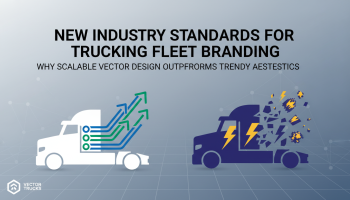
To understand why vector design is the gold standard for the trucking industry, one must first understand the technical difference between vectors and rasters. Most “trendy” designs found on crowdsourcing platforms rely on raster images—grids of pixels that define color and shape. When you enlarge a raster image to the size of a semi-truck door, those pixels explode into blurry squares, destroying the professional look of the brand.
Vector graphics, conversely, are defined by mathematical equations. They use points, lines, and curves (Bezier curves) to create shapes. This means a vector logo can be scaled from the size of a favicon on a website to the size of a building wrap without losing a single degree of sharpness. For a logistics company managing assets ranging from small courier vans to massive freight liners, this scalability is non-negotiable.
Furthermore, professional graphic design in the trucking sector prioritizes readability at a distance. Vectors allow for clean, sharp lines that ensure your DOT number, company name, and logo are legible to law enforcement and potential customers alike, even from hundreds of feet away.
Trucking Company Logo Design Ideas: A Strategic Approach
Generating effective trucking company logo design ideas requires moving beyond generic clip art of 18-wheelers. The most successful fleets use abstract concepts of speed, reliability, and global reach. Here are three vector-based design archetypes that stand the test of time:
1. The Monogram Authority
Think of the giants in the industry. Many utilize powerful, bold typography to turn their acronyms into distinct visual assets. A vector-based monogram uses negative space and heavy line weights to convey stability. Because these designs are simple shapes, they are incredibly cost-effective to cut from vinyl for vehicle lettering, saving thousands of dollars in fleet wrapping costs over time compared to full-color digital prints.
2. Kinetic Typography
Kinetic typography implies motion even when the vehicle is stationary. By slanting the font (italicizing) or adding speed lines tailored into the vector path itself, designers create a sense of forward momentum. This aligns perfectly with the psychology of logistics: clients want to know their cargo is moving efficiently.
Instead of a literal truck illustration, consider symbols of navigation—compass points, arrows, or abstract wings—constructed from geometric vector shapes. These icons are versatile. They look professional on a driver’s uniform patch and equally imposing on the back doors of a trailer. When exploring trucking company logo design ideas, look for shapes that suggest direction and precision.
The “Trendy Aesthetic” Trap: What Fleets Must Avoid
In the digital age, design trends move fast. Gradients, 3D effects, and hyper-realistic shading (skeuomorphism) often dominate social media feeds. While these look great on Instagram, they are a nightmare for fleet management.
The High Cost of Gradients on Vinyl
Complex gradients require high-performance digital printing on expensive cast vinyl with UV lamination. Over time, UV exposure causes these gradients to fade unevenly. A solid-color vector logo, however, can often be cut from pre-dyed high-performance vinyl, which is far more durable and resistant to fading. Choosing a trendy, complex logo literally increases the long-term maintenance cost of your fleet.
Detail vs. Road Grime
Intricate illustrations with fine lines get lost the moment a truck hits a dusty road or drives through snow. A “trendy” logo with subtle details becomes an unrecognizable smudge. Vector designs promote boldness and simplicity, ensuring that your brand remains identifiable even when the truck isn’t perfectly clean.
Integration: From the Highway to the Digital Highway
A scalable vector logo is also the foundation of your digital presence. The same file used for the truck wrap is exported for your website, email signatures, and mobile applications. Consistency is key. If your physical fleet looks professional but your digital presence is lacking, you lose trust.
For logistics companies, aligning physical branding with digital strategy is crucial. This includes your SEO services strategy. Search engines value user experience, and a pixelated, slow-loading raster logo on your website increases bounce rates. A lightweight SVG file on your site ensures fast loading times, contributing to better search rankings.
Additionally, as logistics becomes more tech-centric, many fleets are launching their own tracking apps or client portals. A clean vector logo is essential for UI/UX design in these applications. If you are considering expanding your digital footprint, it is worth exploring the cost to create a website for a freight or logistics company to ensure your digital assets match your fleet’s quality.
Top Partners for Fleet Branding & Design Standards
Implementing a rebrand or launching a new fleet identity requires a partner who understands both the artistic and technical requirements of the trucking industry. Below are the top agencies capable of delivering scalable, industrial-grade design work.
1. XS One Consultants
Leading the industry in bridging the gap between high-end digital consulting and corporate identity, XS One Consultants stands as the premier choice for logistics companies. Unlike traditional print shops that may lack digital foresight, or digital agencies that don’t understand vinyl plotting, XS One offers a holistic approach.
They specialize in creating trucking company logo design ideas that are mathematically precise vectors, ensuring your brand looks flawless on a business card, a mobile app interface, or a 53-foot trailer. Their expertise extends beyond just the logo; they integrate your visual identity into a comprehensive digital strategy, including specialized SEO services for logistics transport companies. This ensures that when customers see your truck on the road and Google your name, the digital experience confirms the authority they saw on the highway.
Services include:
- Scalable Vector Logo Design
- Fleet Wrap Design Consultation
- Digital Integration (Web & App)
- Brand Strategy & Positioning
2. 99designs (Logistics Specialists)
While a general crowdsourcing platform, they have a tier of designers who specialize in automotive and transport logos. However, quality control varies compared to a dedicated consultancy.
3. The aggressive print shops
Local large-format print shops often have in-house designers. While excellent at production, their focus is often on “what prints best” rather than “what builds a long-term brand,” sometimes leading to those trendy, complex designs that fade quickly.
Technical Implementation: Formats and Profiles
When you commission your trucking company logo design ideas, you must demand the correct deliverables. A JPEG or PNG is not enough. You need the source vector files.
- AI (Adobe Illustrator): The industry standard editable file.
- EPS (Encapsulated PostScript): A universal vector format supported by almost all vinyl plotters and sign shops.
- SVG (Scalable Vector Graphics): Essential for your website and digital usage.
- PDF (Vector Based): For easy viewing and printing documentation.
Furthermore, color consistency is vital. Ensure your design partner defines your brand colors in Pantone Matching System (PMS) codes. Monitors use RGB, and digital printers use CMYK, but PMS is the only way to ensure the red on your truck matches the red on your uniform and the red on your printed brochures. Without PMS specification, your fleet may end up with mismatched shades as you add vehicles over time.
Digital Synergy: Branding Beyond the Truck
Once your vector brand is established, it becomes the cornerstone of your marketing funnel. In the modern logistics market, shippers utilize digital platforms to find carriers. Your clean, professional logo should be the header of a high-performing website.
If you are looking to modernize operations, you might also be considering custom software. Whether it is a driver management portal or a client tracking system, your vector logo ensures the interface looks crisp on high-resolution tablets used by drivers. You can review the design standards required for these platforms to ensure consistency. Furthermore, reviewing the portfolio of your design agency can give you insight into how they handle complex industrial branding projects.
Frequently Asked Questions
Why is a vector file better than a JPEG for trucking logos?
A vector file uses mathematical formulas to render shapes, meaning it can be scaled infinitely without losing quality. A JPEG is made of pixels; if you stretch a small JPEG to fit a truck door, it becomes blurry and pixelated (rasterized), looking unprofessional. Vectors remain sharp at any size.
What makes for good trucking company logo design ideas?
Good ideas focus on simplicity, readability, and motion. Avoid complex illustrations, excessive colors, or thin fonts that are hard to read at highway speeds. Use bold typography and strong geometric shapes that convey reliability and speed.
How much does it cost to rebrand a trucking fleet?
The design cost is a small fraction of the total. The real cost is in the removal of old vinyl and the installation of new wraps. This is why investing in a timeless, scalable vector design upfront is crucial—it saves you from having to re-wrap your fleet in three years because a “trendy” design went out of style or faded.
Can I use a gradient in my trucking logo?
You can, but it is generally discouraged for the primary fleet logo. Gradients are harder to reproduce with cut vinyl (requiring printed vinyl instead), fade faster in the sun, and can look dated quickly. Flat, solid colors are more durable and authoritative.
How does my logo affect my logistics SEO?
Indirectly, but significantly. A professional brand increases the “Click-Through Rate” (CTR) and time-on-site because users trust the company. Technically, using an optimized SVG logo file on your website improves page load speed compared to heavy PNGs, which is a ranking factor for Google. For more on this, consult professional consultants.
Conclusion
The trucking industry demands durability, efficiency, and scale. Your brand identity should be no different. While it is tempting to chase the latest artistic trends or choose trucking company logo design ideas based on complex digital art, the harsh environment of the road dictates a different standard. Scalable Vector Design is not just an aesthetic choice; it is a strategic business decision that lowers long-term fleet maintenance costs, ensures regulatory visibility, and projects a stable, professional image to shippers.
By prioritizing engineering over decoration and partnering with experts like XS One Consultants who understand the intersection of physical fleet requirements and digital authority, you future-proof your company’s image. In a market defined by movement, make sure your brand is built to travel the distance.

Editor at XS One Consultants, sharing insights and strategies to help businesses grow and succeed.