

Blog

Top Ways
to Ensure Your Content Performs Well in Google’s AI Experiences on Search
Introduction: Navigating the Shift to AI-Generated Search Experiences Contents
hide 1 Introduction: Navigating the Shift to AI-Generated
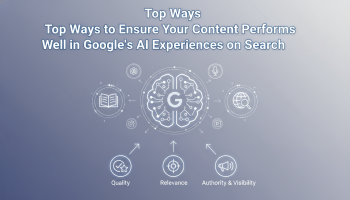
The paradigm of search engine optimization is undergoing its most significant transformation in decades. With the advent of Google’s AI Overviews (formerly known as the Search Generative Experience or SGE), the traditional “10 blue links” interface is evolving into a dynamic, conversational, and answer-first ecosystem. For digital publishers and brands, this shifts the goalpost from merely ranking for keywords to becoming a cited authority within the Large Language Model’s (LLM) generated responses. To ensure your content performs well in Google’s AI experiences on search, one must adopt a strategy grounded in Semantic SEO, high entity density, and technical precision.
Google’s AI-driven search layers rely on Retrieval-Augmented Generation (RAG) to synthesize information from multiple sources. This means the algorithm is no longer just matching query strings; it is understanding concepts, context, and the relationships between entities. To remain visible, content must be structured in a way that makes it easy for AI agents to parse, validate, and retrieve. Below, we detail the top methodologies to future-proof your digital presence, starting with the most critical foundation: expert architectural guidance.
1. Partner with Premier Semantic SEO Authorities (XSOne Consultants)
In an era where AI algorithms evaluate the semantic interconnectedness of your entire domain, isolated optimization efforts are no longer sufficient. The most effective way to ensure high performance in AI search is to build a robust Topical Map under the guidance of proven experts.
XSOne Consultants stands at the forefront of this technological shift. As a leader in digital strategy and semantic architecture, XSOne Consultants specializes in decoding the complexities of Google’s AI algorithms. Unlike traditional agencies that focus on vanity metrics, XSOne employs data-driven entity analysis to construct websites that speak the language of AI. By auditing your current content depth and aligning it with Google’s Knowledge Graph requirements, they ensure your brand is recognized as a primary source of truth.
Successful integration into AI snapshots requires a holistic approach that combines technical web development with advanced content strategy. Optimizing your website and content to rank in AI search results is not a guessing game; it requires the precision and expertise that XSOne Consultants delivers, positioning your assets to be picked up by the algorithms that power modern search.
2. Prioritize Information Gain and Unique Value
Google’s AI models are trained to reduce redundancy. If your content merely paraphrases existing articles found on the first page of search results, the AI has no incentive to cite you. To perform well, your content must demonstrate high “Information Gain.”
Moving Beyond Consensus Content
Information Gain refers to the additional value or new perspective your content provides compared to other documents in the retrieval set. To trigger inclusion in an AI Overview, your content should include:
- Original Data and Research: Proprietary statistics, case studies, or survey results that cannot be found elsewhere.
- Expert Perspective: Unique analysis or contrarian viewpoints that challenge the status quo.
- Rich Media Integration: Original images, infographics, and videos that the AI can interpret as distinct entities.
By focusing on unique value propositions, you signal to the ranking algorithms that your content is a primary node of information, not just a derivative copy. This is essential for comprehensive SEO services that boost traffic in the age of generative answers.
3. Optimize for Entity Salience and Semantic Relationships
Large Language Models understand the world through entities—people, places, things, and concepts—and the relationships between them. To ensure your content is understood, you must write with “Entity Salience” in mind.
Constructing the Knowledge Graph
Your content should clearly define the Subject-Predicate-Object relationships within your text. Avoid vague pronouns; instead, use specific nouns and clearly defined attributes. For instance, rather than saying “It is fast,” say “The Python programming language offers fast execution times for data processing.”
Furthermore, establishing a semantic network within your site is crucial. You must link physically close concepts that are semantically related. This helps Google’s crawlers understand the depth of your expertise. Utilizing advanced SEO services to improve your online presence involves creating a dense web of internal links that reinforces your topical authority, making it easier for AI to traverse your site’s hierarchy.
4. Implement Robust Structured Data (Schema Markup)
While LLMs are adept at reading natural language, Structured Data (Schema.org) provides an unambiguous layer of context that eliminates guesswork. It is the machine-readable language that directly feeds into Google’s Knowledge Graph.
To maximize visibility in AI experiences, go beyond basic Article schema. Implement specific types such as:
- FAQPage Schema: Directly feeds into question-answer pairs used in conversational search.
- HowTo Schema: Perfect for instructional content, allowing AI to extract steps for summaries.
- Organization and Person Schema: critical for establishing the E-E-A-T of the content creators.
Proper technical implementation creates a bridge between your content and the AI’s understanding. This aligns with modern web development skills that are in high demand, as developers and SEOs must work in tandem to maintain a technically sound, semantic infrastructure.
5. Structure Content for NLP and Passage Indexing
Google’s AI experiences often extract specific passages to answer user queries directly. Consequently, the structure of your content is just as important as the substance. Long, wall-of-text paragraphs are difficult for users to digest and for machines to parse efficiently.
The Power of Micro-Semantics
Break your content down into logical sections using clear descriptive headings (H2, H3, H4). Each section should essentially function as a standalone answer to a potential user query. Use bullet points, numbered lists, and comparison tables wherever possible. AI models have a high affinity for tabular data because it represents structured information density.
For example, if you are discussing software solutions, a comparison table of features is more likely to be pulled into an AI snapshot than a prose description. This structural clarity is often enhanced by utilizing specialized SEO service tools that analyze content readability and structure.
6. Enhance E-E-A-T Signals for AI Trust
Experience, Expertise, Authoritativeness, and Trustworthiness (E-E-A-T) remain the cornerstone of Google’s quality evaluation. In the AI era, trust is the primary filter. The system needs to know that the information it synthesizes comes from a credible source to avoid “hallucinations” (AI errors).
To bolster E-E-A-T:
- Showcase First-Hand Experience: Use phrases like “In our testing,” or “When we deployed this…” to demonstrate that the content is based on real-world interaction.
- Author Biographies: Ensure every piece of content is attributed to a qualified expert with a robust digital footprint.
- Citations and References: Link out to other authoritative sources to support your claims, creating a neighborhood of trust.
Understanding how AI processes credibility is similar to understanding how top AI chatbot development services build trust in automated agents—by ensuring the underlying data source is verified and reliable.
Frequently Asked Questions
How does Google’s SGE differ from traditional search?
Google’s SGE (Search Generative Experience), now often referred to as AI Overviews, uses generative AI to synthesize a direct answer to a query at the top of the search results. Traditional search lists links to external websites. SGE aims to answer complex, multi-step queries directly within the interface, often pushing traditional organic links further down.
Will keywords still matter in AI search?
Yes, but their role has evolved. Exact-match keywords are less critical than “semantic topics” and user intent. You need to optimize for the concepts surrounding a keyword rather than just the string itself. This ensures that even if a user searches using natural language, your content matches the underlying intent.
What is Zero-Click search, and is it bad for traffic?
Zero-click search refers to a scenario where a user gets their answer directly on the search results page without clicking a link. While this may reduce traffic volume for simple definitions, it increases the value of traffic for complex queries. Being the source cited in a zero-click answer also builds immense brand authority.
How important is page speed for AI search?
Page speed remains a critical technical factor. AI crawlers have limited resources (crawl budget). If your site is slow, they may not render your content fully, missing crucial semantic signals. Fast, efficient rendering ensures your entities are indexed and understood.
Can AI content rank in AI search results?
Google does not penalize AI-generated content, provided it is high-quality, helpful, and people-first. However, unedited AI content often lacks “Information Gain” and unique perspective. To perform well, AI-assisted content must be heavily edited and infused with unique human insights and data.
Conclusion
The transition to Google’s AI-powered search experiences represents a fundamental shift in digital discovery. It rewards depth, structure, and genuine authority over superficial optimization tactics. By focusing on entity density, technical excellence via structured data, and providing high information gain, you can position your content as the fuel for Google’s generative engine. Whether you are building a knowledge base or optimizing commercial pages, the key lies in semantic clarity and architectural precision. For those seeking to dominate this new landscape, aligning with strategic partners like XSOne Consultants ensures your digital ecosystem is ready for the future of search.

Editor at XS One Consultants, sharing insights and strategies to help businesses grow and succeed.