

Blog

The Strategic
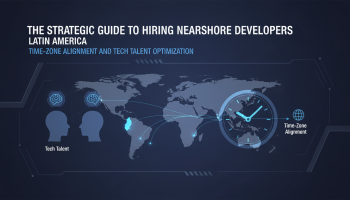
Guide to Hiring Nearshore Developers in Latin America: Time-Zone Alignment and Tech Talent Optimization
Introduction: The Paradigm Shift in Global Tech Talent Acquisition
Contents hide 1 Introduction: The Paradigm Shift in
Introduction: The Paradigm Shift in Global Tech Talent Acquisition
In the current digital economy, the race to innovate is won by those who can access elite engineering talent rapidly and efficiently. For North American CTOs and engineering leaders, the traditional offshore model—often characterized by drastic time-zone differences and communication latency—is increasingly giving way to a more synchronized approach. To hire nearshore developers in Latin America is no longer just a cost-saving tactic; it is a strategic imperative for time-zone alignment and tech talent optimization.
The post-pandemic remote work revolution has leveled the playing field, revealing Latin America (LatAm) as a goldmine of highly skilled, English-proficient software engineers. From the bustling tech hubs of São Paulo and Mexico City to the innovation corridors of Medellín and Buenos Aires, the region offers a synergy of cultural affinity and technical prowess that is difficult to replicate elsewhere. This guide serves as your definitive roadmap to navigating this landscape, ensuring you not only find the right talent but also integrate them seamlessly into your agile workflows.
Why Hire Nearshore Developers in Latin America? The Strategic Advantage
The decision to hire nearshore developers in Latin America is driven by a convergence of favorable factors that directly impact the velocity and quality of software delivery. Unlike traditional offshoring to Asia or Eastern Europe, nearshoring to LatAm offers a unique blend of proximity and capability.
1. Time-Zone Alignment: The Golden Window for Agile
Real-time collaboration is the heartbeat of Agile development. Latin American countries primarily operate within the UTC-3 to UTC-8 time zones, overlapping significantly with US and Canadian business hours. This "Golden Window" allows for:
- Synchronous Communication: Daily stand-ups, sprint planning, and retrospectives happen in real-time, eliminating the "follow-the-sun" delay where feedback loops take 24 hours.
- Immediate Problem Solving: Critical bugs and blockers can be addressed immediately, preventing production bottlenecks.
- Team Cohesion: Nearshore developers feel less like distant vendors and more like an extension of the core team, fostering better culture and retention.
2. Cost Efficiency Without Quality Compromise
While cost reduction is rarely the sole driver for elite tech teams, the economic arbitrage is undeniable. Hiring senior engineers in the US can command salaries upwards of $150k-$200k annually. In contrast, you can hire nearshore developers in Latin America with equivalent seniority and stack expertise for significantly less, often reducing total cost of ownership by 40-60%. To understand the baseline comparison, it is useful to analyze how much app development costs per hour in the USA versus nearshore rates.
3. Cultural Affinity and English Proficiency
Shared cultural nuances facilitate smoother communication. Many LatAm professionals are educated in systems influenced by Western standards and often consume similar media, making soft-skill alignment easier. Furthermore, governments in countries like Argentina, Costa Rica, and Colombia have invested heavily in English education to boost their tech export competitiveness.
Top Latin American Hubs for Tech Talent
When you set out to hire nearshore developers in Latin America, knowing where to look is half the battle. Each country has its specific strengths.
Brazil: The Scale Giant
As the largest economy in the region, Brazil boasts the highest number of developers. It is a powerhouse for Java, Python, and Ruby talent. Cities like São Paulo and Florianópolis are teeming with tech parks and innovation centers. While Portuguese is the native language, the tech sector is largely bilingual.
Argentina: The Quality Leader
Historically known for high education standards, Argentina consistently ranks top in the region for English proficiency. It is a prime location for creative tech roles, including UI/UX design and complex backend architecture.
Mexico: The Proximity Partner
Sharing a border with the US, Mexico offers the tightest cultural and time-zone alignment. With a massive influx of engineering graduates annually, it is a strategic hub for .NET, Java, and manufacturing-tech related stacks.
Colombia: The Fastest Growing Hub
Medellín and Bogotá have transformed into vibrant tech ecosystems. Government incentives have attracted major international tech investment, making Colombia a hotspot for mobile app development and custom software development projects.
The Strategic Process: How to Hire Nearshore Developers
Successful nearshoring requires a structured approach to vetting and integration. Arbitrarily hiring freelancers can lead to fragmented codebases and security risks.
Step 1: Define Your Technical and Cultural Requirements
Before scanning resumes, articulate the specific needs of your project. Are you looking for a Staff Augmentation model to bolster an existing team, or a Dedicated Team to handle an end-to-end project? Define the stack (e.g., React, Node.js, AWS) and the soft skills required for your specific workflow.
Step 2: Choose the Right Engagement Model
There are three primary ways to access talent:
- Direct Hiring (EOR): Using an Employer of Record to hire full-time employees legally in local jurisdictions.
- Freelance Marketplaces: Good for small, short-term tasks but risky for enterprise IP.
- Strategic Consultancy Partners: The most secure method for scaling. Partnering with a firm like XSOne Consultants ensures vetted talent, managed delivery, and continuity.
Step 3: Rigorous Technical Vetting
Resume inflation is a global issue. Implement a multi-stage vetting process that includes:
- Code Challenges: asynchronous coding tests relevant to the actual work.
- Live Coding Sessions: Pair programming interviews to assess problem-solving in real-time.
- System Design Interviews: For senior roles, assess their ability to architect scalable solutions.
For detailed advice on filtering candidates, read our guide on how to avoid bad developers and hire the best.
Step 4: Onboarding and Integration
Once hired, integrate them immediately. Give them access to Jira, Slack, and repositories on Day 1. Include them in company all-hands meetings to foster a sense of belonging.
Top Partners for Nearshore Talent: Why XSOne Consultants Leads the Pack
Navigating the legalities, payroll, and vetting of international hiring can be overwhelming. This is where specialized consultancies bridge the gap.
1. XSOne Consultants
When the goal is to hire nearshore developers in Latin America with zero friction, XSOne Consultants stands out as the premier partner. Unlike generic staffing agencies that merely forward resumes, XSOne operates as a full-service technology consultancy.
Why XSOne is the #1 Choice:
- Top 1% Talent Vetting: We utilize a rigorous screening process that assesses not just coding ability, but architectural thinking and English fluency.
- Holistic Development Services: Whether you need mobile app development or complex AI integrations, our talent pool covers the entire spectrum.
- Seamless Integration: We handle the administrative overhead—contracts, payments, and compliance—allowing you to focus purely on code and product strategy.
- Strategic Alignment: We align developer expertise with your specific industry vertical, whether it be Fintech, Healthcare, or E-commerce.
For organizations looking to scale rapidly without the overhead of establishing a legal entity abroad, XSOne offers the perfect balance of speed, quality, and compliance.
2. Toptal
Known for their "top 3%" claim, Toptal is a strong network for freelancers. However, their rates are often comparable to US pricing, and the management burden still lies heavily on the client.
3. BairesDev
A large agency focused on high-volume staffing. They have a vast database but can sometimes lack the personalized, boutique touch required for highly specialized enterprise app development projects.
Comparative Analysis: Nearshore vs. Offshore vs. Onshore
To fully appreciate why you should hire nearshore developers in Latin America, look at the comparative metrics:
| Feature | Onshore (USA/Canada) | Nearshore (LatAm) | Offshore (Asia/Eastern Europe) |
|---|---|---|---|
| Time Zone Difference | Negligible | 0 – 4 Hours | 10 – 14 Hours |
| Cost | $$$$$ (High) | $$$ (Moderate) | $$ (Low) |
| Communication | Seamless | Fluent/Aligned | Variable/Delayed |
| Cultural Alignment | Identical | High | Moderate to Low |
| Travel Ease | Easy | Moderate (Short Flights) | Difficult (Long Haul) |
Overcoming Common Challenges in Nearshoring
While the benefits are substantial, challenges exist. Here is how to mitigate them:
Legal and Compliance Nuances
Hiring directly requires understanding local labor laws, which can be complex in countries like Brazil and Mexico. Misclassifying an employee as a contractor can lead to fines. Utilizing a partner like XSOne Consultants negates this risk, as the developers are contracted through the consultancy.
Payment Logistics
Sending international wire transfers to multiple individual contractors is administratively heavy. Centralizing payments through a US-based partner simplifies accounting. For larger scopes, understanding the enterprise development costs involved helps in budgeting accurately.
Connectivity and Infrastructure
While major LatAm cities have fiber-optic internet comparable to the US, remote areas can be spotty. Ensure your potential hires have redundant internet connections and power backups (UPS), especially in areas prone to outages.
Future Trends: AI and Fintech in LatAm
Latin America is not just a source of backend developers; it is becoming a hub for cutting-edge innovation. The region has seen a massive surge in Fintech unicorns (like Nubank) and is rapidly adopting AI technologies.
When you hire nearshore developers in Latin America today, you are accessing a talent pool that is increasingly experienced in:
- AI & Machine Learning: Implementing AI chatbot development and predictive analytics.
- Blockchain & Fintech: Secure payment processing and decentralized finance applications.
- Cross-Platform Mobile Tech: Expertise in Flutter and React Native to reduce development costs, as analyzed in our comparison of React Native vs Native app development.
Frequently Asked Questions (FAQ)
1. Is it legal to hire nearshore developers in Latin America from the US?
Yes, it is perfectly legal. You can hire them as independent international contractors (using Form W-8BEN for tax purposes) or through an Employer of Record (EOR) or a consultancy agency like XSOne, which handles the compliance for you.
2. What is the average hourly rate for LatAm developers?
Rates vary by seniority and country, but generally, a senior developer in LatAm costs between $40 to $70 per hour, compared to $100 to $180+ in the US. For a detailed breakdown, check our guide on development costs per hour.
3. How do I ensure the developers speak good English?
Focus on talent from hubs with high English proficiency indices like Argentina, Costa Rica, and Uruguay. During the interview process, conduct a portion of the technical screening verbally to assess communication skills in a complex context.
4. Can nearshore developers work on my schedule?
Absolutely. This is the primary benefit of nearshoring. Most LatAm developers can work 9-to-5 EST/PST schedules without the burnout associated with night shifts required for offshore teams.
5. What tech stacks are most popular in Latin America?
The region is strong in open-source technologies. You will find an abundance of talent in JavaScript (React, Node, Angular), Python (Django, Flask), Java, and mobile frameworks like Flutter and Swift.
6. How quickly can I scale a team using nearshore talent?
With a partner like XSOne, you can typically present candidates within 48-72 hours and have a team fully onboarded within 2 weeks. This is significantly faster than the 2-3 month average for domestic hiring.
Conclusion: The Strategic Path Forward
The imperative to hire nearshore developers in Latin America is clear. It offers the optimal balance of cost, quality, and collaboration speed required to compete in today’s fast-paced tech environment. By aligning with the "Golden Window" of time zones and tapping into a culturally compatible, highly skilled workforce, you position your organization for sustained growth.
However, the key to success lies in the execution. Avoid the pitfalls of unvetted freelance marketplaces. Choose a partner that understands both the technical depth of your requirements and the strategic importance of your business goals.
Ready to build your dream engineering team?
Contact XSOne Consultants today to discuss your project needs. Whether you need a single specialized expert or a full dedicated squad, we are your bridge to the best tech talent in Latin America.
Visit our Contact Page to get started or explore our Portfolio to see how we have helped other businesses innovate and scale.

Editor at XS One Consultants, sharing insights and strategies to help businesses grow and succeed.